Let 99 flowers bloom
|
 |
In their cages at the DNC, gay politicos enjoy water, feed
By
Jim D'Entremont
Efforts by the city of Boston to contain protests at the 2004 Democratic National Convention (DNC) were simultaneously denounced and validated by US District Judge Douglas Woodlock on July 22, four days before the convention began.
Calling the perceived need for restrictions "irretrievably sad," Woodlock said he saw no alternative to herding demonstrators into an improvised enclosure underneath an abandoned stretch of elevated train tracks. While turning down a challenge to this "Free Speech
Zone" by the National Lawyers Guild and the ACLU, he admitted that after having visited the site, he viewed critics' comparison of the set-up to an internment camp as "an understatement."
"One glance at the DNC protest cage tells you all you need to know about how the Democratic leadership and Boston's powers-that-be view protest," said queer activist Bill Dobbs, media coordinator for the antiwar coalition United for Peace and Justice. "All over this
country," he added, "the screws are being tightened on dissent."
It has never been adequately explained how the Fleet Center, a sports arena built over North Station, a major public transport terminal, became the site of the DNC-- especially since a more spacious facility has recently opened in a less logistically problematic part of Boston.
Securing the Fleet Center called for extraordinary measures. To address the concerns of the Department of Homeland Security, the Secret Service, the FBI, the Democratic Party, the Boston police, and Mayor Thomas Menino, local officials shut down North Station,
barricaded streets around the Fleet Center, established a no-fly zone for civilian aircraft, and curtailed the flow of traffic through downtown Boston. Police and military helicopters hovered in the sky above the city. SWAT teams cruised the streets in stretch SUVs; sharpshooters crouched
on rooftops. Scores of police officers darted around in cars, in vans, on motorcycles, on bicycles, on horseback, and on foot.
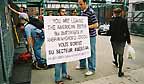
The Free Speech Zone, widely dismissed as the Free Speech Zoo, Gitmo North, or The Pen, was created around the corner from the Fleet Center at a point where MBTA Green Line trains used to emerge from a tunnel and climb to the elevated North Station stop. (The
Green Line was recently rerouted underground.) From the adjacent parking lot reserved for delegates' buses, protestors could not be seen. Twelve-foot metal barriers lined the edge of the parking area; behind this obstacle, an eight-foot chain-link fence mounted on concrete buffers
loomed above the protest pen. Plastic netting extended from the fence to the overhead train tracks, where National Guardsmen patrolled behind razor wire.
Inside The Pen, surveillance cameras monitored activity in every corner. The zone covered 25,800 feet interspersed with green girders and shuttered subway entrances. It ran parallel to Canal Street, one of two main pedestrian routes to the Fleet Center, but was hidden
from the street by a line of construction trailers in front of a second stretch of chain-link fence. Commenting on this arrangement in the July 26
Newsday, veteran columnist Jimmy Breslin wrote that he had "never seen anything to match it except in old Nazi movies."
The area was supposed to accommodate 4000 people. The number was later reduced to 1000, but because the zone was shunned by nearly everyone, capacity became an academic issue. Rather than submit to the insult of the Free Speech Zone, most protestors
dispersed. A vehicle resembling an ice cream truck tooled around town with posters depicting dismembered fetuses plastered to its sides. The American Friends Service Committee and other anti-war contingents found limited visibility on Boston Common and in Copley Square, nearly two
miles from the convention's groud zero.
The Free Speech Zone was designed as a catchall for dissenters, where political groups with divergent and frequently conflicting agendas-- Quakers, anarchists, pacifists, pro-lifers, Palestinians, "Billionaires for Bush"-- would be boxed in together and somehow made to
behave. In the end, however, the protest pen became simply a place where one went to protest the protest pen's existence.
On a makeshift wooden stage beneath the Green Line tracks, speakers holding permits were allowed access to a microphone at appointed times. Spokespeople for various organizations took turns addressing audiences made up largely of reporters and police. Some
individuals put up signs emblazoned with slogans such as "Pens Are for Animals." Members of special-interest groups, such as Christian opponents of gay marriage, would sometimes sweep through, tie banners to the fences, and move on.
Faded pink presence
Many gay men and lesbians joined the protestors, some as unaffiliated individuals, some as members of antiwar organizations. Outside the Fleet Center, however, no organized gay presence existed. Inside, a place dubbed "The Inner Pen" by some who were shut out of it,
255 openly gay and lesbian delegates, alternate delegates, and committee members comprised the largest number of out gay people ever involved in a major American political convention. Yet gay visibility was rarely very high.
Gay concerns, especially the same-sex marriage question Bush supporters have eagerly sought to exploit, were for the most part handled with tongs. The Democratic Party platform included safe references to anti-discrimination efforts and HIV/AIDS funding. Keynote
speaker Barack Obama made a passing reference to gay people as he extolled American diversity. In an address on health care issues, US Representative Tammy Baldwin (D.-Wisconsin) touched on domestic-partner benefits, but never alluded to her personal status as a lesbian. Cheryl
Jaques, Executive Director of the Human Rights Campaign (HRC), gave a short speech in which she sidestepped the fact that neither the right of gay people to serve openly in the military nor their right to marry-- two of the HRC's leading agenda items-- are supported by Democratic
candidate John Kerry.
Most speeches were carefully vetted in advance by the Democratic National Committee. There were far fewer gay-specific references than there had been at the three previous Democratic Conventions. Only Massachusetts Congressman Barney Frank, founder of the
Stonewall Democrats, departed from his script somewhat, calling gay marriage "a good thing for the stability of society." In any other context, Frank's statements would have been viewed as cautious, boilerplate gay political rhetoric.
The speech in which John Kerry accepted his party's nomination for the Presidency contained one veiled but crowd-pleasing allusion. "Let's honor this nation's diversity," Kerry said, "let's respect one another, and let's never misuse for political purposes the most
precious document in American history, the Constitution of the United States." Those able to decode this passage knew that Kerry was referring to George W. Bush's support for the failed, anti-gay Federal Marriage Amendment, a constitutional strategy he finds as unacceptable as he
finds gay marriage.
"He's not perfect," says Roberta Sklar of the National Gay and Lesbian Task Force (NGLTF), "but John Kerry is better on our issues than any Presidential candidate has ever been."
Queer visibility was much more prominent behind the scenes, where hardly anyone questioned the canonization of Kerry. (The few Ralph Nader supporters who declared themselves were pelted with abuse.) The Gay and Lesbian Victory Fund threw a floating party on
Boston Harbor. Teresa Heinz Kerry addressed the Lesbian, Gay, Bisexual and Transgendered Caucus, inviting them to call her "Mama T." Accolades were directed at Boston's purportedly gay-friendly mayor, Tom Menino, despite his imposition of content restrictions on the city's annual
Pride parade, and his diligence in running sexually oriented businesses out of town.
The principal gay party, Unity '04, was held at Avalon, a discotheque near Fenway Park. The HRC-dominated bash was intended to bring together various gay organizations whose work isn't always in sync. But cracks in the unity began to show when caustic stand-up
satirist Margaret Cho was disinvited. Cho, an active supporter of Stonewall Democrats, had been scheduled to present portions of "State of Emergency," a politically scathing performance piece about to go on tour. "We don't want to censor her," HRC spokesman Mark Shields told
reporters, presenting a justification for telling her not to appear at all. Despite the HRC's assertions to the contrary, the NGLTF and other groups insist they were not consulted about the program change, which caused the NGLTF to withdraw support from the event.
In the sheepfold on the animal farm
In recent years the conservative, assimilationist Human Rights campaign has set the gay agenda, perhaps because its well-heeled constituents believe they have paid for the privilege. The NGLTF has historically taken a broader social overview, and might have been
expected to question Kerry's support for the Iraq War, the Orwellian USA Patriot Act, and other atrocities. But during the Democratic Convention, the NGLTF, the Stonewall Democrats, and other organizations hastened instead to join the HRC in formulating a homogenized gay position
that brooks no dissent-- "Bush must go; John Kerry is good on our issues," whatever those are.
"The HRC and groups like it care very little about improving the world," says Bill Dobbs. "Their emphasis on equality is really about preserving the status quo and kissing up to the power structure. Mainstream gay activism is no longer about freedom."
In a politicized pen where some animals are more equal than others, perhaps equality can be counted upon to trump liberty every time.
You are not logged in.
No comments yet, but
click here to be the first to comment on this
News Slant!
|