Perptims
|
 |
The messiness of sorting the whodunit from the deed
By
Bill Andriette
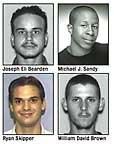
Ryan Skipper, 25, lived in Winter Haven, Florida, and was studying computer repair and worked at Sunglass Hut. On the morning of March 14, his body was found, throat slit and stabbed some 20 times, on a road in rural Wahneta, a mile and a half from his home.
The night before, Skipper had given a ride to two young men. Their fingerprints were all over his bloodstained car, which was left abandoned. Joseph Eli Bearden, 21, and William David Brown, 20, were arrested and are charged with first-degree murder.
O
ne consequence of Skipper's death is a proposed mobile memorial to victims of anti-gay murder. Scott Hall came up with the idea for
Gay American Heroes. Hall had himself been gay-bashed twice, once hit in the head so hard he was
left for dead in a ditch. Both times his attackers got away. Hall lives not far from where Ryan Skipper was killed. He says that he wondered, if he'd only dedicated himself to fight anti-gay violence, whether he could have made a difference for Skipper.
Hall is not letting the chance slip by again. He's enlisted Congressman Barney Frank, veteran Washington, D.C., activist Frank Kameny, and singer Cyndi Lauper to lend their names to the project.
The group says it is $60,000 away from building a mobile memorial to victims of anti-gay crime that can travel to places where an attack has occurred for the sake of both consoling and politicizing.
Hall says the Gay American Heroes monument would be a sort of cross between the AIDS Quilt and the Vietnam War Memorial in Washington, where the name of every American killed in the conflict is etched into low-slung marble walls.
"It's going to be made out of aluminum, and it's going to be lit up, it's going to be over 100 feet long, and it's going to be travel," Hall tells
The Guide. A prototype will be unveiled at Orlando's gay pride celebration this October.
The memorial also takes page from Catholic shrines to saints. There won't be wizened bones and leathered hearts on view. But the aim is making a visceral connection to what's presented as the sacrifice of the dead.
"When you get to the backside of the memorial there will be stars, with the name, the age, and the occupation of the victims," says Hall. "We want to bring them as much to life as we can." Bring a crayon and trace a name and take it as a keepsake, he suggests. "As
well, we have an adopt-a-hero program. There's an application to adopt, and for a $25 donation, we will select a hero, you'll adopt them, you'll get a whole profile on that person, a picture, and we'll send a snail-mail card to their family."
Blood lust
Like ritual sacrifices, a killing can become a totem of group identity. After his 1998 murder, Matthew Shepard didn't just become a symbol of anti-gay violence but a mascot for the gay community.
Yet intensifying a sense of group connection doesn't necessarily aid moral clarity. The Vietnam War memorial lists some 58,000 Americans but leaves nameless some 1.5 million Vietnamese dead. The intense emotions that follow a killing billed as a hate crime
can devolve into a push for bloody retribution. Florida prosecutors of Skipper's accused murderers say they're seeking the death sentence.
Ironically, if the imperative is protecting gay people, punishing gay-bashers means sometimes getting the wrong guys. Ted Haggard to Mark Foley to Larry Craig -- fallen public figure after figure shows that those most viscerally hostile to homosexuality are
often personally implicated. Sometimes attacks labeled as "hate crimes" can't sustain the burden of the stereotypes overlaid on perpetrators and victims.
This fall, gay New York has been transfixed by the trial of two of a group of young men involved in the October 2006 death of 29-year-old Michael J. Sandy. On an internet hookup site, the men had lured Sandy to an isolated beach in Brooklyn on the pretext of
sex. Then they tried to rob him. In the ensuing pursuit Sandy was chased onto the Belt Parkway and struck by a car.
Sandy was gay and black and his attackers white and presumed straight. Prosecutors pursued Sandy's death as a hate-crime, allowing for a harsher sentence.
At his trial, accused 21-year-old Anthony Fortunato emphasized his gay side. There was gay porn on his computer. Three men testified under subpoena that Fortunato had hooked up with them for sex and that he had a predilection for wearing a bra and panties.
On October 8, Fortunato's co-defendant was found guilty of manslaughter under the terms of the hate-crimes law, and faces up to 25 years. On October 11, another jury dealt the same verdict to Fortunato.
In a way, whether Fortunato kept gay porn or liked women's undergarments or enjoyed sucking cock are irrelevancies. What matters is his participation in a ruse to con and steal that left a man dead. But distraction is invited by a focus on identity rather
than consequences. Is justice better served by -- on these matters -- blind impartiality? The impresario of the Gay American Heroes memorial isn't quite ready to sign on to that program. But, Hall says, "I would love to see simply a senseless-death memorial."
| Author Profile: Bill Andriette |
| Bill Andriette is features editor of
The Guide |
| Email: |
theguide@guidemag.com |
You are not logged in.
No comments yet, but
click here to be the first to comment on this
Queer n There!
|