|
 |
By
Mitzel
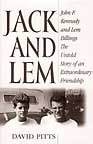
I love moments of pure-- well, almost pure-- serendipity. And I had one the other day. I was perusing the new book,
Jack and Lem: John F. Kennedy and Lem Billings: The Story of an Extraordinary
Friendship by David Pitts. Lem was Kirk LeMoyne Billings, known to everyone as
Lem. He and John Kennedy met when both were students at Choate School for boys. Lem promptly fell in love with Jack Kennedy and stayed in love with him all his life. Lem was a year older than Jack. They were roommates for two years; Lem stayed at Choate for an extra year just
to have Kennedy's company.
K
ennedy often invited Lem to various family functions, and Lem befriended all the many folks. The name of Lem Billings pops up in the many books of the Kennedys; this is the first account of his own story. When Kennedy was President, Lem was often in the White House--
even given a room!-- to be Best Friend of the Chief Executive. After the President was famously murdered in Dallas, while sitting next to his wife in a motorcade (as far as I'm concerned an unresolved homicide) Lem became close to Bobby Kennedy, his wife, and children. After
Bobby's murder, nearly five years after Jack's, Lem gave time and attention to the children; his favorite was Robert, Jr.
Billings worked as an advertising executive. He died in 1981. Pitts writes: "After his death, Teddy Kennedy referred to it [Lem and Jack's friendship] as 'a bond of perfect trust and understanding that served them all their lives.' Jackie said, 'So many grown-ups lose their sense
of play. Lem never did. And how he loved his friends.'" One of the Kennedy children is quoted as saying that Billings had offered the Kennedy family "unconditional love." When young, Billings, I should note, was drop-dead gorgeous.
Having put Jack and Lem aside, I picked up
Fellow Travelers, the latest novel from Thomas Mallon. The story is set in Washington in the 1950s and follows Timothy Laughlin, a Fordham grad and devout Catholic, as he seeks work to battle the Communist menace. He falls in love
with a handsome State Department official, and one of the themes of the novel is the secret male homo-sexual subculture in DC in those years, a fascinating subject.
While skipping through the chapters, I stopped on a particular page-- this is the serendipity part-- and found our young hero in the military service in New Orleans, a guest at the home of Clay Shaw!
Remember Clay Shaw? Shaw was the only person to be put on trial for the murder of President Kennedy. The indictment was brought by New Orleans District Attorney Jim Garrison. The trial took place in the late 1960s. Clay Shaw was a prominent figure in the business and
social circles in New Orleans. He had come from modest means, had done well for himself, was active in the movement to restore some of the old New Orleans homes in the Garden District and elsewhere-- long before gentrification took off in other cities-- and he wound up as director
of the New Orleans Trade Mart, a facility which coordinated the international trade in and out of New Orleans. Shaw, also, was a writer and had written a play,
Submerged, which I read and then found out that at one time was the most produced play in US high schools-- bigger than
Our Town, imagine that!
Clay Shaw was a gay man, and Garrison tried to play the "gay card" in the build-up to the trial. The late James Kirkwood wrote a wonderful book about the tragic-farce in New Orleans; it's called
American Grotesque. After reading it, you really want to take a shower. The New
Orleans he paints is not a pretty picture.
In 1975, I published, in Fag Rag, my own meditations of these events. The piece was called: "Clay Shaw, The Queen Network, and That Kennedy Killing," which didn't cause much comment. (The piece was reprinted in the early 1990s in Boston's
Gay Community News, after the release of Oliver Stone's movie,
JFK, under the title "Triumph of the Swill," perhaps the best title for any of my pieces.) In early 2007, I received an e-mail from a certain gentleman, seeking info on Clay Shaw. I answered, and he later called. We had a lengthy conversation. Turns out
he's working on a book about Clay Shaw and he wanted to dredge my memory for the various people-- numerous-- I had interviewed for my piece. My memory of research I'd done more than 30 years ago was thin, but as we talked I hoped I was of some utility.
These are the cast and crew of some of the folks in New Orleans who may or may not have been linked to people who may or may not have been involved in the conspiracy to kill Jack Kennedy. But Clay Shaw, who may or may not have known some of this roster, was the wrong
guy for Garrison to pick on. The indictment and trial ruined Shaw's life. A heavy smoker, Shaw packed the nicotine into his lungs and died in 1974, after his acquittal for the assassination rap, but not before he was out from under the indictment for perjury that a mean-spirited
Garrison had slapped on him.
Back to Jack. And to Camelot, a place and time-- a loop really, hard to get away from. What are the odds that a man who becomes President of the United States will have as his best friend a gay man? And what are the odds that the only man to be accused of his assassination
was another prominent gay man? One in ten may be gay-- who's counting?-- but one in two seems to hit the headlines. Why?
You are not logged in.
No comments yet, but
click here to be the first to comment on this
Common Sense!
|