|
 |
By
Blanche Poubelle
Why does losing
/ popping / busting someone's cherry mean
"ending virginity"? One slang dictionary speculates that the
term is used because of a fancied resemblance between this fruit and
the clitoris. However, there's a logical problem here, since for a
woman the loss of virginity often involves breaking the hymen. And
the hymen looks nothing like a cherry. (Also Blanche's authorities
tell her than in general nothing happens to a woman's clitoris
during her first sexual experience!)
A possible answer to the
clitoris/hymen problem might instead look the word cherry to
refer not to the fruit itself but to the color cherry. So
while a hymen does not look like a fruit, it is often a reddish,
cherry-like color. That would make cherry comparable to the
slang term pink, as in "I hope I'm gonna get some pink
tonight."
The first likely citation
for this sense of cherry in the Oxford English Dictionary
dates from an 1889 slang lexicon which lists cherry as
thieves' vernacular for a young woman. Modern usage also primarily
uses cherry to refer to women. Blanche tried a few Google
searches to get a sense of this and found that lose / take
/ bust / pop her cherry appears from four to 15 times
as often as lose / take / bust / pop his
cherry. Blanche also checked Urbandictionary.com, in which
definitions involving female anatomy and virginity greatly outnumber
those involving male virginity. The early slang lexicon entry
referring to women and the modern usage statistics seem to reinforce
each other and suggest that cherry is related to the female
genitalia.
Yet that theory faces a
difficult problem when we look at the other early references, many
of which refer to males! A 1928 novel contains the line "I told
him he wuz too young to lose his cherry." And in Saul Bellow's
1953 The Adventures of Augie March we find "She now held
off my hands and now led them inside her dress, alleging
instruction, boisterous that I was still cherry."
It is true, of
course, that Caucasian men may have red/pink balls or dicks, but
they certainly don't lose them when they lose their virginity. So
when the character in the novel says that someone is too young to
lose his cherry, it hardly makes sense to imagine that this is
referring to the color of his dick.
This suggests to Blanche
that we need to look in another direction for the origin of cherry.
Fruit is now used to refer to gay men, but it originally had a wider
range of uses. As early as 1895, fruit is listed as a word
meaning "easy mark," that is, someone who can easily be taken in
a scam. The metaphor here seems to be a desirable or tasty object
that is easily acquired.
By 1931 we see evidence
that fruit was used for easily available young women, and the
term is defined as follows in a slang dictionary: "Fruit, an 'easy
mark.' A girl or woman willing to oblige. Probably... from the
fact that they are 'easy picking.'" Words for gay men and
loose women often come from the same source in English, and so it is
not surprising to see that by 1935, fruit is used for gay men
as well.
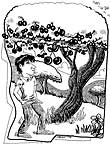
A cherry is a kind of
fruit, of course, and for some people a virgin is a particularly
tasty treat. So it seems likely to Blanche that cherry
originates as a metaphor that compares virginity to a delicious
fruit. The word doesn't have to do with the color or the shape of
the genitals, so cherry can be equally applied to both men and women
(and can also be applied to any race).
Still, in Miss Poubelle's
experience, the appeals of virginity are much exaggerated and the
potential for virginal disasters are greatly under-appreciated.
Youth is appealing, but she prefers men who know how to do what
needs to be done. She'll take well-aged beef over fresh fruit any
day!
You are not logged in.
No comments yet, but
click here to be the first to comment on this
Loose Lips!
|