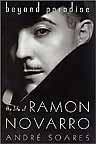
Let’s look under his hat
|
 |
A silent film star's life & death
By
Michael Bronski
Beyond Paradise: The Life of Ramon
by Andre Soares, (St. Martin's Press, 400 pages,
$27.95)
How to order
It was an ugly cultural moment that unnerved Hollywood and pushed it, a few steps, into the future. On Halloween morning, 1968, the body of famed silent film actor Ramon Novarro
was found murdered in his Hollywood Hills home. He had been killed by two brothers hustlers who, either through drunken accident or homicidal intention, beat and pummeled the
69-year-old actor. Within a week, 22-year-old Paul and 17-year-old Tom Furgerson were arrested for Novarro's murder. The vicious manner of the film star's death propelled the story to front page
news and outed him to the general public. It was a high-profile, first-rate Hollywood scandal that abruptly brought to the surface the reality that many of the industry's most noted names
had secret lives.
Beyond Paradise, Andre Soares's excellent biography of the film star, begins with the murder and ends with the trial of the two hustlers. While this is fascinating material Soares is
the first person to interview the Furgersons since they went to prison the worth and value of the book resides in Soares's enormous skills as a film historian, cultural critic, and biographer,
all of which combined with a strong narrative and eloquent writing style makes this one of the best books on Hollywood in years.
Through extensive interviews and combing through private papers, archives, studio files, and movie magazines, and press releases Soares has pieced together the first
complete biography of Novarro. Born in Mexico in 1899, Novarro's family fled to the US to avoid revolution in Mexico. By 1917 Ramon Novarro had moved to Los Angeles and, with his sensual
good looks and persistence, quickly found roles as an "extra" in films. By 1922 he was in starring roles, and was a huge success in the hit The Prisoner of Zenda. By 1925 he was cast, and
became world famous, as the lead in the mega-production of Ben-Hur. By 1932, with the advent of talkies, his star was in decline, although he made films consistently for the next few years and
even appeared in films until the early 1960s. After this he did some stage work including a 1962 tour of The Flower Drum Song as the aged Chinese patriarch and appeared frequently
on television.
Soares's groundbreaking work in the book is his explication of Novarro's homosexuality. Often cast as a libidinous-but-romantic Latin lover, Novarro acquired a screen reputation
as intrinsically heterosexual with a soft-edge: "lyric charm, poetical charm, plus the beauty of a Greek boy," as journalist Adela Rogers St. John described him in a 1926 issue of
Photoplay. But Novarro once he overcame the guilt induced by his intensely Catholic upbringing was very homosexual. In the 1930s he frequented gay speakeasies (usually on a "date" with a female
star), and maintained a very private personal life that was shielded by a very public persona. Later in life he often sought paid companionship, while still keeping up the company of a wide
range of gay friends.
Soares neither glamorizes the closet, nor applies contemporary standards of "gay liberation" to past lives; he's cautious in labeling anyone "gay" or "lesbian" without sure evidence
of their behavior and of how they saw themselves. He dispels the myths that have grown up around Novarro's sexuality: there is no truth to the rumor that he had an affair with
Rudolf Valentino, or that he was murdered with a lead dildo that the Italian star had given him (a tale circulated by Kenneth Anger in
Hollywood Babylon).
By the end of Novarro's story, Soares has painted a complex portrait of a complicated man living and working in an industry that was happy to help him hide who he was, while
creating the context in which he was vulnerable to exploitation.
In an odd way, Novarro's death was the beginning of the industry's grappling with its own homophobia.
Beyond Paradise is an important addition to the analysis of queers and Hollywood.
| Author Profile: Michael Bronski |
|
Michael Bronski is the author of
Culture Clash: The Making of Gay
Sensibility and The Pleasure
Principle: Sex, Backlash, and the
Struggle for Gay Freedom. He writes
frequently on sex, books, movies, and
culture, and lives in Cambridge,
Massachusetts. |
| Email: |
mabronski@aol.com |
You are not logged in.
No comments yet, but
click here to be the first to comment on this
Book Review!
|