Just meandering
|
 |
All in all, The Trip's an OK film
By
Michael Bronski
The Trip
Written and directed by Miles
Swain
Starring Larry Sullivan, Steve
Braun, Ray Baker, Jill St. John, and Sirena
Irwin
How to order
There is a dearth of "gay movies"-- whatever they are-- this summer.
Capturing the Friedmans exposes the hysteria around man-boy relationships and is a
great film, but not especially gay. American
Wedding has some good gay jokes. Camp has some great gay kids.
Pirates of the Caribbean has some great gay makeup
on Johnny Depp. And Sinbad: Legend of the Seven
Seas has some weird gay sensibility, with Brad Pitt's voice sounding faggier than usual. But none are really
gay movies.
In the midst of this appears The
Trip-- a very sweet, mostly inept, and yet oddly affecting love story. It begins as a quirky political comedy, moves
quickly through several decades, turns into a road movie, and then becomes a melodrama. This genre-jumping is not necessarily a bad thing-- it makes attentive
viewers' minds nimble, which is more than you could say for the brain-deadening narratives of films like
Kiss Me Guido or Trick.
Written and directed by Miles Swain, The
Trip is clearly a labor of love. There's studiousness and a "film school" quality here that lends a welcome
earnestness, in contrast to the flipness or Relentless Fun so many gay films push upon their audiences.
The Trip has the integrity to want us to take it seriously.
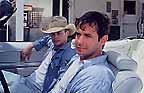
At the center of the film is the ongoing relationship between uptight, Republican-inclined Alan Oakley (Larry Sullivan), and free spirit Tommy Ballenger
(Steve Braun). They meet in the early 1970s when Tommy is a hippie and radical gay activist and Alan is a closeted, hardly-even-knows-he's-gay newspaper man.
They fall in love and live happily ever after, until 1978, when an anti-gay book Alan has written is suddenly published anonymously. They break up and Tommy drops
out of politics and Alan ends up moving in with his older
mentor-cum-lover Peter (Ray Baker), who is a very closeted and uptight lawyer. After several years, Alan
is told that Tommy has AIDS, and through the prodding of his mother Mary (Jill St. John) and Beverly (Sirena Irwin), a close friend, he leaves Peter to find
and romantically rescue Tommy.
Nothing much really happens in the film-- it ends with the eponymous road trip-- but that's OK. Swain has obviously intended
The Trip to be a character study with a historical perspective, and for the most part that works. At its best, the film is smart and nuanced about its two main characters. When not at its
best-- luckily not often-- one winces. Swain has a tendency to be overly cute around the details and it can be painful. Alexis Arquette, as Tommy's outrageous
friend Michael, gives a camping performance that does not work. The same is true for Julie Brown's receptionist role. Jill St. John begins with giving a broad, but
graceful, performance (she looks like a drag queen doing Holland Taylor, but even Holland Taylor sometimes looks like a drag queen doing Holland Taylor) that by the
end of the film-- when she is urging Alan to leave Peter-- becomes ridiculous and embarrassing. It's as though Swain cannot trust his great material and feels the
need to make fun of what would be more honest if played straight.
It's too bad because there is much in The
Trip that is affecting. Despite its low budget and sometimes clunkiness,
The Trip is emotionally honest, and this is why it succeeds. True, critics-- in both the gay and mainstream press-- were generally not fond of
The Trip-- it violates the glibness that we have come
to associate with the genre of "gay movies." But if you go on to Internet Movie Data Base (www.imbd.com) and read the viewer ratings-- from ordinary
folks-- The Trip wins high praise.
Why the disparity? Gay audiences are hungry for gay movies. There is so little out there that's aimed at a distinctly gay market-- we are not talking
Far from Heaven or The Hours here, we are talking the queer version of the "date movie"-- that gay men will flock to almost any flick with a hint of relevance. The bulk
of them turn out to be hackneyed and predictable-- think
The Broken Hearts Club or But I'm a
Cheerleader-- so a film like The Trip that possesses a core of
emotional sincerity looks great. Miles Swain has a vision here that may not be unique, but is truthful and decent and often starkly painful. Don't expect a huge amount
from The Trip, but don't be put off by the reviews. It's a small, but often potent movie that is well worth watching.
| Author Profile: Michael Bronski |

|
Michael Bronski is the author of
Culture Clash: The Making of Gay
Sensibility and The Pleasure
Principle: Sex, Backlash, and the
Struggle for Gay Freedom. He writes
frequently on sex, books, movies, and
culture, and lives in Cambridge,
Massachusetts. |
| Email: |
mabronski@aol.com |
You are not logged in.
No comments yet, but
click here to be the first to comment on this
Movie Review!
|