Trash or treasure?
|
 |
Possessed by possessions
By
Mitzel
Why do people collect stuff? I have asked myself this question numerous times in recent days. It being, finally, spring here in Boston, some guys have done their spring-cleaning, given me a call at the bookstore, and asked if
they can unload some of the magazines, books, and videos they've accumulated. I tell them: bring 'em in! I get to observe not just what they collect but how they collect. Some just schlep the goods in stuffed in shopping bags.
Some have them neatly organized in moving crates. One fellow brought in a nearly-complete run of
Playgirl, packed in chronological order of publication. Some videos arrive packed in a condition I can only describe as reverential.
Do people keep things because they once got pleasure from them? Because they remind us of ourselves when younger-- a mixed bag, to be sure? Or is it that because things change so quickly, these artifacts are weird snapshots of
a time and place that will never be seen again? If you don't keep this tendency in check, you might wind up like Andy Warhol who, upon his death, left a house full of stuff-- cookie jars, paintings of shoes, etc. I know: one
person's junk is another's treasure.
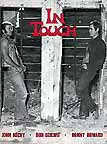
And speaking of treasures, in one trunkful of old mags, I came across the March, 1974, issue of
In Touch. Let's peruse our gay past. The cover, set at some sort of construction site, has two guys in denim pants and tops
cutely eyeing each other. There is an ad for Colt products. There is an editorial, a quite good one, by Jim Kepner about "The Humanist Manifesto II." I learned that Brigid Brophy had, with sympathy, declined to sign the document.
Why? There is a double-spread calendar of events. On 03 March 1974, the coronation of Emperor and Empress of Orange County was scheduled to take place at the Grand Ballroom at the Disneyland Hotel in Anaheim. There is a
full-page ad for Glen's For Men Turkish Baths. Following is a feature spread on "Ronny" Howard, the TV tyke turned teenager of films and sitcoms. Next up is a long profile of author John Rechy, which includes a photo spread
of pictures of John from toddler to pumped-up and stripped down (well, sneakers still on) nudes. Then comes a short story, and then a fashion spread. The motif for the black-and-white clothes showcase is "plaid." Some outfits
gave the 1970s their distinct look. The word I'm seeking is not
outrageous, it's not tacky-- but, you know, it's as though the fashion compass took a turn toward the Liberace Museum and stayed there. I pass through the "Fashion
News" with eyes modestly turned away. Next up is "Discovery," the beefcake spread, featuring 29-year-old Polish immigrant named Bob Dziewit (pronounced "Jevit"). "My idol at that time was Mia Farrow." There is a tasteful
nude centerfold. Bob's a darling. A book review section is next. Reviewed are: "Miss Thing," "Odd John," David Gerrold's "When Harlie Was One," about a computer that thinks it is human, and Marco Vassi's "The Stoned
Apocalypse." Another photo spread is a celebration of a new book called "The Naked Image," nude photo studies by Dean. There are pages devoted to film and theater reviews. The cover boys reappear in a spread showing them
cavorting through abandoned buildings in a "Ghost Town." In no time they are out of their clothes. Jim Kepner is back with an essay, "Sick No More," an analysis of the American Psychiatric Association's decision, in December 1973,
to remove homosexual behavior as a mental illness. Ads, restaurant reviews, letters to the editor-- there is an ad for some furniture that, I can only assume, would be appropriate décor for those models in their plaid suits. I have
worked in the gay press; I know every ad is hard-sought and is important. And 1974 was on the cusp of that time when the gay sex industry really got formatted and had sex-related products and services to fill their ad holes. (I think
the phone sex industry, in the late 80s and early 90s, supplied much of the revenue for many publications.)
All in all, this copy of In Touch is completely satisfying for what it is meant to do. I like the mix-- nude authors, Kepner's historical perspectives, and the concern about so many things long gone. The Platonic ideal of
gay publishing was defined by Boyd McDonald's Straight To Hell: The Manhattan Review of Unnatural
Acts ("no ballet reviews"), the pioneer work of a genius. The smart ones who came along after Boyd's copied his formula--
all those confessional stories ("Priest Tears Marine's Skivvies," etc.). Oddly, no one comes in with sets of
Straight To Hell. Did no one collect them? Hard to believe. If they did, can they spare to part with them? The imitators
seem to have more devoted followers than the original. I collect little-- maybe a little wool as I wander through life. Perhaps I should collect stuff, but if I did, and I'd need much more room, and that would set me off on another of
my fave rants-- Real Estate.
Save Me!
You are not logged in.
No comments yet, but
click here to be the first to comment on this
Common Sense!
|