Cocksucking for the masses
|
 |
Deep Throat
By
Michael Bronski
Inside Deep Throat
Directed by Fenton Bailey and Randy Barbato
How to order
The time-line of popular culture moves both far too quickly and far too slowly. Five years ago "Queer Eye for the Straight Guy" would have been unthinkable as a TV show. Ten years ago it would've been a joke on "Saturday Night Live." And now it is hot, with several spin-offs.
The fact that it's still a stupid, mostly boring show is beside the point-- but the reality is that substantive cultural change would look like something quite different.
Watching Fenton Bailey and Randy Barbato's fascinating documentary
Inside Deep Throat is a little like being trapped in H.G. Wells's Time Machine as it zooms backwards and forwards through zones of popular culture and politics. As narrated by Dennis Hopper,
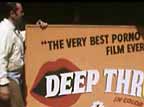
Inside Deep Throat documents the history of what is probably the world's most famous porn movie-- the film that in 1972 introduced oral sex-- a.k.a. cocksucking-- to mainstream discourse and suburban mall theaters.
As a cultural phenomenon Deep
Throat was the real thing: cheaply produced and intended to be just another dumb porno flick that would play adult theaters for two weeks on a XXX triple bill, the movie-- in part because it was playful parody of itself-- became cult hit in
almost every major US city, drawing audiences from the raincoat set to the New York literati and (according to John Waters, who is interviewed in the film) Jackie Kennedy herself. In fact,
Deep Throat became such a huge cultural hit that the federal government tried censoring it,
igniting one of the major anti-porn campaigns in the postwar years-- one still echoing today.
Inside Deep Throat is both charming and politically savvy. Bailey and Barbato do nothing shockingly original-- they interview everyone they can who was connected with the making, distribution, and prosecution of
Deep Throat, and then a host of cultural critics who have a
lot to say about its place in history.
But this non-exploitative, modest approach produces lovely results. Many of the people who were connected with making the film-- particularly director Gerard Damiano-- turn out to be complete characters and highly entertaining. Even the villains here-- Larry Parrish, the
federal prosecutor who dedicated his career to banning the film, Charles Keeting, the Nixon appointee who (after being jailed for Watergate) runs a radical-Christian right organization-- entertain as much as they infuriate. And Bailey and Barbato have done well choosing their
commentators, who include a witty Norman Mailer, a distressingly disheveled (and mostly inarticulate) Helen Gurley Brown, a very funny Dick Cavett, and a loquacious and perceptive Gore Vidal. After watching
Inside Deep Throat you come away with the impression that the porn-movie's most
lasting legacy might be to actually spark intelligent and discerning commentary. Certainly the film itself-- while minimally amusing and showcasing the talents of stars Linda Lovelace and the substantial, and attractive, penis of Harry Reems-- is far more interesting as a cultural object,
not a piece of film or a great turn-on.
Bailey and Barbato are even handed-- they give as much time to Charles Keeting and Larry Parish as they do to Hugh Heffner and Larry Flynt, the minds behind
Playboy and Hustler. But the general feeling that we take away is that while
Deep Throat was a flashpoint for both sexual revolution and social repression, today we are more a more sophisticated and adult culture that is able to deal with sexuality in better ways. A cultural battle over showing oral-sex now sees mostly quaint and even old-fashioned.
While the film doesn't ignore on-going state attempts to suppress sexual material, it doesn't really doesn't fill us in on censorship's current scope and ideological framework. Granted,
Inside Deep Throat is not a movie about present day censorship-- nor does it have
aspirations to do more cultural work than it sets out to do-- but it does raise larger questions.
The new censorship is everywhere. The FCC's new campaigns against overt depictions of sexuality on television are a prime example. They were started by Michael Powell, with his fury over last year's Superbowl's Janet Jackson's tittie-gate (as opposed to her brother's
kiddy-gate), and continue now under the agency's new head, Margaret Spelling, and her rampaging about lesbian moms on a PBS cartoon show. These scandals function as warning for TV producers to think twice about doing anything.
But even more blatant are the litigious moves of the Justice Department to reaffirm and strengthen federal obscenity laws that are now being repealed by appellate courts (check out the February 17, 2005,
New York Times article, "Justice Department Fights Ruling
on Obscenity").
Inside Deep Throat walks a thin line-- it presents the 1970s and the age of
Deep Throat as almost a time of nostalgia, but also recognizes the dangerous, extremist repression that grew from that historical moment. It is a lot of fun to watch-- as well as being great social
history-- but it's also a warning of what we still have to fight today three decades later.
| Author Profile: Michael Bronski |

|
Michael Bronski is the author of
Culture Clash: The Making of Gay
Sensibility and The Pleasure
Principle: Sex, Backlash, and the
Struggle for Gay Freedom. He writes
frequently on sex, books, movies, and
culture, and lives in Cambridge,
Massachusetts. |
| Email: |
mabronski@aol.com |
You are not logged in.
No comments yet, but
click here to be the first to comment on this
Movie Review!
|