Don’t trip
|
 |
If life deals you a dick down the gullet, enjoy it
By
Michael Bronski
How to order
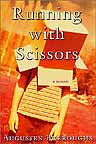
Running with Scissors, by Augusten Burroughs (St. Martin's Press, cloth, 288 pages, $23.95)
I'm laying on Neil's bed, the top of my head knocking against the headboard because his cock is inexplicably down my throat. All I can see is a triangle of dark hair coming at me.
This, and I have the unprecedented sensation of fullness in my throat. It's hard to breathe. The air comes into my nose in gasps that seem controlled by the thrusting of Neil's hips.
He thrusts; I get air. The air comes out my mouth, forced around the shaft of his cock.
"Yes, fuck, yes," he spits. "Jesus mother fucking Christ."
This is the narrator's initiation into sex at the age of 14 with the 33-year-old adopted son of his mother's crazy psychiatrist with whom he has been to live after his father leaves
and his mother decides she is a dyke. The wonderful thing about the episode is that it is really rather romantic-- as well as realistic-- and the brilliance of Burroughs's memoir is that it
neatly takes us around the hairpin turns of reality in which getting forcibly face-fucked for the first time is actually sort of an adventure.
Actually, an affair with a mostly-crazy man who is 20 years his senior is really the least of Burroughs's problems. In this ironic, wildly funny, and often scary memoir highlights
the sheer randomness of living in the world-- and the pleasurable continual invention of strategies to deal with it. The book jacket copy compares Burroughs to essayist David Sedaris and
film maker Todd (Welcome to the Dollhouse) Solondz, but this isn't really quite right. While both Sedaris and Solondz look askance at the absurdities of growing up, they are-- in the
end-- essentially sentimentalists who use their nightmare visions of maturation to make their audience feel better. Burroughs is more subversive, for he uses this material-- his idea of a
home movie is Who's Afraid of Virginia
Woolf-- to actually make us feel worse. Somehow, even as his life-situations go from worse to hilariously terrible, we can't help but envy him to
some degree: he makes survival seem like fun.
Part of this is because Burroughs has a sublime, understated, ironic style that enhances and deflects emotional pain nicely. "My mother only wears fancy shoes when she's going
out, so I've come to associate them with a feeling of abandonment and dread." As well he should since neither his father-- a drunk university professor who lives covered in painful
psoriasis-- or his mother seem to have much use for him as their lives flair out of control. That is when he ends up living with Dr. Finch, an unorthodox psychiatrist his mother sees (and whom
she makes her son's legal guardian) and Finch's even more unorthodox family. The doctor is odd-- he speaks to his patients of his masturbatoriam where he whacks off looking at photos
of Golda Meir ("An incredible woman. Highly evolved. Spiritually, she is the woman who should be my wife.")-- and his family of discontents is even odder. But it is here that Burroughs
begins to, in a way, flourish. He is worried that the Finches won't accept his deep dark secret-- being queer-- but they have no problem with it. In fact, Dr. Finch thinks that the only problem
with the 13-year-old Burroughs having an affair with the 33-year-old Neil is that his adopted son is deeply disturbed. Burroughs is also lucky that he has not internalized a lot of
homophobia. He really has no friends, so gets no peer pressure. So far as mass media goes, he notes that "Anita Bryant on TV talked about how sick and evil gay people were. But I thought she
was tacky and classless and this made me have no respect for her."
While his affair with Neil is hardly ideal-- the older man really is deeply disturbed-- Burroughs continues with his life and goes to school (sort of). After his mother has a
breakdown (she is being treated 'round-the-clock by Finch in a motel and is saved from complete madness by a friendly waitress named Winnie), Burroughs decides to move to New York
and become a writer.
One of the most potent, and enjoyable
aspects, of Running with Scissors is Burroughs' complete lack of victimhood. In the center of a life-- and lives-- out of control, he is happy
to deal with what is wrong, enjoy what might be good, and make his way through the rest of it.
| Author Profile: Michael Bronski |

|
Michael Bronski is the author of
Culture Clash: The Making of Gay
Sensibility and The Pleasure
Principle: Sex, Backlash, and the
Struggle for Gay Freedom. He writes
frequently on sex, books, movies, and
culture, and lives in Cambridge,
Massachusetts. |
| Email: |
mabronski@aol.com |
You are not logged in.
No comments yet, but
click here to be the first to comment on this
Book Review!
|