By
Thomas Kilduff
Attempting a gay pride march in Latvia means
battling city hall and nationalist thugs, as activists
found out in July for the second year running. So is
all dreary repression in this tiny Baltic nation? Not
when you consider
Latvia's nearly 50 years under Russia's thumb.
Despite difficulties, gay people in Latvia are
stretching their limbs and finding their dancing
feet-- often at a club that sounds like 'Pervs' and
means 'swamp'
The first omen occurred in the gargantuan
Frankfurt airport. We saw two gorgeous and dapper
Latvian boys, about 19 years old, appearing very
businesslike and waiting to board the plane. Their
laminated name tags were
not touting an affiliation with Master Card or Calvin
Klein or even Lufthansa, but rather the Church of
Latter Day Saints, better known as the Mormons.
My partner and I were turned both on and
off. Turned on because young men representing the
Mormon Church always hold themselves as neat,
clean, and willing. Turned off because it was a sign
that a distasteful
American export-- right-wing religion-- was
infecting the youth of a former Soviet-bloc. We
thought we'd be able to shop Riga in peace, far
beyond the culture wars grown so tiresome in
America.
From that point on, our vacation became a
quest to seek a brave, gay Latvia. How was the
small country faring at-- in its most recent period
of democratic independence-- 14 years? How did
sex play against religion
(neither of which were encouraged under 50 years
of Soviet communism)? And what about gay culture?
Queer activism? Was gay life loud and proud? Or
relegated to backrooms and secret codes?
Balticology 101
Latvia is the middle of three Baltic nations
(Estonia and Lithuania are its neighbors). Through
shared national solidarity, each worked towards
independence as the Soviet Union fell in the early
1990s. Latvia's
first independence was a prosperous 22-year stint
between the two world wars. In the early 1940s it
suffered occupation by both German and Russian
forces, before falling under the Soviet "sphere
of influence" for nearly
two generations.
Riga, Latvia's capital, lies on the River
Daugava, and is an old dandy's dream. (Disclosure:
the author is 26 years old but appreciates the finer
things in life as any old dandy would). My partner,
Eric, whose maternal
ancestry stretches generations in Latvia, told me
that during the Soviet days the whole of Riga was
painted in yellow-- the only color that they had in
surplus. I came at a better time. When I first
stepped foot in Riga's historic "Old
Town," I fell in love with its hues of oranges,
creams, browns, and blues.
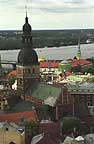
Founded in 1201, Riga's Old Town is an
historically intact medieval district whose great
church spires prick the Baltic sky. The mainstay
religion here is temperate Lutheranism, with
pockets of Anglicanism and
Catholicism. As well, the Russian Orthodox Church
plays a role for a huge slice of the population. As a
tourist, you can stroll the parks and patronize the
cafes by day, stopping at any major street corner to
purchase flowers to lay at
the freedom monument. By night you can attend
the stately opera house to catch a performance for
a mere eight American dollars.
But it's not all high culture. Besides the
textbook romantic tourism, the cobblestone streets
teem with solicitations for strip-shows with private
lap-dances. Young Russian men prowl their beats
wearing sign
boards showcasing naked women. Was this always
the case? I asked Valters Nollendorfs, who keeps an
eye on Latvian culture from his perch at the
Museum of Occupation.
"The Soviet regime was rather sexless,
even heterosexually speaking," Nollendorfs
told me. "Things opened up in the early
1990s. In the first year or two following
independence, bookstores were filled with how-to
guides and a lot of semi-pornographic
books." Prostitution, as far as he knows, is
supposed to be restricted to a certain zone (along
with the many casinos), but the law seems rarely
enforced.
There are two glossy periodicals for tourists
in
Riga-- Riga this Week and Riga in Your
Pocket. In addition to listing cafes and
museums, each runs a slew of ads for escort
services. For men seeking men, there's only
one choice-- an outfit called "
Dreamboys." Also listed were two official gay
nightclubs, XXL and Purvs (that translates as "
swamp"). The selection seemed pitiful for a
city of 800,000, but my partner and I just took it as
a
challenge, and headed into the field for more
research.
Native cheer
An aspect of the Baltic character is a
tendency to be brutally honest, not timid about
expressing opinions. This includes businesspeople
who would normally be given a tip.
On our first Friday night out, we decided to
tackle the scene at
Purvs (Matisa 60/62). We hailed a cab and
gave the driver the location. Everything seemed to
be going swimmingly until halfway across town.
"Why don't you go to a nice normal
club?" our cabdriver queried. He pointed to a
pink silhouette on one of the Soviet facades, one of
Riga's gazillion female strip joints. He made it seem
like having tits rubbed in your
face was an act of purity compared to the funny
stuff he imagined at our original destination.
"Just please take us to Purvs,"
my partner said.
The driver muttered something resentful
(capitalism
can be a hard pill to swallow) and dropped
us off at Matisa Iela, the street where Purvs goes
bump in the night. We lifted our heads to see a
tattered rainbow flag
behind a thin pane of glass above an old wooden
door.
"This must be it," I said.
We opened the door and walked down a
long shady hallway, where we met a man dressed in
black who took our coats.
Purvs is a mostly Russian institution (not
that there weren't plenty of Latvians, too). Dark
Russian electro clash and new wave-- a sort of
Slavic Pet Shop Boys-- drilled from the speakers. A
handful of young men
seemed passed out against the wall, with a few
lesbians dressed in black leather getting their
groove on. We lasted 15 minutes.
Uneasy commingling
A key feature of Latvian society is the
awkward division between the Russians living
here-- often born here-- and ethnic Latvians. The
tension between these two groups stretches back
centuries, but is not as keen
for younger people. Because independent Latvia's
economy is thriving more than post-Soviet Russia's,
many Russian immigrants who could, see no reason
to go back to the mother country. Russians are the
second biggest
ethnic group in their country after Latvians
themselves. "In 1989, this Russian national
group made up 34.8 percent of the whole
population in Latvia," notes the non-profit
Latvian Institute-- an increase of four-and-a-half
fold compared to the period before World War II.
While we were in Riga, Russian immigrants
rallied to protest their "alien" status,
which can often be a legal limbo for them between
citizen and foreigner. Part of the Latvian
nationalism that confronts Russians here
follows from fear of the disappearing Latvian
language, which has 1,534,844 speakers
worldwide-- a little more than one percent of the
145,031,551 who speak Russian (the figures come
from www.ethnologue.com
).
But from an old dandy perspective, Latvian
and Russian men are both hot, each in their own
way. While Latvians may be more gentle-looking
and classically handsome, the Russian attraction
lies in the way they walk
with curled fists, as if ready to beat up any
American tourist with a lisp.
Global spectrum
With Purvs crossed off our list, the
inevitable next stop was
XXL (A. Kalnina 4; www.xxl.lv ), which
Eric told me had more of a scene. We paid a cover
of three lats and were greeted by Tom of Finland
illustrations on
one wall, and the spray-painted exhortation to
"FUCK ME" on the other. A dark hallway
snaked past a labyrinth of backrooms and onto the
dance floor. XXL was larger and more upbeat, with
people dancing to both Latvian and
Russian pop music, as well as the globally
unavoidable Whitney Houston. We met the club's
owner, Sergie Rimss, who led us around the gay
hotel upstairs, complete with Riga's first all-gay
bathhouse, named
Varaviksne (Latvian for "
rainbow").
Rimss says that his international hotel
guests have included a smorgasbord of Estonians,
Lithuanians, Germans, and Brits. There's a tidy
community kitchen decked out in lipstick red and
chrome. Hotel guests are
granted free access to the club, and at reduced cost
to the adjoining bathhouse. The bathhouse itself
was warm and stylish with softer Tom of Finland
images on the wall, and naked supermen frolicking,
Eve-less, in a Garden of Eden.
"The bathhouse has only been open
for two weeks, but so far it has been very
popular," Rimss says, attributing the success
to their ad in
Spartacus. "It is seven lats to get in,
and four lats for men younger than 25."
I ask him if there is evidence of drug use
along with the sex.
"Drugs are not popular here," he
said, perhaps predictably. "Riga is like a
village life, very quiet." We would soon learn
that the "village" metaphor would
extend to other less savory aspects of Riga: small-
minded intolerance.
Pride before a fall?
On July 19 (just before this issue of The
Guide went to press) Riga authorities banned,
for the second year running, a request from several
gay rights groups to hold a march the upcoming
weekend, as part of a series
of pride events, from July 19 to 23. The city claimed
the marchers' safety couldn't be guaranteed-- a bit
rich, activists said, given that Riga city fathers plan
to host, and presumably protect, US President Bush
and other
leaders at a NATO summit later this year. In case
the city was inclined to allow the march, anti-gay
demonstrators had gathered at city hall every day
for days. Organizers vowed to go to court to
overturn Riga's diktat.
Déjà vu?
Riga made international headlines last
summer, a rarity in this overlooked corner of the
Western world. On July 23, 2005, Latvia's first ever
gay-pride parade snaked through the streets of Old
Town.
Three days earlier, Eriks Skapars, head of
the Riga city council, had revoked the permit to
march. The grounds were, again, marchers' safety.
Organizers went to court and had the city's ruling
overturned. If they
hadn't won, the activists said they were prepared to
defy the city and march anyway.
Riga's first pride march proved tumultuous,
with only a few dozen participants facing some
10,000 curious onlookers. Among the latter were a
thousand right-wing nationalists and skinheads,
who blocked the way.
Some threw rocks, eggs, and tomatoes at the gay
marchers.
Opposition from politicians and religious
figures helped inflame the violence. On national TV,
Prime Minister Aigars Kalvitis called the parade a
"mistake," contending Latvia was built
on "Christian values." Catholic
Cardinal Janis Pujats was also hostile. In a
sermon after the march, he declared pink to be
worse than red: "In Soviet times we faced
atheism, which oppressed religion; now we have an
era of sexual atheism," the cardinal said in a
service also broadcast on state TV and radio.
"This form of atheism is even more infectious
and dangerous-- spiritual values disappear in a
swamp of sexual irregularity." Swamps seem
to be a leading Latvian erotic metaphor.
Amnesty International condemned both the
city of Riga and the national government, saying
that their push for a ban on the pride march "
might encourage a climate of intolerance and
hatred, and incite further verbal
and physical attacks against gay and lesbian
people."
This year promises a repeat. But now the
world's eyes are on Riga, and the locals have more
help. (To stay posted on what happens, browse to
Riga Pride online.
Rabble-rousing optimists
Who were the people behind all this bold
organizing? I tracked down the address of the gay
youth group, and arrived on foot looking for an
interview. Their offices were in an almost hidden
office building in a less
comely part of town. GLJAG (I won't try to unfurl the
Latvian acronym) shares a space with an HIV
support group, and the secretary from the latter
gave me the card of Imants Kozlovskis, the man I
wanted.
A few days later I sat down with 18-year-
old Imants and his 26-year-old cohort, Gabriels
Andrejs Strautins, GLJAG's chairman and founder.
Imants, I learned, had made the personal
political in a very public way: he took his mother
onto the "Aina" show-- a touchy-feely
talk show that's the Baltic answer to Sally Jesse
Raphael-- and proceeded to come-out
to his religious, conservative mom live on Latvian
television.
"His mother still thinks it's
curable," Gabriels says.
We met for the interview at a funky Tex-
Mex eatery with the walls covered in yellow
newsprint, and a Madonna concert playing on
television. The waitress delivered the hugest heap
of ice cream ever witnessed.
Gabriels then began to inhale the monstrosity
between staccato answers in English.
Imants and Gabriels were the architects of
Latvia's first gay pride parade, which they had
started planning six months before the day of the
event.
"There was a lot of screaming,
protesting, and placards," Gabriels said.
"People are still talking about the parade--
we hear it every day on the TV and radio."
I ask Gabriels about a right-wing party now
in Latvia calling for a constitutional ban on same-
sex marriage. "The 'Latvia First' party is very
populist and quite new, actually." Such a ban,
he says, could readily pass.
There's certainly precedent for anti-gay
legislation in Latvia. In June 2004, an anti-
discrimination bill had been submitted to the
Latvian Parliament from the directive of the EU.
"However," notes a report from
the International Lesbian and Gay Association
website, "the parliamentary Human Rights
and Public Affairs Commission, which is responsible
for the bill, amended it and deleted the ban on
sexual orientation discrimination"-- an
early sign of the anti-gay refrain that's become a
leitmotif in populist politics throughout the former
Soviet bloc.
As the ice cream disappeared, we discussed
the tension between the Russians and Latvians and
if that crosses over into the gay world.
"Yes, of course I date Russians,"
Gabriels says. "Politicians make these
confrontations, but in daily life it doesn't
matter." As well as English and Latvian, he
speaks Russian. "All three can cover most of
where I want to
go," he says.
If there is violence at this year's pride
parade, Gabriels relates, at least there will be more
media and international observers to document
what happens-- though as the melee at Moscow's
first pride march this past
May proves, even prominent foreign guests is no
guarantee things won't spiral out of control.
GLJAG, very much a grassroots affair in a
new democracy, relies on private donations and
grants from the European Commission. But its
financial straits are such that even a shared office
has become too much, so
currently the group is mainly operating out of
Gabriels' parents' living-room.
Yet Gabriels is hopeful for the future. There
are politicians countering the rabid Latvia First.
"Parties, such as 'New Era,' say they are not
supporting this aggression against gay people, and
that everyone is equal."
Latvia's president, Vaira Vike-Freiberga, is
uncompromising on human rights. "She may
take Kofi Annan's position in the UN next
year," Gabriels suggests, which would add
prestige to progressive voices in Latvia.
Land, peace, & bread
Reviewing our two weeks on the flight back
to Boston, we decided that Latvia, for all its growing
pains, is probably right where it should be.
Democracies are supposed to be laboratories of
contradictions. With all
its wonderful cafes and flowers and pimps and
architecture, Latvia is still finding its way into its
own version of a Western mode, after losing 50
years to unsexy Russian communist colonialists. For
all the protests over gay
pride certain to happen again this year, our
impression is that Latvians are more concerned
with economic growth and language preservation
than sodomy, and that, as Gabriels suggests,
tolerance and equality will win here in the end.
Oh, and speaking of sodomy, the one regret
we did have was not interviewing those cute Latvian
Mormons when we had the chance. Even an old
dandy like me can appreciate religion (if it's dressed
up nice).
You are not logged in.
No comments yet, but
click here to be the first to comment on this
Magazine Article!
|





 Advertise with us
Subscriptions
Contact us
Site map
Translate
Advertise with us
Subscriptions
Contact us
Site map
Translate