Oscar wouldn’t abide it
|
 |
By
Michael Bronski
How to order
Oscar Wilde's The Importance of Being
Earnest is a near-flawless play. Elegantly constructed and utterly sure of itself,
Earnest manages to surprise even if we already know it by
heart. The play's power resides not so much in its endlessly witty language but how it ticks itself to its ending like a perfectly constructed clock. It's hard to see how anyone-- simply
sticking to Wilde's play-- could make a mess of it. Well, welcome to the world of Oliver Parker who (re)wrote and directed this high-scale version of Wilde's Victorian comedy of
ill-conceived manners.
It's hard to know where to begin describing how Parker's
Importance of Being Earnest goes wrong. Is it because some of the dialogue is tossed off so carelessly that
it's sometimes hard to hear Wilde's words? Or is it the scene where Gwendolen (Frances O'Connor) decides to get a tattoo on her butt to show her devotion to Jack (Colin Firth)? Maybe
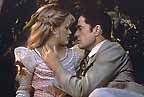
it's the scene of Jack and Algy (Rupert Everett) lounging in a whorehouse? Certainly the fantasy sequences of Cecily (Reese Witherspoon) imagining herself bound and about to be
ravished as in a Burne-Jonesesque watercolor speak to an explicit imagination that Wilde would have found vulgar and unnecessary-- if, granted, somewhat true to the character. Next to
these trespasses, the flashback of Lady Bracknell (Judi Dench) beginning her career as a pregnant dance-hall performer hints of moderately insightful literary acumen.
Messing with the stuffing
There's nothing wrong with "opening up" classic plays-- unless of course there's no need to do so and you don't know what you're doing. Wilde shows his characters as
horrendously confined by Victorian propriety and constantly seeking ways to negotiate escape. So, thematically, it makes no sense to take them out of those overstuffed, stuffy
drawing rooms and plop them into restaurants and gardens. As in his botch-job of Wilde's
An Ideal Husband a few years ago, Parker-- as both (re)writer and director, shows that he has
little understanding of the master's themes and ideas. He can identify the jokes, but when he isn't throwing them away he's hammering them home. Is there any real need for
Gwendolyn's flirtatiousness-- through which Wilde indicates both her independence and her strict adherence to convention-- to be underscored by her flaunting her breasts in front of Jack? Or for
her independence to be illustrated by her driving a car down to Jack's country house even though she states later that she took a train?
But worse is Parker's inability to portray Wilde's seamless, perfectly inviolate structure. One of Wilde's greatest feats as a writer-- and an inventor of modern gay sensibility--
was the application of the theoretical "art for art's sake" to dramatic form. Like a classic Greek statue or beautifully designed chair, the power-- as well as the meaning-- of
The Importance of Being Earnest resides in its graceful linguistic and narrative contours. The novelist Brigid Brophy pointed out that the "truth" of Wilde's epigrams resides not only in their
psychological astuteness, but their neat, flawless form. They are Freudian bon-bons. The same is true for each scene in Wilde's plays. Parker, however, treats Wilde's epigrams like laugh-lines and
his well-executed narrative flow like sit-com segments. Not only will Parker go for the obvious joke-- Lady Bracknell's dresses are better suited for a drag show-- but he doesn't
even understand how a joke works. The early interchanges between Dr. Chasuble (Tom Wilkinson) and Miss Prism (Anna Massey) simply don't produce laughs, because Parker has
so injudiciously truncated them as to make them nonsense.
In the midst of all this are some very fine performers caught in a web of stupid incompetence. Certainly Colin Firth and Rupert Everett would make fine Wildean actors-- they
have the looks, training, and timing to bring it off. And Anna Massey and Tom Wilkinson manage to shine through the shambles that Parker has made of their characters. But it would
have been wonderful to see the always fascinating Reese Witherspoon really have a shot at playing Cicely. And while Frances O'Connor does her best as Gwendolen, whatever comic
ability she has is obscured by the idiocies of Parker's script. As Lady Bracknell, Judi Dench looks rather above-it-all, and treats her part rather as a walkon that has little to do with
anything around her. Unlike everyone else here, she shines because she seems to be refusing to acknowledge where she is or what she's doing there.
| Author Profile: Michael Bronski |
|
Michael Bronski is the author of
Culture Clash: The Making of Gay
Sensibility and The Pleasure
Principle: Sex, Backlash, and the
Struggle for Gay Freedom. He writes
frequently on sex, books, movies, and
culture, and lives in Cambridge,
Massachusetts. |
| Email: |
mabronski@aol.com |
You are not logged in.
No comments yet, but
click here to be the first to comment on this
Movie Review!
|