Attaining political consciousness?
|
 |
And Jews as Queers
By
Michael Bronski
Focus
written by Kendrew Lascelles
directed by Neal Slavin
with William H. Macy, Laura Dern, Kenneth Welsh
How to order
Hollywood has never been much good at social issues, especially when it pats itself on the back for dealing with them. What was the big film about racial tensions in the 1960s? Stanley Kramer's horrid and insulting
Guess Who's Coming to Dinner? Before that there was Elia Kazan's 1949
Pinky, about the problems faced by a young African-American woman who passes for white in the north after she comes home to the south. Amazingly, the film,
cast the very white Jeanne Crain in the title role, thus holding tight the industry bar against people of color in lead roles. In 1947 Hollywood touted itself for making a film of Laura Z. Hobson's
Gentleman's Agreement which exposed American anti-Semitism. The film starred Gregory Peck as a gentile reporter who "passes" for Jewish to write a magazine piece about the plight of Jews. While the novel was incisive, the film totally wimped out: the joke on
the set was "You should always be nice to Jews; they might turn out to be gentiles." When Hollywood decided to deal with queerness and AIDS we got
Philadelphia. (Although to be fair, we also got
Boys Don't Cry two years later, proving that even a stopped clock, and industry, can be right at least once a lifetime.)
If there is a problem with Hollywood films about queerness, it is that they generally do not want to deal with homophobia: in
Victor/Victoria it is negligible; in The
Birdcage, it is ridiculous; and in In and
Out, it is nearly non-existent. But when you think about it, it isn't as though Hollywood has done very much dealing with racism or anti-Semitism either.
Focus, a new film based on Arthur Miller's 1945 novel, is an honest, interesting, and not
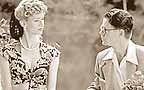
very successful attempt to look at the texture, tone, and personal politics of anti-Semitism in World War II America. Written by Kendrew Lascelles and directed by Neal Slavin it focuses on what happens to a couple Lawrence
Newman (William H. Macy) and Gertrude Hart (Laura Dern) who are faced with the problem that people think they are Jewish. In the start of the film Newman loses his job because of his perceived religious identity, and we discover
that Hart, has already changed her German name because she was always mistaken as Jewish. They fall in love, get married, and settle down to a happy life in the neighborhood in which Newman has always lived, only to face
the constant and persistent rumor that they are
really Jewish a crisis that escalates as many of the lower-middle class neighbors begin to join a neo-Nazi, America-first group who take their cues from the right-wing ideologue
Father Crighton (Kenneth Welsh) based on the popular and ravingly anti-Semitic Father Cloughlin who begin to physically harass local store-owner Finkelstein (David Paymer) and then the Newmans.
But the film feels like an evasion are the Newmans Jewish? Of course, that's the point; it doesn't matter. But something about Lascelles's plain-American dialogue and Slavin's no-frills directing keeps bringing us back
to this question. As the narrative unfolds, it becomes clear well, it comes into focus to first Newman and then his wife, that the hate and fear they increasingly face is the real threat that is facing America. You can't talk yourself
out of anti-Semitism because, on some profound level anti-Semites are acting outside of the normal, allegedly rational, framework. It is only when Newman sides with them "obviously" Jewish Finklestein that his life and the
world around him begins to make sense.
But what is curious about the film which feels simultaneously both too literal and too metaphoric is that it actually works better as a parable of queer-hating. There's no reason to think this was intended
Focus is a mostly faithful transfer to the screen of Miller's novel but, this reading gives the film a depth and resonance it doesn't sustain on its own. Surely, anti-Semitism is a perfectly good and important theme for a film, but
Focus feels like it's missing something. Historically this calls to mind a situation that was somewhat the reverse. Richard Brook's 1945 novel
The Brick Foxhole which dealt with the murderous effects of queer-hating in the US military was
made into a 1947 film, Crossfire. Unable to tackle the idea that killing a homosexual was wrong, the film changed the victim from queer to Jewish, thus making
Crossfire the first minor, but important, Hollywood film to deal with
anti-Semitism.
Gay critics, beginning with Vito Russo in
The Celluloid Closet, have long lamented the sexual politics that mandated such a change but the reality is that
Crossfire is probably a more interesting film, both in its own
time as well as now, because it was not about homophobia in the military. Brooks's novel is great,. But his theme which is really about how men are trapped in the "brick foxhole" of masculinity would have been flattened out in
a film version. By making anti-Semitism the ostensible subject of the film, the writers and director hit more resonant cords than they might have if they were able to use Brooks's original plot. Throughout
Crossfire, the characters refer to the Jewish victim as "weak" and as "not a man," which on one hand recalls the novel, but also makes insightful and provocative comments on how anti-Semitism configures gender and sexuality. Similarly, in
Focus, the specter of queer-hating hangs over the film as Newman and his wife face increasingly dangerous obstacles simply to living their lives.
On a basic level, Focus, is about the attainment of political consciousness; when the Newmans feel that they are just like everyone else, they have no incentive to take any political stands whatsoever. Once the trouble
starts they are forced to take sides and initially choose the neo-Nazis the choice of power and the safety. Only when they are refused entry do they have to take a stand against the status quo. Here
Focus works best: most people, at heart, follow self-interest and only under duress will they take a principled, ethical stand. A statement that applies as much to the queer community as any other.
| Author Profile: Michael Bronski |
|
Michael Bronski is the author of
Culture Clash: The Making of Gay
Sensibility and The Pleasure
Principle: Sex, Backlash, and the
Struggle for Gay Freedom. He writes
frequently on sex, books, movies, and
culture, and lives in Cambridge,
Massachusetts. |
| Email: |
mabronski@aol.com |
You are not logged in.
No comments yet, but
click here to be the first to comment on this
Movie Review!
|