|
 |
Supremes decide not to abolish online free speech this term
By
Jim D'Entremont
By a narrow margin, the US Supreme Court recently upheld for the second time an injunction barring enforcement of the Child Online Protection Act (COPA). Writing for the 5-4 majority, Justice Anthony Kennedy warned that content-restrictive measures like COPA, ostensibly
aimed at shielding children from pornographic material, have "the constant potential to be a repressive force in the lives and thoughts of a free people."
The June 29 ruling did not strike down the law, which was crafted to sidestep First Amendment concerns that undid its antecedent, the Communications Decency Act (CDA), ruled unconstitutional in 1997. The CDA would have halted transmission of "indecent" material;
COPA, known to civil libertarians as "Son of CDA," would restrict internet content held to be "harmful to minors."
The high court sent the case-- Ashcroft v. American Civil Liberties
Union-- back to the Third Circuit Court of Appeals for further consideration, as it had in 2002 in response to an earlier challenge.
Ashcroft v. ACLU may now go to trial in the lower court. What remains at
issue is whether parents retain the right to determine what websites their children can view, or if-- on the other hand-- the US government can step in and decide what internet content is permissible for all.
Here we go again
The Supreme Court has, in effect, handed US Attorney General John Ashcroft's Justice Department one more opportunity to prove its claim that enforcement of COPA would not impinge on First Amendment guarantees of freedom of speech.
In uncharacteristic alignment with conservative Justices Rehnquist, Scalia, and O'Connor, Clinton-appointee Stephen Breyer dismissed the idea that COPA could have any serious First Amendment implications, claiming that at worst it "imposes a modest additional burden
on adult access to legally obscene material."
But five of Breyer's colleagues disagreed. In addition to Justice Kennedy, the majority included senior liberal John Paul Stevens, left-leaning Ruth Bader Ginsburg, quasi-conservative free-speech champion David Souter, and archconservative Clarence Thomas. (It's
worth remembering that during Thomas's stormy 1991 confirmation hearings, the prospective justice's apparent interest in porn-- indicated in part by remarks to Anita Hill about porn star Long Dong Silver-- was a key issue.)
Noting that the means to limit children's access to websites has evolved since 1998, the year COPA was passed, this politically diverse quintet echoed the position of the ACLU, suggesting that filtering software might offer a less problematic and more constitutionally
sound alternative to COPA. "Promoting filter use," wrote Justice Kennedy, "does not condemn as criminal any category of speech, and so the potential chilling effect is eliminated, or at least much diminished."
The 'net on ice
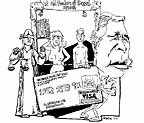
If COPA is allowed to stand, the chilling effect will be frigid indeed. Anyone whose website contains material branded "harmful to minors" could be slapped with a six-month jail term and a fine of $50,000 for every day the targeted content remains available. Adults may
be required to register, submit credit card information, pay burdensome fees, obtain access codes, and jump through other hoops before connecting with AIDS resources, gay online magazines, photos from
Playboy, artistic images from dealers or museums, family-planning
information, and other material widely available now without restriction.
"Harmful to minors" is one of those vague, elastic terms whose meaning varies from community to community, and from one subculture to the next. Law-enforcement officials can tailor their interpretation of such terminology to fit almost any occasion.
According to language embedded in COPA, material harmful to minors is "any communication, picture, image, graphic image file, article, recording, writing, or other matter of any kind" that is "obscene"-- or that (1) appeals to "the prurient interest," (2) would be
considered "patently offensive" for minors by the average person applying contemporary community standards, and (3) "lacks serious literary, artistic, political, or scientific value for minors." This harmful-to-minors test is essentially a stepchild of the three-pronged
Miller v. California obscenity definition. COPA's inclusion of text is somewhat surprising, since federal anti-obscenity legislation has since the late 1960s been focused primarily on images.
Theological precepts
Among COPA's many drawbacks is that no one really agrees on the meanings of "obscene," "prurient interest," or "patently offensive"-- or on who is qualified to judge "literary, artistic, political, or scientific value for minors," or for anyone. Another problem is that the
internet is geographically non-specific. In June 2000, the Third Circuit Court of Appeals shot down COPA because its "community-standards test would essentially require every web communication to abide by the most restrictive community's standards." (In other words, it would hold
the New York website of the Gay Men's Health Crisis to the community standards of Provo, Utah.) The circuit court also cited the law's prohibition of "a wide range of protected expression."
The ACLU challenge to COPA was undertaken on behalf of an array of organizations and business entities exemplifying that range of expression. The plaintiffs, all of which maintain websites, include the American Booksellers Foundation for Free Expression, the American
Society of Journalists and Authors, the online magazine
Salon, ArtNet, the Sexual Health Network, Planet Out, the gay and lesbian Different Light Bookstore, and
Philadelphia Gay News. COPA would target such Web publications as Susie Bright's "sexpert" column at the
Salon website, and most online writings on gay sexuality.
Baby with the bathwater
COPA's right-wing Congressional supporters make no distinction between such material and hardcore smut. "I'm tired that the flesh merchants keep hiding behind artistic expression," groused one co-sponsor, Rep. Michael Oxley (R.-Ohio). One of the law's chief architects
was Indiana Senator Dan Coats, now retired, a leading Republican demonizer of former Surgeon General Joycelyn Elders, and a dedicated crusader against dial-a-porn.
The Justice Department's case on behalf of COPA was bolstered by an
amicus brief from the American Center for Law and Justice (ACLJ), the Christian Coalition's anti-ACLU. The ACLJ-- a promoter of school prayer and a foe of gay rights, abortion, and sex education--
claims the ACLU objects to COPA simply because "commercial pornographers on the Web would be required to abide by community standards with respect to what was deemed harmful to minors."
The ACLU is also challenging the Children's Internet Protection Act (CIPA), a law passed in 2000 requiring federally funded schools and libraries to install filtering software to block "adult" material. Ignoring the principles that underlie both challenges, the ACLJ accuses the
ACLU of double-dealing-- of claiming to support the use of internet filters while seeking to ban their use.
Most free-speech advocates concede that filtering software has its uses, providing, for example, a means to avoid having one's personal e-mail account clogged with junk messages, or spam-- and offering convenient tools to parents who don't mind letting inherently
biased commercial devices like Net Nanny shape their children's online activities. (The politics of such censorware is revealed through blocking priorities; some products shut out gay and lesbian websites regardless of content.)
In fact, the American Civil Liberties Union supports the use of filters as a parental option, but opposes state-mandated installation of filtering devices in the virtual public square. Resisting state-mandated content restrictions in general, the ACLU views COPA as a classic
violation of First Amendment rights despite its "harmful-to-minors" smokescreen.
"Ultimately the government's only argument is that COPA should be upheld because it is not quite as censorious as the CDA," attorney Ann Beeson once stated in an ACLU press release. "But a law banning books does not become constitutional because it is rewritten to
remove every other book on the shelves."
Proponents of COPA seem to think the expression of artists, sex educators, AIDS activists, and queers must recede before a sanitized, die-cut, all-encompassing vision of parenting. Time will tell whether the US government, acting
in loco parentis as an ever-expanding Nanny State, can succeed in making infants of us all.
You are not logged in.
No comments yet, but
click here to be the first to comment on this
News Slant!
|