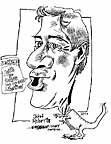
Set to freshly hex the court
|
 |
John Roberts may have a small pink spot on his underbelly, but he's likely just further to hex the US Supreme Court
By
Jim D'Entremont
On July 20, less than three weeks after Supreme Court Justice Sandra Day O'Connor announced her retirement (see
The Guide, August 2005), George W. Bush proposed Judge John
Roberts as her successor. The president had appointed Roberts to the US Court of Appeals for the District of Columbia Circuit in 2003.
The announcement was timed to upstage news of possibly criminal machinations by presidential hit-man Karl Rove and others who trumped up the case for the 2003 US invasion of Iraq.
The strategy appeared to work. Puff pieces on Roberts nudged intimations of scandal off the front page. Mainstream news outlets ratified the notion that during his two short years
on the bench, the 50-year-old, Harvard-educated judge had given no indication of how he would rule on such hot-button issues as gay rights and abortion, and therefore was
noncontroversial. There seemed little to say except that Roberts was a brilliant but affable regular guy from Buffalo, New York; the media said it at prodigious length.
But social conservatives knew better. The
Weekly Standard promised its Republican readers that Roberts would not turn out to be another David Souter, a supposedly conservative
Bush pre appointee who became a staunch defender of social justice. Many hoped that Roberts, a Roman Catholic, would echo the opinions of pro-life, homophobic, devoutly Catholic
Antonin Scalia, the most outspoken right-wing voice on the high court. (Traditional Catholic opposition to the death penalty and other forms of Republican uplift were conveniently ignored.)
Bush supporters reminded themselves of their President's pledge to select a Justice in the mold of Scalia or his most reactionary colleague, Clarence Thomas. Roberts seemed to fulfill
that promise.
Organizations such as the Family Research Council (FRC), which seeks to undo Supreme Court rulings permitting abortion and upending sodomy laws, began a propaganda blitz
on Roberts's behalf. Progress for America, a group with ties to Rove, produced pro-Roberts commercials. Meanwhile, left-leaning advocacy groups like the National Abortion Rights
Action League (NARAL) and Move On sounded alarms about the nominee's record on abortion, civil rights, environmental affairs, and criminal justice.
On August 3, both supporters and opponents were startled by the revelation that Roberts, while in private practice, had provided
pro bono advice to gay activists in Romer v.
Evans. The case was a challenge to Colorado's Amendment 2, a measure banning anti-discrimination protections on grounds of sexual orientation. Roberts was "terrifically helpful... very
fair-minded and very astute," lead attorney Jean Dubofsky told the
LA Times. He spent about five hours giving Dubofsky's legal team strategic advice and participating in a moot court exercise in
which he took positions illustrating those of Associate Justice Scalia. Dubofsky then argued the case before the Supreme Court, which struck down Amendment 2 by a 6-3 majority in May 1996.
Roberts had not mentioned his brush
with Romer v. Evans in answering the Senate Judiciary Committee's request for an outline of his
pro bono work. Former colleagues attributed
this "oversight" to his forgettably minor role in the case, and noted that as an advisor Roberts was simply behaving professionally, representing his client regardless of personal predilection.
Jekyll & Hyde? Or just Jekyll?
The news that Roberts had played even a supernumerary role in a gay-rights breakthrough ruffled his hard-right supporters. Eugene Delgaudio's Public Advocates of the United
States dropped plans for a pro-Roberts mailing. But most right-wing opinion-makers reaffirmed their commitment to the nominee. "Concerned Women for America will do all in our power to
support him all the way to confirmation," vowed Beverly LaHaye.
The Family Research Council's Tony Perkins said he had been reassured by "reviewing Judge Roberts's judicial opinions." In civil rights issues, Roberts has a history of favoring
"judicial restraint"-- a euphemism for relaxed standards in defending the rights of women and minorities, or upholding the 14th Amendment's equal protection clause.
John G. Roberts, Jr., is a man whose defining opinions and associations have been right-of-center. His resume, includes a year (1980-81) of clerking for then-Associate Justice
William Rehnquist; a stint (1981-82) as assistant to William French Smith, Ronald Reagan's first Attorney General; and four years (1982-86, encompassing the Iran/Contra affair) as
associate counsel to President Reagan. He served as Deputy Solicitor General of the US through the George H.W. Bush Administration (1989-93).
During Roberts's tenure as Deputy Solicitor General, he co-wrote the government's brief in
Rust v. Sullivan, the 1991 "gag rule" decision that upheld regulations forbidding
counselors in Title X programs to mention abortion or make referrals to clinics performing the procedure. "We continue to believe that
Roe v. Wade was wrongly decided and should be overruled,"
he argued. "The Court's conclusion in
Roe that there is a fundamental right to an abortion... finds no support in the text, structure, or history of the Constitution." Since he concedes
that Roe is "settled law," Roberts might hesitate to overturn it outright, but he is likely to obstruct access to abortion whenever possible.
Rust v. Sullivan was both an affront to women's rights and an egregious First Amendment decision validating the idea that public funding forces its recipients to bow to the views
of whoever happens to be holding the purse strings.
Rust is now cited as precedent whenever controversy strikes any area touched by federal money. It cinched the outcome
of such cases as NEA v. Finley (1998), in which the Supreme Court, masking prejudice against gay, lesbian, and feminist art, upheld the restrictive "decency" standard the National Endowment for the
Arts was forced to impose on grantees.
Rust will shape Supreme Court cases in which Roberts will probably participate. These include a constitutional challenge to the Solomon Amendment, a law that denies federal
funding to law schools that ban or limit on-campus military recruiting. The measure was passed in opposition to efforts by the Association of American Law Schools to fight policies of
discrimination on grounds of sexual orientation, such as the US military's "Don't Ask, Don't Tell" scheme.
Despite Roberts's backstage brush with gay rights
via Romer v. Evans, his documented attitude toward
Roe suggests hostility toward
Lawrence v. Texas, the 2003 decision that
voided sodomy laws and paved the way for gay marriage. Both
Roe and Lawrence depend on the right to privacy first established under
Griswold v. Connecticut in 1965. Roberts, who does
not believe that such a right is implied by the US Constitution, would almost certainly have upheld
Bowers v. Hardwick (1986), the now-overturned affirmation of a state's right to
criminalize consensual, private sex between gay adults.
The nominee's positions on civil liberties have an identifiable ideological bent. While supporting the conservative tactic of chipping away at rights such as abortion by narrowing
First Amendment protections, Roberts, like Scalia, favors free-speech absolutism when it suits his politics. He has interpreted Operation Rescue's clinic blockades as protected speech.
He has also opposed affirmative-action and sought to restrict minority voting rights. His recent rulings include validation of the Bush administration's view that the Geneva
conventions do not apply to terrorism suspects held at Guantanamo.
And look at his pals
Roberts rode into Washington on the Reagan landslide of 1980, attached himself to the Bush clan, and is viewed as a loyalist who shares the Bush administration's views on
criminal justice, the environment, separation of church and state, and the Bill of Rights. He was one of the horde of Republican attorneys who dispensed advice to the Florida Bush camp during
the disputed Presidential election of 2000.
He has been involved in the Federalist Society, an elite network of lawyers and politicians dedicated to rolling back civil rights. (Roberts has denied this affiliation, though the
Federalist Society's 1997-98 directory lists him among the steering committee of its Washington chapter.) His wife, attorney Jane Sullivan Roberts, belongs to Feminists for Life, a
Washington-based anti-abortion group.
Confirmation hearings are tentatively scheduled to begin before the Senate Judiciary Committee on September 6, but may start earlier. The goal is to install the new Associate
Justice before October 3, when the Supreme Court goes back into session. Roberts stands now to benefit from the propaganda style he used to urge on right-wing office-seekers during his
days at the Reagan DOJ, when he coached Sandra Day O'Connor to give noncommittal answers at her confirmation hearing in order to obscure her conservatism.
Because Justice O'Connor was a swing vote on decisions affecting a range of constitutional rights, whoever takes her lifetime seat on the US Supreme Court may determine the
high court's bias for decades to come. This factor mandates close examination of any prospective replacement.
The nominee will be interrogated about his legal philosophy, asked how he might have ruled in various exemplary cases. It would be revealing, for example, to hear his views on
McCreary County v. ACLU, the recent 5-4 ruling against displaying the Ten Commandments in Kentucky courtrooms, or
Stenberg v. Carhart (2000), the 5-4 ruling that struck down a Nebraska
law prohibiting late-term abortions. However Roberts responds, mere complaints about his politics will not derail his confirmation.
Once installed, Associate Justice Roberts can look forward to a long career, during which the Court will be considering an array of gay rights issues, including the inevitable challenge
to Lawrence v. Texas.
You are not logged in.
No comments yet, but
click here to be the first to comment on this
News Slant!
|