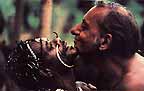
Two worlds greet
|
 |
A queer New Yorker's journey to Paleolithic
By
Michael Bronski
Keep the River on Your Right
directed by David and Laurie
Shapiro
with Tobias
Schneebaum
How to order
Homosexuals get accused often of antisocial behaviors, but cannibalism isn't among them. Anthropologist, writer, raconteur, and homosexual, Tobias Schneebaum is one of the few New Yorkers to have confessed to engaging
in the practice (well, just once). In his engaging 1969 memoir
Keep the River on Your Right, Schneebaum described his journey to Peru on a Fulbright, his happy friendship with a tribe of Indians, and the day he joined them on a
raid of a nearby village, afterwards partaking in a dinner of the losers. Since then, Schneebaum has become famous for his catholic palate. But really, in the broader view of his life, this is one of the least remarkable aspects of
Tobias Schneebaum and his career.
In 1973, Schneebaum went on another personal anthropological expedition, to live with the Asmat, a native people of New Guinea. He stayed among them for three years, was adopted into their tribe, and became
lovers-- "exchange friends" is the Asmat term-- with Akatpitsjin, a handsome married man. In the documentary
Keep the River on Your Right, film-makers David and Laurie Shapiro coax Schneebaum (who is now close to 80) back to
Peru and New Guinea to revisit the native peoples he'd befriended.
Keep the River on Your Right, the film, is a marvelous, witty, and moving account of Schneebaum's life and his journey back to places and peoples that no longer exist quite as he once knew them. The film is also
an anthropological document-- partly about the daily life of a band of Peruvian ex-cannibals and, shifting to New Guinea, about the Asmat, who are relatively unknown and unstudied by Westerners. But the film's center of
gravity is Schneebaum's own life as a gay man who feels so distanced from his own world that he finds happiness, freedom, and emotional sustenance in a world as far removed as possible from civilization.
Homosexuals escaping the repression of Western civ is not new. From Sir Richard Burton's Asian junkets, Herman Melville's excursions to the South Seas, to T.E. Lawrence's thrusting himself into Arab culture (and
vice versa), there's been a gay tradition of "going native."
Schneebaum's anthropological bent came about because he was, well, bent. This wasn't just about looking for sex-- Schneebaum was openly gay, living as a painter in Greenwich Village during an era of increasing
sexual tolerance. Rather, Schneebaum was drawn to places and times in which the very structures that produced Western cultural intolerance were absent. When we see Schneebaum in New York chatting about his life, or on a cruise
ship lecturing to tourists about the Asmat (as well as answering the eternal question about cannibalism) he seems competent, capable, and even happy. But later in the film, when he's back among the Asmat-- many of whom
remember him and welcome him-- Schneebaum is radiant. Yet it's here when the film takes on an aura of melancholy. While Schneebaum's journey back feels redemptive to him-- he never expected it, and feared the return as it
grew impending-- the specter of his death lies over the film. So does the inevitable march of "progress." The Asmat and the Peruvian Indians, though world's away, use eerily the same phrases to express that their histories are now
dead and buried. Both groups have satellite dish television in their jungle outposts.
What's most revealing about the film is Schneebaum's capacity to be honest and open about his life. He's happy to answer
the question, although he does seem a little tired of it, and is ingenuous about how he's lived his
life. Schneebaum views his time with the Asmat as a gift. He doesn't carelessly idolize or sentimentalize them in the way so common among Westerners who reject their culture. Indeed, Schneebaum seems even to lack bitterness
about the life in the US that he was so eager to leave. It's this degree of acceptance and wisdom that allowed him to live among the Asmat and be so welcomed. Unlike anthropologists who "simply" observe, or others who
actively interfere, Schneebaum's genius as a participant in his adventures/studies is simply that he participates.
While the film avoids easy moralizing and the pitfall of talking heads (although Normal Mailer make a funny and apt appearance) it leaves us, in a good way, wanting more. As we see Schneebaum making his way
through the jungle and over rough terrain, we realize that by temperament and nature, he's a man trapped between two worlds-- the paleolithic and modernity-- both of which are only partially available to him. Schneebaum himself
is conscious of this, and his redemption and pain are conditional on being between these two places. This film is the perfect counterpart to Schneebaum's books as we see so vividly the writer's own ambivalence and confusion as
he makes a life for himself always knowing what he is missing.
| Author Profile: Michael Bronski |

|
Michael Bronski is the author of
Culture Clash: The Making of Gay
Sensibility and The Pleasure
Principle: Sex, Backlash, and the
Struggle for Gay Freedom. He writes
frequently on sex, books, movies, and
culture, and lives in Cambridge,
Massachusetts. |
| Email: |
mabronski@aol.com |
You are not logged in.
No comments yet, but
click here to be the first to comment on this
Movie Review!
|