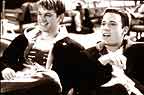
Really angelic...
|
 |
Lacks bite
By
Michael Bronski
Dogma
Kevin Smith, director; with Matt Damon, Ben Affelck, Linda Fiorentino; George Carlin
How to order
A wacky, on-the-surface blasphemous examination of Catholicism,
Dogma, the new Kevin Smith movie, seems primed to attract attention. Even positive reviews
admit, in a jocular way, that the film pushes the edges. On top of that, it features the ever popular Matt Damon and Ben Affleck. But while a raucous, dicey, irreligious
movie would be nice to have as an antidote to Christmas, this is not it.
Structurally, Dogma is what's known in the trade as a quest narrative. Here it is up to Bethany (Linda Fiorentino), a nearly lapsed Catholic who works in an
abortion clinic, to stop two renegade angels from proving God a liar, and consequently not infallible, and therefore wiping out the totality of existence. Not content with a
simple religious parable, Smith fills the film with a series of arcane theological arguments and riffs that prove unworkable as narrative, untrustworthy as theology,
and unbearable as comedy.
The plot in brief: Loki (Matt Damon) was the avenging angel to be slaughtered in God's name for the millennium, but eons ago he was talked out of this game
by his best angelic friend Bartleby (Ben Affleck) and told the Deity that he was through. Not taking disobedience well, God banishes them for eternity to semi-human
form and life in Wisconsin. Now, Cardinal Glick (George Carlin)-- heading a PR campaign called "Catholic Wow" aimed at making Catholicism fun-- is re-consecrating
a church and offering plenary indulgences (in Vatican parlance, the complete elimination of all punishment due to committed sins) to anyone who attends. Loki
and Bartleby are determined to be there and get clean. But the problem is that if they are sin-less and get into heaven, then God would have been wrong, and if God is
wrong than he doesn't exist, and neither does the world. It would be haggling to point out that angels are not human and lack the same concept of free will given to man,
and therefore are incapable of committing sins that can be forgiven in the same way, but hey.
Anyway, Bethany who is the last surviving relative of Christ (don't ask) has to stop the angels from entering the church. Meanwhile, Azrael (Jason Lee) an
important demon, is doing his best to foil Bethany and bring about the end of existence. Oh, and God can't help with this because he likes to play Skee-ball on the Jersey
Shore and while in human form has been savagely attacked by teenaged hockey playing punks-- really devils-- and is trapped in human form on a respirator.
Smith displayed an anarchic insouciance in his early films.
Clerks and Mallrats ridiculed pop and youth culture in ways sprightly, on-target, and disarming.
The more mainstream Chasing Amy-- about a woman who identifies as a lesbian deciding to have an affair with a man-- lacked this spontaneity, but came blessed with
one-liners and insight about human relationships. This was apparent not only in Amy's change in the object of her desires, but in her male lover's Holden's (Ben
Affleck) relationship with his best friend Banky Edwards (Jason Lee). Banky becomes highly jealous of Amy and Holden's relationship and suggests that he and Holden
become lovers as well. While Smith ultimately backed off from this plot-line, it was nervy.
Unfortunately, none of these qualities are conspicuous in
Dogma. The plot is clunky, the exposition slow, and for all its hipper-than-thou cockiness, the film
is essentially devout. Despite the idiocies of organized religion, it seems to say, both God and man are good and noble. (Yawn.)
But what is most curious about
Dogma is Smith's insistence on uncovering and then displacing the gay subtext. The potential, and quite real, homosexual
relationship between Holden and Banky in Chasing
Amy was an interesting breakthrough. But here, while homosexuality keeps raising its head, it is also always absent.
The relationship between Bartleby and Loki is referenced as being gay-- by the couple and others. Despite the fact that angels have no genitals, Affleck and Damon end
up looking queer. This is not so different from their relationship in
Good Will Hunting-- another film rife with nonexplicit homoeroticism. Along with Loki and
Bartleby, Jay and Silent Bob also look like lovers. This was true in
Mallrats, Clerks, and Chasing
Amy as well, but it is made more forthright here.
While Smith always treats homosexuality as a perfectly reasonable life-option, the insistence on repressed homosexuality here is wearing. It is a curious subtext--
or at this point in Smith's small but growing oeuvre-- simply
text.
It is too bad that Dogma isn't funnier and more daring. Its potentially quirky take on religion is curtailed by its obsession
with theological detail and an essentially sentimental view of God. This devotional fixation ultimately makes the film as mainstream as
Touched by an Angel or It's a Wonderful
Life. And in this context, Dogma's obsession with repressed homosexuality makes perfect sense. In
the end, Kevin Smith, like all bad alter boys, still believes: in God, the virgin birth, the epic battle between good and evil, miracles, angels,
and that the best homosexual is a repressed homosexual.
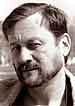
| Author Profile: Michael Bronski |
|
Michael Bronski is the author of
Culture Clash: The Making of Gay
Sensibility and The Pleasure
Principle: Sex, Backlash, and the
Struggle for Gay Freedom. He writes
frequently on sex, books, movies, and
culture, and lives in Cambridge,
Massachusetts. |
| Email: |
mabronski@aol.com |
You are not logged in.
No comments yet, but
click here to be the first to comment on this
Movie Review!
|