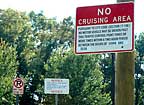
Orwell in Knoxville-- signs at Fort Dickerson Park (photo: Paul Balo)
|
 |
Police pose as cruisers to entrap over a dozen men in Knoxville park
By
Jim D'Entremont
Tyson Park, a 27-acre recreation area near the University of Tennessee at Knoxville, has 14 tennis courts, eight picnic shelters, and, according to the city's website, a playground
featuring "the largest children's play structure in Knoxville." As of December 22nd, the park could also claim the largest wave of arrests for "indecent exposure" in recent Tennessee history.
Acting as decoys, undercover officers arrested 15 men, aged 26 to 62, at least some of whom had been circling a section of Tyson Park in their cars. Fourteen were charged with
indecent exposure; one was simply cited for disorderly conduct. A few received additional misdemeanor charges, including simple possession of a controlled substance, possession of drug
paraphernalia, and resisting arrest.
"
[The park is] for families, for children and everything, and for folks to come and enjoy," police Lieutenant Mark Presley told a reporter from Knoxville's WVLT-TV, "but when you're
having illicit sexual activity like these folks are doing, in a public park, it takes away the family."
The sting operation lasted from 3:30 to 11:30pm on one of the darkest days of winter, soon after the solstice. No information is available on how many arrests, if any, were made in
waning daylight during the first hour of the stakeout, but it seems certain that nearly all of the arrests took place after sunset. A follow-up operation in Tyson Park snared four more men on the
night of January 9th.
The stings presumably served to protect law-abiding, child-raising Knoxville families who enjoy spending dark winter evenings picnicking and playing wholesome games of Whiffle ball in
an urban park until nearly midnight.
In Tennessee, a person charged with indecent exposure-- whatever that means-- incurs a fine of up to $500 for the first two offenses. A third conviction can mean a $1500 fine, a
one-year jail sentence, and a place on the Tennessee Sex Offender Registry.
All of the recent arrestees appear to have paid fines and quietly retreated into personal lives that may in some cases have suffered incalculable damage. None has come forward to
contest the charges or to describe the specifics of the police entrapment scheme. Beth Maples-Bays and Todd Cramer, co-presidents of Knoxville's LGBTQ Leadership Council, say they have
been unable to determine who these men are.
Following the pre-Christmas arrests, right-wing talk show host Hallerin Hilton Hill invited a Knoxville police spokesman to read the names of the 15 miscreants on WNOX radio. WVLT-TV
also reported the men's names; as of this writing, the list remains available at the station's website.
"When I heard the names read on the air," says Todd Cramer, "I thought of specific locations where I know my straight friends go and park and make out with their girlfriends, and you
never hear of busts in places like that."
"It's a double standard rooted in homophobia," adds Paul Balo, who heads the Knoxville chapter of PFLAG.
"Knoxville police say the homosexual population has been gathering here, using [Tyson Park] as their meeting point," leered WVLT's Whitney Daniels, instantly offending much of
the homosexual population of Greater Knoxville. Maples-Bays, a lesbian journalist who edits the online
Equality Herald, telephoned Daniels in protest. The wording of the online version of
the story was soon changed from "the homosexual population" to "this group."
According to Knoxville law enforcement officials, gay men have been finding new places to cruise whenever a venue has been, in effect, shut down. Though Tyson Park rates a mention
at Cruising forSex.com, the park's reputation is new. Other city parks, such as West Hills and Fort Dickerson, have long been recognized as places where men could meet for sex.
Knoxville has an extensive park system, portions of which are interconnected by a wooded, paved bike path.
The West Hills and Fort Dickerson parks have witnessed a number of arrests in recent years. In March 2006, there were busts at Sharp's Ridge Park and an adjacent video store. Last
June, in Blount County, police zeroed in on a TVA boat ramp used for "homosexual solicitation." (Local police invent their own gay-related terminology and lore; there is no gay liaison to
the Knoxville Police Department.)
"I've never experienced, nor heard of anyone experiencing, any kind of harassment or unwanted advances in these places," says Cramer, a mountain bike enthusiast who often cycles
through local parks.
In Knoxville, men trying to make sexual connections often cruise by car, looping over the same terrain, or sitting in parked vehicles waiting to be approached. In some locations, the city
has installed "No Cruising" signs warning drivers not to pass a certain point three times within two hours. Other signs notify park visitors of police surveillance, stating, "Those here for an
illegal purpose are subject to arrest." In Knoxville parks, a police officer's imputation of intent can be grounds for arrest.
"I'm concerned," says Paul Balo, "that gay men are afraid to go to the park at all, for any reason, because they think they're being targeted."
Not out of the woods
With a population of 174,000, Knoxville is Tennessee's third largest city. Greater Knoxville has five gay bars, a few mixed venues, and no bathhouses or sex clubs.
"In my experience," Balo observes, "cruising areas attract a lot of closeted people, some of them married, people who have nowhere to go. There aren't any bathhouses; they can't
bring people home. They don't go to clubs, because they're afraid of being recognized. They wind up in cruising areas. People talk about cruising as if the sex were right out in the open, but
usually you have to go back in the woods to see places where people have been."
Some gay Tennesseans view men who seek out cruising areas less sympathetically. "These guys are an embarrassment to the gay community if they are even gay at all," a Nashville
man complained via e-mail after the first Tyson Park raid. "People with families or gay couples can't even enjoy the parks because of these trolls making it unsafe for everyone."
The correspondent contended that men who pursue public sex contribute to the demonization of the gay community, and encourage gay-bashing incidents. His sentiments are shared
by many across the state.
Although Tennessee's gay leadership leans toward the Democratic Party, "a lot of gay people in Tennessee are conservative," notes Beth Maples-Bays. "They're even Christian
Republicans. We're on the front lines of the culture wars here."
Cohesive, sometimes vibrant gay communities exist in its major cities, especially Nashville, but Tennessee is not a notably gay-friendly state. It's the sort of state where, in 2002, a
man named Chad Allen Conyers could be sentenced to four years' probation for strangling Joseph Camber, a Pride co-chair he met at Carousel, a Knoxville gay bar.
The slap-on-the-wrist sentence resulted from an agreement reducing a second-degree murder charge to involuntary homicide in exchange for a guilty plea. The DA's office explained
that because Camber was gay, it was impossible to determine whether his killing was premeditated murder; the result of provoked, sudden rage on the part of someone he had importuned
for sex; or the product of kinky gay sex gone awry. There was no public outcry.
Within the past year, various less lethal anti-gay incidents have occurred across Tennessee, including a cross-burning on one gay couple's lawn. In the Volunteer State, homophobia is an
old, indigenous presence. The city of Memphis is the home of Love in Action, the ex-gay therapy program sponsored by the fundamentalist Christian movement Exodus International.
Christian Right organizations converged on Tennessee last year to insure the success of a ballot initiative banning gay marriage; in November 2006, 81 percent of Tennessee's voters approved
a constitutional amendment strictly defining matrimony as heterosexual.
Todd Cramer points out that the December Tyson Park arrests were followed by a police sweep of local female prostitutes' straight, often upper-middle-class johns. The latter
operation received unsensational press coverage, engendered no public shaming, and precipitated no pro-family media rants.
"It's unjust," he says, "that local authorities would make a public example of ordinary gay men, and not men who are perhaps more affluent, more 'respectable,' and-- above all--
more straight."
In June 2006, two young gay men, Conrad Honicker and Jake Green, were verbally harassed for holding hands as they passed through Tyson Park. As one observer of the local gay
scene points out, the pair were "children of wealthy, highly educated residents of Sequoyah Hills, the most upscale part of town." The incident inspired members of a Unitarian gay youth
program to organize a "Holding Hands" rally in Knoxville on July 25th, culminating in a procession down Gay Street of a dozen hand-holding same-sex couples, protectively encircled by gay
men, lesbians, friends, and relatives.
Men arrested in the Knoxville park system, usually through constitutionally questionable entrapment schemes, receive no such support.
You are not logged in.
No comments yet, but
click here to be the first to comment on this
News Slant!
|