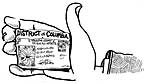
US-mandated anus scans celebrate citizens' individuality
By
Bill Andriette
What guarantees that you are uniquely you? Your fingerprints? Your retina's spider-web of tiny capillaries? A certain unmistakable bouquet?
Until now, security experts say, the problem has proven intractable.
Fingerprints are readily burned away with acid or abraded with sandpaper. Mirrored shades, headshaking, or even use of Viagra can throw-off retinal scanners. And a snack of pickled garlic can mask body odor.
A reliable method of quickly identifying people has eluded governments. Now researchers at the US defense contractor Brown & Root, working with a number of accredited Ph.D.'s, say they've gotten to the bottom of
the problem.
What best expresses an individual's identity? The unique pattern of ridges, wrinkles, stretch-marks, and striations surrounding the anal sphincter, say Carnegie Mellon scientists. "Your anus," says Dr. Harry Heindlick, chair of
the school's Department of Biometrics, "is actually more unique than your face."
Expressive like an eye
To a rimmer, the anus might seem simply a moist, redolent spot of puckered pink that at first resists, and then-- in-a-skip-of-a-heartbeat-- poignantly surrenders to wordless lingual interrogation.
Yet over a lifetime-- through the daily push and pull of work and play-- each anus retains a unique "signature," invisible to the naked eye or probing tongue, but readily discernible to the wily AnuScan.
That's the name for the latest generation of anal imaging devices. In a split-second, the Anu-Scan's blu-ray burst yields a data-rich 11-dimensional anal map-- a holographic image that the scanner's built-in
floating-point processor autoconverts to 666-digit binary code. That's the unique identifier that's known as the Anal Sphincter Signature, or ASS.
If you've lived in or visited the US since the mid-1990s-- or even just traveled in Homeland airspace-- chances are that the feds already have your ASS.
The first crude anus scanners were introduced in public toilets at San Francisco's Union Station in 1993, under the aegis of a secret NSA program. The devices appeared under the guise of sonar "hands-free" flush sensors
that took the place of toilet handles. Within a few years, the devices were ubiquitous in washrooms from highway rest-stops to commercial airliners.
"The early models worked so poorly at their stated task it's amazing their real purpose was never suspected," says Colin Dowell, a former NSA staffer now with defense conglomerate Brown & Root.
As the government collects more and more information about its citizens, the need for anal scanning, say DHS officials, only increases.
"The main problem with the government coagulating all this data about people-- thousands of video captures every day, transcripts of every e-mail and web-browse, recordings of every phone call, entries on every
purchase, every car trip-- is that these rich databanks themselves become a terribly-tempting treasure-trove for predators and terrorists," says Michael Chertoff, chief of the Department of Homeland Security. "By indexing all records
to a suspect's ASS-- to which only The Department has access-- Americans can enjoy greater protection and transparency."
An individual's AnuScan and his or her corresponding ASS, will become "the identifier of choice," Chertoff predicts.
Starting in 2009, children under age 27 will have the option of substituting their "AnusGram" for a face-shot on passports and driver's licenses. And by 2011, when nongovernmental photo
graphy of persons under that age
will be completely banned, the AnusGram will be mandatory in place of faces for class and graduation photos.
Culturally sensitive
Chertoff hails the AnuScan as not just technological marvel, but a feat of social engineering.
"Muslims are crazy about depilation and personal cleanliness," the director notes, adding the he expects most terrorists will be fooled by the in-toilet spy cams, mistaking them for the in-bowl bidets common throughout the
Arab world's undemocratic, often toiletpaperless wastes.
Don't think progress will stop with the Anu-Scans, security experts tell The Guide. The scanners, Chertoff says, are only one node in a "increasingly perfect web" of surveillance and protection.
By Veterans' Day 2009, federal legislation signed by President Bush last summer requires public-toilet managers to install ankle-level sensors that will remotely "read" drivers licenses and other RFID-chipped official
documents in users' pockets. The idea is to insure that the documents' Anal Sphincter Signatures corresponds to that of the bathroom-goer. In case of discrepancies, special software will auto-lock stall doors, trapping suspects in the
act until they can be captured or killed.
As well, Chertoff and US Attorney General Alberto Gonzales have announced they want to "slam the toilet seat" on the loophole that has allowed criminals simply to flush evidence away. The feds also want to catch users
of drugs that can't be detected simply by urine tests. So starting on Memorial Day , 2010, TSA's "Securing the Homeland against Internal Threats" (SHIT) initiative comes online. Under SHIT, municipal sewage authorities
are mandated to identify and memorialize the contents of every flush for a period of ten years.
| Author Profile: Bill Andriette |
| Bill Andriette is features editor of
The Guide |
| Email: |
theguide@guidemag.com |
You are not logged in.
No comments yet, but
click here to be the first to comment on this
Queer n There!
|





 Advertise with us
Subscriptions
Contact us
Site map
Translate
Advertise with us
Subscriptions
Contact us
Site map
Translate