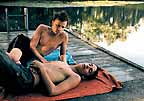
In the forecast: Summer Storm
|
 |
and its discontents
By
Michael Bronski
June has been the customary month of gay film festivals, which means that queer-themed films often find theatrical release soon after, filling independent theaters with gay summer
fare. With changing distribution patterns, it's now more common for these gay films to open in your neighborhood independent cinemas in later summer or the fall. Indeed, this August will
see the release of three popular festival favorites: Olivier Ducastel and Jacques Martineau's
Cote d'Azur, (the insinuating French title of which is
Crustacés et Coquillages-- "shellfish
and shells"), a funny French comedy of the sexual mishaps of a family vacation. Then there's Marco Kreuzpaintner's
Summer Storm (Summerstrum), a sweet coming-out story of
German boys at a crew meet. And also Tennyson Bardwell's
Dorian Blues, an American indie about a gay youth dealing with his parents and first love.
But what about the summer à
la Hollywood? Well, there's Batman
Begins (and Batman is always of the lavender hue) and
Charlie and the Chocolate Factory (with
the invariably queer Johnny Depp), but not much else.
There are, however, two great films newly available on DVD that are quite-- in each their own way-- queer, smart, and very intriguing.
The first is The Promise
(La Promesa), a psychological thriller written and directed by Héctor Carré, and starring the ever-fabulous Carmen Maura. Most US audiences will know
Maura from the many films she made with Pedro Almodovar, in particular their great 1988
Women on the Verge of a Nervous Breakdown. Here Maura is also having a breakdown, but she's
way beyond the "verge" part. She plays Gregoria, an abused wife of deeply religious devotions who lives on the outskirts of complete psychosis and who wishes that her name was Celia.
After a violent departure from home, she ends up in a small Galician village where she becomes the nanny for Daniel (Santiago Barón), an eight-year-old-boy who's trapped between Dorita
(Ana Fernández)-- his doting, if ineffectual, mother-- and Leandro (Evaristo Calvo), his brutish, domineering father. The family is very wealthy and Celia-- Georgia took a new name for her new
life-- becomes as doggedly devoted to her young charge as she is to her obsessive dedication to her saints and religious beliefs. Unfortunately, for everyone in the house with her, she
believes that Daniel is in constant danger and it is up to her to protect him. Oh no!
The jacket copy on the case for The
Promise describes it as a cross between Women on the Verge and Henry James's novella
The Turn of the Screw. And this is true, but the film
also has hints of Bette Davis's wonderfully scary gothic
1965 The Nanny as well as Otto Preminger's 1965
Bunny Lake is Missing. What makes all these stories so compelling-- and, at heart
so queer, is-- their adult character's obsession with the innocence of children and how children become the displaced site of all adult anxieties about sex and danger, fear and hope. While
The Innocence and The Nanny have a clear sexual subtext-- the former throbs with it, the latter only hints at it--
The Promise satisfies merely by gently and eloquently suggesting it. Daniel
is, for Celia, the sexual innocence that she had lost and been so wounded by. Her desire to "save" him-- and nothing stops her in her pursuit of this-- is, at heart, a desire to save herself
and her sexual purity. No doubt this is a tension that resonates with Spanish audiences-- who are still grappling with distresses and palpable nervousness between secularism and state
religion even three decades after the death of General Franco.
The Promise is a great, unnerving film and available in local video stores, gay book stores, or on line at www.tlareleasing.com.
Birth, is also new to DVD and certainly not, in the economic sense, an alternative film. Directed by Jonathan Glazer (who made the 2002
Sexy Beast ) and staring Nicole Kidman, it
was released in later October 2004, and has just appeared in video stores. Written by Jean-Claude Carrière and Milo Addica
Birth is a profoundly creepy, moving and ultimately chilling
examination of how love, grief, and sex can be inextricably intertwined as to become indistinguishable, or at least totally confusing.
Ghost buster
The plot is deceptively simple: Anna (Kidman) is a widow of ten years who is just now remarrying. Her fiancee Joseph (Danny Huston) has spent years waiting for her to overcome
her grief at losing Sean, her husband. Suddenly, during a family dinner, a ten-year-old Sean (Cameron Bright) shows up at her door announcing that he is Sean. Not only is his name Sean, but
that he is the reincarnation of her late husband. This absurd idea is brushed away by everyone, except that Sean is so determined and persistent and Anna is so unnerved and still
grief-stricken that she begins to believe him and ultimately even considers running off with him to marry him when he is older. Clearly her fiancee and her family think this is a poor idea.
What might have been a not very interesting psychological or horror thriller-- depending on whether or not you believe in reincarnation-- becomes instead a moody meditation on
how grief can change our lives and how loves (and the prospect of sex) can heal that. But what is most striking about
Birth-- and unsettling to many views, some of whom complained
bitterly about the sexual implications of the film-- is that Anna and the young Sean obviously have a sexual attraction to one another. At one point they bathe together and at another Anna
kisses Sean in a manner more conjugal than parental. While this hint at child-love-- well, they may really be husband and wife-- flipped out some critics and viewers it is the logical extension of
what has been implied in films such as The Promise, The
Innocence, and The Nanny. If the sexual gothic-- a genre with deep roots in western culture and psyche-- is about anything it is
the crossing, the violation, of sexual taboos. What could be more taboo, or make more sense, than a grown woman wanting to have a physical relationship with her husband: even if he is
now reincarnated as a boy? Birth, although marketed as an upscale Hollywood thriller, is really closer to a European art film-- think of Max Orphals's
The Earrings of Madam D or Francois Ozon's
Under the Sand-- and deserving of that attention and respect.
| Author Profile: Michael Bronski |

|
Michael Bronski is the author of
Culture Clash: The Making of Gay
Sensibility and The Pleasure
Principle: Sex, Backlash, and the
Struggle for Gay Freedom. He writes
frequently on sex, books, movies, and
culture, and lives in Cambridge,
Massachusetts. |
| Email: |
mabronski@aol.com |
You are not logged in.
No comments yet, but
click here to be the first to comment on this
Movie Review!
|