Fag and hag
in Get Real
|
 |
Hollywood kicks sand in our faces
By
Michael Bronski
Notting Hill
With Julia Roberts, Hugh Grant.
How to order
Get Real
Simon Shore, director; written by Patrick Wilde; with Ben Silverstone, Brad Gorton
How to order
Summer romance hasn't changed much since Sandra Dee and Troy Donahue found pain and redemption in
A Summer Place and Frankie and Annette found sand
and existential pain in Beach Blanket Bingo. Of course, gay people have never had summer romance, thanks to the homophobia of Hollywood. Unless you figure that
Troy (he of the bleach-blond hair and the sublimely dimpled eyes) and Frankie (he of the shaven chest, trimmed underarm hair, and two of the perkiest nipples to grace
the silver screen of the 1960s) made those film gayer than geese and twice as honky.
But this summer brings two ultimate summer-romance films-- one gay, one straight-- each a reflection of the times in which we live and love.
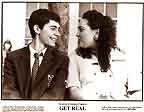
Get Real is, on its face, charming. Written by Patrick Wilde and directed by Simon Shore, it tells the story of British high-school puppy-love among the
middle-classes in post-Thatcherite England. Steven Carter (Ben Silverstone) is a cute, smart gay teen who knows he's gay and knows what he wants. Which is romance. But
he is more than happy to go meeting men in the public loo until the real things comes along. Which it does in the stall to his right when he meets John Dixon
(Brad Gorton), the most popular boy and star athlete in his school. Whose fantasy is this anyway?
After some early negotiation-- John is far more closeted than Steven and feels he risks losing social stature with his violently homophobic team-mates-- the
boys become lovers. Steven's easier acceptance of his sexuality-- he has the requisite chubby female best friend to whom he tells everything-- makes John's closetedness
a problem. (At one point the film implies that John is uncomfortable because Steven acts so "gay," but this seems odd, given that all the boys in the film, being
British, look like poofs). Anyway the romance continues until the pressure becomes too much and John is forced to publicly reject Steven, who comes out at graduation after
he writes an anonymous editorial-- titled "Get Real"-- in the school paper. At film's end, the love between the boys remains but the romance is over when John cannot
live up to the commitment and demands of being openly gay.
Screenwriter Patrick White said that he wanted to write a more realistic version of
Beautiful Thing, which was subtitled A Fairy
Tale. But for all its good intentions, Get
Real is no piece of gritty British realism ą
la Look Back in Anger. Given how flighty the film can be, it's more like
Look Back in Angora. While it does deal
with serious topics, Get Real feels in the end insignificantly lightweight even for summer romance.
Compare this to the Hollywood summer lovefest
Notting Hill-- a film so craftily engineered and finely tuned that almost none of its obvious creaky mechanics
are visible. The most beautiful woman and most famous movie star in the world, Anna Scott (Julia Roberts in the Julia Roberts part) accidentally meets a shy, cute, and
oh-so-special bookseller, William Thacker (Hugh Grant in the Hugh Grant role) in London's charming Notting Hill. (The film presents this actually very
multicultural neighborhood as a white English urban village.) It is almost love-at-first-sight, but Anna has the demands of her career and, for publicity reasons, cannot be seen with
a commoner. She keeps putting up barriers, and after a series of near hits and misses, the charming couple moves to Hollywood to live happily ever after.
While both films are only a few rungs above sentimental dross,
Notting Hill's women's point of view actually makes it a more original film.
Get Real suggests that even the geek can get the famous athlete, but of course, he isn't really worth the effort. We go to movies to be entertained and leave our own lives behind. The
cultural myth is that our own lives are humdrum, which is why we need the fantasy of the silver screen. But the reality is that we all live probably more interesting lives
than those of our intently scrutinized screen projections. Steven and John, Anna and William are less projected wish-fulfillment than dumbed-down,
single-minded caricatures in contemporary morality plays. What moral do they teach us? That real life-- with all its fascinating, intriguing complications-- sucks. The pat
coming-out narrative of Get Real hardly homes in on the real complications of that process;
Notting Hill's it's-lonely-at-the-top-poor-little-rich-girl plot is silly,
Hollywood nonsense. Both films make our allegedly impoverished, empty lives seem like emotional psychological Gardens of Eden.
We live in a more knowing time than audiences did in the 1950s where Sandra and Troy, Frankie and Annette actually
did represent an-- almost unobtainable-- ideal of elusive fantasy; nowadays, the ideal of silver-screen summer romance feels empty and
silly. Welcome to the end of the 90s.
| Author Profile: Michael Bronski |

|
Michael Bronski is the author of
Culture Clash: The Making of Gay
Sensibility and The Pleasure
Principle: Sex, Backlash, and the
Struggle for Gay Freedom. He writes
frequently on sex, books, movies, and
culture, and lives in Cambridge,
Massachusetts. |
| Email: |
mabronski@aol.com |
You are not logged in.
No comments yet, but
click here to be the first to comment on this
Movie Review!
|