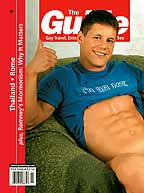
February 2008 Cover
|
 |
By
Michael Bronski
Rufus Does Judy at Carnegie Hall
Starring Rufus Wainwright.
How to order
I'm Not There
Directed by Todd Haynes
Starring Cate Blanchett, Ben Whishaw, Christian Bale, Richard Gere, Marcus Carl Franklin.
How to order
Transvestism
-- and other forms of gender impersonation -- are staples of
almost all cultures, from the "aboriginal" to European
civilization's alleged heights. In the past, Americans have shown
an enthusiasm for transvestism that today might seem startling.
Female impressionist
(as he was sometimes called) Julian Eltinge was so famous in the
early 20th century that a Broadway theater was named after him. But
cross-dressing has been too associated with gay culture for most
audiences to feel completely comfortable with it. This changed a bit
in the late 1970s and early 1980s with films such as La
Cage aux Folles
(1978) and Tootsie
(1982). John Waters's diva Divine attracted mass media attention
for his role as Edna Turnblad, the harassed yet understanding
housewife and mother in the 1988 Hairspray.
(Divine's impact was such that even John Travolta won plaudits for
his scrupulous drag performance in that film's 2007 musical remake
-- in which he does Divine one better and seems to be playing Edna
Turnblad as an aging Gina Lollobrigida.) The re-popularization of
transgender owes much to the enormous gay (and feminist) influence
on popular culture and a resulting radicalizing of our ideas of
gender roles.
C
onsider Todd
Haynes's extraordinary I'm Not There, a faux documentary of the
life of Bob Dylan. Haynes's subject isn't gay, but his film
would be impossible without gay culture. More explicitly
gender-bendingly gay is Rufus Wainwright's new CD Rufus Does Judy
at Carnegie Hall -- a meticulous recreation of Garland's noted
1961 Carnegie Hall concert and a fabulous reclamation and
reaffirmation of gay culture and history.
Hipster songster
There's always been
something slightly queer about Bob Dylan -- not at all gay, but
queer. His Jewish roots were entwined with American traditions of
political folk-singing and lyric poetry. But he was more William
Blake and Dylan Thomas (from whom he took his last name, when he
dropped "Zimmerman") than the more overtly homoerotic Walt
Whitman or Hart Crane. Still, this mixed legacy positioned Dylan in
the early 1960s as an alternative to both the traditional and
emerging hard-rock musicians. Dylan's visceral social protests as
well as his emotional connections to the feminine -- his bruised
and hurt emotional self in "Positively Fourth Street" or his
empathetic, even feminist sentiments in "Sad Eyed Lady of the
Lowlands" and "Just Like a Woman" -- constructed a unique,
decidedly unmasculine public persona.
Todd Haynes's I'm
Not There takes a postmodern approach to Dylan and fractures the
singer (whose career is itself marked by radical disjunctures) into
a kaleidoscope of characters including a 14-year-old
African-American blues singer named Woody Guthrie (Marcus Carl
Franklin), a reformed Western outlaw named Billy the Kid (Richard
Gere), a 1960s coffeehouse singer named Jack Rollins (Christian
Bale), Arthur Rimbaud (Ben Whishaw), an actor named Robbie Clark
(Heath Ledger), and a late-1960s folk star named Jude Quinn (Cate
Blanchett).
Haynes's film is
a cavalcade of impressions, inside jokes, cultural ruminations,
parodies, insightful asides, and sheer-out audacity. Haynes has the
pop-cultural depth to pull it off. He turned Karen and Richard
Carpenter into Barbie dolls in his 1987 Superstar, explored
David Bowie's ambiguous glam-rock sexuality in The Velvet
Goldmine, and in his 2002 Far From Heaven explicated the
homoerotic subtext of Rock Hudson's performance in Douglas Sirk's
1955 All that Heaven Allows. As written by Haynes and Oren
Moverman, I'm Not There takes its title literally,
displacing or confusing Dylan's persona and career so that the
artist is figuratively deconstructed and reassembled before our
eyes.
The film's
standout performance is Cate Blanchett's, in her cross-dressed
appearance as Jude Quinn. She portrays a mid-to-late '60s Dylan --
all diffident and sort-of-angry, with black jackets and close
cropped unruly hair, and still reeling from the affair with Edie
Sedgewick. Blanchett really gets at the heart of Dylan's
androgynous character. She has always been a mercurial actor; her
regal, tough queen in Elizabeth (1998) and its 2007 sequel
are perfect counterparts to her epicene Katharine Hepburn in Martin
Scorsese's The Aviator (2004). Whatever the gender
gyrations her roles demand, Blanchett finds an emotional center.
It's not that she feminizes Dylan (that would have been
disastrous) but rather she locates him in the specificity of the
radical gender changes of the 1960s.
The genius of
Blanchett's performance -- and Haynes's savvy in casting her
here -- lies in her ability to limn the psychic territory that
Dylan explored at this time. Dylan's popularity followed in part
from his threatening/non-threatening, aggressive/passive,
angry/healing sets of dichotomized messages -- all located in his
gender presentation. Susan Sontag, in her 1964 essay "Notes on
Camp," contended that "camp" promotes the epicene star (she is
writing here about Greta Garbo and Marlene Dietrich) and contradicts
gender-specificity as a ploy to make the star desirable to both
sexes. That's in part the case here, but Blanchett's performance
feels as far from camp as you can get, yet still is one of the most
startling investigations into androgynous creativity you'll ever
see.
Girly boy Garland
It would be tempting to
write that Rufus Wainwright's theatrical impersonation of Judy
Garland's Carnegie Hall concert was -- or verged on -- camp. But
this is not the case. Wainwright -- the son of singers Loudon
Wainwright III and Kate McGarrigle -- released his debut album,
Rufus Wainwright, in 1998, a compelling mixture of songs
that, while tinged with traditional folk touches, were a mixture of
early Joni Mitchell and Leonard Cohen and a kinder, gentler
middle-period Bob Dylan. Wainwright, openly gay, became
extraordinarily popular with both gay and straight audiences and has
built a devoted audience over the past decade. He has not been
afraid to experiment with musical forms.
But nothing here
has prepared us for the sheer audacity of Rufus Does Judy at
Carnegie Hall. Here Rufus not just recreates Garland's 1961
performance -- the high-water mark of her career, a landmark of
American popular music, and a milestone of 20th-century gay pop
culture -- but elevates it to iconic status. Vocally, Wainwright
shines. While he does not have Garland's purity of tone or
technical abilities (hell, even Garland didn't have that many tics
in concert) he certainly has her emotional depth and psychic
commitment to the material. There are even times -- in "Puttin'
on the Ritz" and "You Go to My Head" -- where Wainwright
actually seems to have a better grasp of the lyrics and timing than
Garland.
Wainwright has
mined and reclaimed an important aspect of mid-20th century gay
culture, reinventing it for contemporary audiences. During one of
the numbers a gay audience-member shouts out "This is our
heritage!" -- and he is right. But it is short-sighted to think
that Wainwright is claiming Garland only as a gay icon. What he's
doing in Rufus Does Judy is exposing the complicated,
complexly interwoven, interconnections between American popular
culture and gay culture and celebrating them from a queer
perspective. Wainwright literally turns Garland into a gay man; when
he sings "The Man Who Got Away" or "San Francisco," he is
isn't so much "queering" the songs as uncovering the gay
context and content. His "transvestism" here -- much like
Blanchett's in I'm Not There -- is less a disguise or
masquerade as an exposure of the obvious. Now that's queer.
| Author Profile: Michael Bronski |
|
Michael Bronski is the author of
Culture Clash: The Making of Gay
Sensibility and The Pleasure
Principle: Sex, Backlash, and the
Struggle for Gay Freedom. He writes
frequently on sex, books, movies, and
culture, and lives in Cambridge,
Massachusetts. |
| Email: |
mabronski@aol.com |
You are not logged in.
No comments yet, but
click here to be the first to comment on this
Movie Review!
|