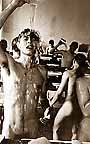
Taking a dousing
|
 |
By
Roger Moody
I, Will McBride
photos by Will
McBride
Könemann
How to order
By anyone's aesthetic yardstick, I, Will McBride
(Könemann, cloth, 460 pages,
$39.95) is among the most engaging and satisfying presentations by an observant, observing, and observed photographer of the past 50 years.
Even those already know McBride's previous compilations will scarcely be prepared for the richness of imagery, the sensuality of form, the palpable yearning for loving human encounters, which shines from almost every page. As
well as Show Me! (reproduced intact), here are many pages from
Tween magazine with which McBride was associated, his human sex project (so mulch more interesting and important than the human genome) and gorgeous plates
from "Siddhartha," perhaps his finest work.
Comparisons faith the oeuvre of Robert Doisneau and Henri Cartier-Bresson, two artists apotheosized by contemporary publishers and galleries, are not out of place. All three are masters of a technique which
communicates immediacy and integrity of subject, even when constructing the photographic moment carefully in advance.
Bruce Weber's Branded Youth came out at almost the same time as the McBride. Superficially the two books are of a piece, dwelling much of the time on the sensual appeal of young males from childhood to their
early twenties. Both abstract contemporary headlines, mix in poetry, other texts and drawings, and are built around a chronology (though Weber's is far less well-defined). But Weber's portraits suffer badly by comparison
with McBride's, rendering him little more than a competent studio technician. Take, for example, Weber's portrayal of Frank Rempe, which follows Allen Ginsberg's poem "Many Loves." This shows a heavily-muscled jock
Y-fronts pulled around his legs peering indifferently at his limp cock which forms a kind of (unintentional?) counterpoint to the well-padded pipes behind him. Then look at McBride's depiction of Uli, his favorite model, photographed
at around 18 years, drying himself in a courtyard. Where Weber's model is static bored and formulaic McBride's is dynamic and self-possessed. It marks the crucial difference between a competent voyeur and a revolutionary lover.
Many photographers fall he love with their subjects; far too few can frame or mediate their passions in a manner that is both subtle subversive and yet approachable.
Jack Schofield a British critic, writes that McBride "photographed skin faith a terrifying intensity." In some respects this was right, but it's not a very considered response. It also comes dangerously close to mirroring
the opinions of those whole tried to damn McBride as a "pornographer." McBride is sometimes bemused by "too much flesh and Jabez." But his genius lies in capturing so many sensual moments leaving us to judge both their
origins and outcome. There are photographs that can snatch away your breath. Page 390 for example depicts a boy sitting atop an empty train eyes downcast fists clenched shorted legs askew, youthful potential and virility
unmistakably present. Where is he going? From whence has he come? Who is accompanying him? What does he seek? As in the greatest art, posing the questions call be far more important than any facile answers.
You are not logged in.
|