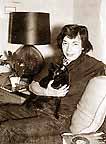
Patricia Highsmith
|
 |
The story of a queer 1950s romance
By
Michael Bronski
Highsmith: A Romance of the 1950s
by Marijane Meaker
Cleis Press
How to order
The 1960s get all the attention. But the decade before, which lay the groundwork for all that ferment, is once again coming into its own.
The newest manifestation of this is Marijane Meaker's memoir,
Highsmith: A Romance of the 1950s. Meaker is a noted author several times over. Currently, as M.E. Kerr she is a prize-winning "young adult" writer. In the 1950s, as Vin Packer, she was a successful pulp
writer, turning out over 20 smart, topical novels on shocking topics such as homosexuality, race relations, and mental illness. As Ann Aldrich, she wrote and edited several pulp collections of lesbian fiction and non-fiction.
Highsmith: A Romance of the 1950s is her account of a
passionate, confusing, and difficult affair with novelist Patricia Highsmith, who was already famous at the time for her 1949 novel
Strangers on a Train and The Talented Mr.
Ripley in 1955. She also penned The Price of
Salt, published in 1952, one of the few lesbian novels to appear in cloth
during this period. Both Highsmith and Meaker went onto greater-- and quite different-- fame as their careers progressed over the next five decades, and this memoir beautifully sets the stage.
Meaker is a fine writer and Highsmith
is terrific. Not very much happens-- Meaker and Highsmith meet, fall in love, encounter the usual problems of relationships, move in together and then break up-- but the book is filled with enough intimate glimpses into
Highsmith's relatively undocumented life and a cavalcade of details about the queer 1950s, that it will immediately become a classic.
The story bares a passing resemblance to a Highsmith novel, in which ordinary elements of everyday day life suddenly, and ominously take a turn for the worse as we realize that one of the main characters is a little unhinged-- in this case it is Highsmith herself.
Meaker and Highsmith met at a party in Manhattan, where they both lived, in the late 1950s. Although Meaker had a partner, and Highsmith spent a good deal of time in Europe, the attraction was so great that they almost immediately became lovers. While there are
many good elements in the relationship-- Meaker tells us the sex was great and that they deeply loved one another-- problems promptly began. Meaker was jealous of her partner's old lovers and crushes, and Highsmith drank a lot. But as their life together progresses--
they decide to leave Manhattan and move in together in Bucks County, Pennsylvania, even though Meaker has qualms and Highsmith would rather be in Europe-- tensions build. Highsmith's drinking increases and she keeps playing with her switchblade at the oddest moments.
As Meaker is attempting to break out of her paperback-and-pulp career into the more prestigious cloth editions, Highsmith is running into problems with her own editors. While there is not a great deal of professional tension between the two women, it is true that
Highsmith is fairly intolerant of Meaker's close friendships with a wide-range of interesting people. And it's Highsmith's crude, overt racism and anti-Semitism that forms the backbone of discontent between the lovers. By the end of the memoir, as in a Highsmith novel, it is all of these
little details that build to an unhappy climax.
If Highsmith: A Romance of the
1950s is fascinating for these personal stories, its tapestry of lesbian life at the time is as captivating. Rather than portraying a completely repressed society in the 1950s, Meaker paints a portrait of vibrant gay and lesbian culture that
thrives in spite of the obvious societal homophobia. Describing the interiors and music in lesbian bars and restaurants-- one can hear Frances Faye singing "Drunk with Love"-- Meaker gives us unique glimpses into 1950s gay nightlife.
At the end of the book, in the 1980s, almost 30 years after their acrimonious breakup, Meaker and Highsmith meet again. Highsmith is famous world-wide for her novels, and Meaker herself has gained a literary reputation. Unfortunately, Highsmith has become more
Highsmith than ever before. While the reunion has some sweet, if tense, moments, it ends badly. But this isn't a sad ending-- simply the one that we had been seeing build for the last 200 pages.
Highsmith is required reading if you are interested in the 1950s, queer history, Patricia Highsmith, or gay literature. If there's a problem with the book it's that Meaker only gives us a tantalizing glance of a small part of what is a vibrant era in which incredible artists
created a queer culture that formed the basis for how we live now.
| Author Profile: Michael Bronski |

|
Michael Bronski is the author of
Culture Clash: The Making of Gay
Sensibility and The Pleasure
Principle: Sex, Backlash, and the
Struggle for Gay Freedom. He writes
frequently on sex, books, movies, and
culture, and lives in Cambridge,
Massachusetts. |
| Email: |
mabronski@aol.com |
You are not logged in.
No comments yet, but
click here to be the first to comment on this
Book Review!
|