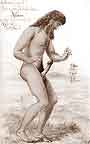
Adam's first stand (it was hard in the Garden of Eden)
|
 |
Before there were cameras, sex preoccupied artists. But the erotica from long ago has all
but faded in waves of fresh porn. Erotica
Universalis sets the situation right.
By
Bill Andriette
Erotica Universalis
by Gilles Néret
Taschen
How to order
Sex points to the future-- sperm to be shot, urges to be doused, children to be born. While romance novels
often unfold in a misty past, the present is pornography's usual tense. It's the same with any appetite: people
want food and drink today-- who cares about the great hungers and deep thirsts sated in, say, the 18th century?
Last year's erotica isn't much different than this week's-- cock, cunt, breasts, and balls haven't changed much in
the past hundred millennia. But pornographers keep pushing out new product as if they were in the business of
eggs and milk-- goods consumed in their enjoyment rather than left uncorroded from use like gold coins.
Even though it gathers dust in closets instead of going sour, pornography is perishable as dairy. Those who make it
a dietary staple want assurance that the milkman's always on his
way, with fresh cream even if packed in old
bottles. Driving the milk truck the wrong direction down sexuality's one-way highway-to-the-future takes pluck and
risks crashing head-on into the incest taboo-- who
regards their parents as hot?
So readers everywhere can be thankful that historian Gilles Néret has undertaken an Oedipal odyssey
on our behalf, by poking around our parents' attics-- our parents' parents', and so on-- straight back to before
5000 BC. The fruit of his searches through archives, museums, and private libraries is
Erotica Universalis, a compendium of erotic art that was enjoyed and forgotten, or sparked scandal and was censored from the start.
Either way, it's material that's been largely hidden from view-- drowned not least by the torrent of fresh erotica
unleashed by the easing of censorship. In 1994, the German-based publisher Taschen put out volume 1,
which covered everything from prehistoric rock drawings to 1950s bondage pornography. Volume 2 has just
been released.
The two volumes comprise together more than 1500 pages and weigh in at around seven pounds.
Still, they don't exhaust their subject any more than they likely will their readers. Néret roams and wanders,
touching down here and there, like a good dinner-party conversationalist. Despite the "Universalis," the
touchdowns occur nowhere outside the Western world, and indeed, stray toward the lands of
amour and Schmutz.
Still, Erotica Universalis makes for a roomy house with unlikely bedfellows. Rembrandt shows up,
with the affectionate line-sketches of his wife pissing and fucking that scandalized Amsterdam's Calvinist
burghers, who helped insure the artist died in penury. But sexually explicit paintings of a youth and maiden fondling
and fucking, executed in rococo perfection, won only favor for François Boucher, whose
Grivoiserie (saucy story) was painted at royal command for the dauphin, the future Louis XVI, to show him the ways of love. "The
family that lays together stays together"-- an apt motto for any number of regal households-- is the caption of a
cartoon by the American Robert Crumb that shows a warmhearted domestic romp, with everyone from gramps to
little sister getting in on the action. There are Picasso's playful odes to lovemaking that are simply drawn and
exquisite.
But the most frequently represented artist is anonymous. To him (one assumes) goes credit for
the sweetly homoerotic scenes from a 1920s edition of Verlaine's
Oeuvres Libres, and a Victorian lithograph
of Adam "on the occasion of his First Cockstand." Even attributed works, such as an extended series of
lighthearted "sadomasochism à la
française" by a "Carlo," published in the interwar years, was actually by no one
in particular. Néret shows how Carlo's works, "with good-natured sadomasochistic practices that never
went further than spanking or whipping" morphed into postwar American SM picture books in which the
women turned "from slave into dominatrix, the mistress of other women but also of the man who in turn has become
her slave"-- a transformation Néret takes to highlight "the vast difference between the Latins and the
Anglo-Saxons." In volume 1 of the series, the more encyclopedic, there are of course vase images from the
cock-crazy Greeks. But knowing them today, who would guess
that perhaps an ancient Saxon ancestor of today's
reserved English inscribed on a Dorset hillside the Cerne Giant, a fearsome naked man, wielding both club and an
erection?
Each of these entries, and dozens of others, is pithily introduced by Néret, a critic and author of
numerous books, including 1000 Dessous: A History of
Lingerie. The Guide interviewed Néret, who replied in
writing from his home in Paris.
What's your take on the connection between sex and art?
Human beings are "half-angel, half-beast," said the French philosopher Blaise Pascal. Life is
dominated by two tendencies: the attraction to spirituality-- call it God or matters unknown-- and to sexuality. A real
work of art must contain both God and Sex. If not, it is just decorative.
From Erotica Universalis, a reader
might conclude God concerns Himself only with Europe
and America. What about the erotic art of, say, Africa, India, China,
Japan?
To represent only Western art is a personal choice and may be part of the success of my erotica
books. Living in Japan as a young journalist for four years in the late 50s and having a Japanese first wife made
me learn that Oriental and Western eroticism have nothing to do with each other. Authors who mix both make
a great mistake, have understood nothing. Maybe I will make in the future a special
Erotica Orientalis to show and explain the big differences. For example, the red point at the neck of a girl or a gay boy in kimono is
very erotic for a Japanese because it means, by the red color, that she is a prostitute.
In Oriental art, to represent things as they are is considered ill-bred. That is why all Japanese
erotic wood-block prints show the males with big pricks, when it is well known that Japanese have just toothpicks.
By the logic of Oriental art, this convention is both correct and, of course, flattering! There are many varied
such codings of feeling according whether the art is Chinese, Korean, or Indian which is why it cannot be mixed
with Western art, which is more direct and primitive.
With only two volumes of Erotica
Universalis I am far from having explored the whole sex
planet. Maybe an Erotica Homosexualis and an
Erotica Orientalis will follow, and then...
The artists in your book are almost all male. Do you think men more than women gain
pleasure from sex on the canvas?
Nobody is 100 percent male or female, but fortunately a mixture of both. Only the percentage differs;
for example, I think I am around 60 percent masculine and 40 percent feminine, which helps me appreciate
all kinds of sex.
That said, it's overwhelmingly the case that since the beginning of humanity cultural creators
artists, poets, mathematicians-- are male, not female. Why? For a very simple and evident reason: females create
life, make babies, and this is the greatest creation. It is because of frustration, because they cannot bear babies,
that da Vinci painted "La Joconde" and Einstein invented the atomic bomb. As for females who create
something different from a baby, let us say that they have a high masculine quotient. For men, art and poetry are
just ejaculations. See Pollock!
Among contemporary art, were there images you wanted to republish but the artists or
executors of their estates refused permission?
Heirs and executors-- in particular widows-- are generally a headache for editors, and a catastrophe
to the artist. The dirty works of their dead husband make them mad because they represent generally their
younger mistresses and models. For example Madame Marquet destroyed many erotic drawings, and it is impossible
to get permission to reproduce in a sex book the paintings of prostitutes by Rouault. Fujita's dirty drawings
are well known, but the family refuses to recognize them. That's why I was careful to publish their attribution with
a question mark!
"The 18th century," you write, "not only displayed a healthy enjoyment of sophisticated
eroticism, but also, with the exception of de Sade, a keen sense of humor." The humor seems downplayed in
20th century erotica. Tetsu's cartoon pornography, with their middle-aged bourgeous Parisians, has a
sardonic edge, and there's humor in Robert Crumb, too, but mixed with bitterness at the women who obsess
him. Maybe it's just America, but it seems hard now to sexually joke and play.
It's true that sex is now less associated with humor than profit and money-- just one more
manifestation of the Americanization of world culture, the spread of consumer society. It's hard to think of another time
when the level of art or literature has been so low. But a swimmer has to kick the bottom of the swimming pool to
rise again, and I remain optimistic for the future. Sex without humor is dull.
If you ask the man on the street about beautiful sexual imagery, chances are he'll think of a
photo or some scene from film-- not a painting or drawing. How do you think film and photography
have changed the representation of sex in art?
When I see the first silent films, or some of the first nude photos featuring Theda Bara, the
sex-goddess of Hollywood or Mae West in her corset, or the delicious erotic photos of Wilhelm von Gloeden or
Guglielmo Plüschow, I think that everything was invented one century ago, and that in both fields, it is impossible to
do better. On the contrary, the evolution of technics is so rapid that photographers and filmmakers seem to
be losing their breath trying to run after it. Is color better than black-and-white? Is it enough to invest a lot
of money and make special effects to make a masterpiece? Eroticism must be suggested, not made too obvious
or colossal. Even the mistakes of the past used to provoke emotions. Too much actual realistic perfection leaves me
cold.
In search of freedom, 19th century European homosexuals often headed south. Oscar
Wilde, André Gide, von Gloeden, and Plüschow made pilgrimages or settled in the Mediterranean. Yet the
erotic imagery in these two volumes, from the Renaissance on, comes from the North. Is there an inverse
relation, perhaps, between doing sex and turning it into pictures?
As a Latin myself, I've always noticed the big difference in sex between the
Mediterranean and the North, between the Latins and the Anglo-Saxons. Latins are brought up under the skirts of their mothers,
and brothers and sisters play freely when young. Therefore they are not afraid of sex they've known about it
since they were born. Anglo-Saxons males and females, said one humorist, are brought up separately and meet only
to play golf. That is what for me makes the big difference. The Clinton-Lewinsky scandal was considered a
joke here in France, and would have only aided the popularity of the president here or in Italy! The more
French leaders have love affairs, the more we like them. French people, male or female, are proud to have at their
head a good lover. They appreciate it, know about it, but don't talk about it, because we respect private life and
love freedom. Another humorist said that America was the only country that went directly from primitivism to
decadence without having passed through civilization.
You note how American servicemen, taking home from the Europe the lighthearted French
SM magazines available during the war, recreated a harder-edged, less playful sadomasochism,
represented in American pornography in the 50s.
Being afraid of females, Northern males turned, for example, to the strip-tease-- which is, by the way,
a French invention, dating from Toulouse-Lautrec and 1900 when women were fully dressed without any
naked part showing. They've turned to an eroticism that I would call "look but don't touch," like the
plastic-wrapped meat sold in supermarkets. This style is typical of the American pop art from Tom Wesselman and Larry
Rivers to John de Andrea and Andy Warhol. And it is not only the Americans Eneg, Stan, or Glen who changed
the charming and harmless spanking girls of Carlo into dominatrix monsters, but also Robert Crumb, the king
of American underground comics, who shows a consumer society dominated by vulture-women.
It's fashionable nowadays to claim rupture between modern Western sexuality and that in
other cultures or long ago. Sex in ancient Greece, for example, is claimed to have been simply about fucking
an inferior-- boy or woman-- and nothing to do with desire or love. In compiling these volumes, which
did you experience more-- continuities or breaks, the shock of difference or of recognition?
Sex has always been a good companion for me, a natural thing without problem, just pleasure.
Therefore it's not the evolution of sex through the ages that interests me, but, on the contrary, its permanence. I'm
more interested in the ways all human beings are sex maniacs like me, and in particular, those with a more
developed libido like artists or poets. Fashions and taboos change, but sex remains the same. It is one of the two legs
on which we walk, the other being God. Death, for the ancient Greeks, was "hollow and dark like woman."
Even with pubic hair removed, the baleful grotto between a woman's legs led directly to Hades. That is the
reason why there flourished in ancient Greece the "sacred love" between men that Plato describes. The reasons
have changed today, but fortunately the "sacred love" flourishes better than ever, and it is a very good thing.
Except maybe for Buddhist chanting, art is often considered as self-expression, as projection of
the will, as a will to power. Which is what Schopenhauer and Freud argued that sex was. So is a focus
on erotic art a redundancy, because all art almost is ultimately about eros?
I don't care about what Buddhism, Schopenhauer, or Freud said about art and sex. They had their
personal sexual problems-- in particular Schopenhauer with his mother. I prefer Adolf Loos, who said in
Ornamentation and Crime that "all art is erotic." The first ornament, the cross, was erotic: an act of penetration
between two people, one horizontal, one vertical. Leonard da Vinci said that the first painting was the shadow on a
wall of a standing man. This is what I think, too, and I would like to add that the man was erect, and that the work
of art is the result of a generous ejaculation. For there is only one real antidote to the anguish engendered in
humanity by its awareness of inevitable death: erotic joy.
| Author Profile: Bill Andriette |
| Bill Andriette is features editor of
The Guide |
| Email: |
theguide@guidemag.com |
You are not logged in.
No comments yet, but
click here to be the first to comment on this
Magazine Article!
|