|
 |
By
Michael Bronski
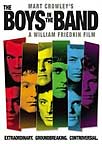
The Boys in the Band
Directed bby William Friedkin
Starring: Frederick Combs, Leonard Frey
How to order
As with almost all cultural products, gay films tend to fade away as soon as something new and shiny comes along. Who thinks these days about such classics in the genre as Saturday Night at the Baths, A Very Natural Thing, Something for Everyone, or even Myra Breckenridge? Each of these films was -- in its own way -- important for gay men in the 1970s. They defined new boundaries of what was permissible, and how far gay culture had infiltrated the mainstream. They marked a new tolerance that was both heady and exhilarating as well as curiously limiting in their reliance on stereotypes to bring gay life into the public eye.
Of all these films, perhaps the most important was William Friedkin's 1970 hit Boys in the Band, based on (actually pretty much a line-for-line adaptation of) Mart Crowley's 1968 off-Broadway hit. Although the film was both a great success and developed a cult following, it was only released on VHS a bit more than a decade ago and has long been out of print, with copies fetching upwards of $120. So it's cause for celebration that on November 11, the DVD version is finally set to be released.
If for no other reason, Boys in the Band is noteworthy as a cinematic representation of the original off-Broadway play. Friedkin used all of the original cast and preserves almost all of the original dialogue. The one-set play -- all of the action happens in the Upper East Side apartment of Michael, the main character -- has been opened a bit, but essentially the film replicates an important part of gay theater history.
The plot is simple. Michael (Kenneth Nelson) is giving a birthday party for Harold (Leonard Frey) and has invited some mutual friends: the chronically underachieving Donald (Frederick Combs), the flighty interior decorator Emory (Cliff Gorman), the sweet Bernard (Reuben Greene) and the lovers school-teacher Hank (Laurence Luckinbill) and fashion photographer Larry (Keith Prentice). At the last moment Michael's old school chum from Georgetown, Alan McCarthy (Peter White), shows up. While Alan is married, Michael has a lurking suspicion that he's actually homosexual and has just left his wife. As the birthday progresses it turns from bitchy humor to vicious Who's Afraid of Virginia Woolf party games. As the guests get drunker, dark secrets and raw emotions tumble out.
Crowley's writing is best when he can throw great one-liners across the screen. Harold to Emory, who has just been punched in the face by Alan: "Your lips are blue. You look like you've been rimming a snowman." Michael bitching to Donald: "Sunt. That's French, with a cedilla." The dialogue in Boys in the Band is not only often funny, but a perfect time capsule of 1960s gay culture and its queen-talk. When was the last time you heard anyone make jokes about Alice Faye, New Moon, Victor Mature, Bette Davis, Rosemary DeCamp, Billy De Wolf and a whole host of other high camp figures?
Many critics have argued that Crowley is better at the comic run-up than the serious conclusion: the emotionally maiming party-games at the end make some, but not enough, dramatic sense. Still, the drama itself holds together. The hurt and the pain of these men's lives is palpable, and clearly linked to the prevailing homophobia. But the play is, at heart, a celebration of their survival. Even Michael, the most wounded of them, manages to get through the evening -- only after trying to destroy everyone else -- and makes his peace with his life.
In the 1970s and '80s, gay critics often protested that the play was a one-sided, even homophobic, take on gay life. Yet 40 years on, it's clear the play has a generous heart and truly understands its characters. In the past eight years I've taught Boys in the Band in a variety of classes. Nearly all the students respond with real feeling to the film, especially gay ones. These latter love it and relate, despite all that's happened in the years since. They don't get the more arcane theater references or the campy asides, and they certainly don't live in a world that promotes these exact stereotypes, but they do understand how the homophobia of today affects their lives -- in ways not always all that different from the boys in the band.
It's great this seminal work is now on disc. If you've already seen it you'll enjoy it all over again, and if you haven't you're in for a tremendous treat.
| Author Profile: Michael Bronski |

|
Michael Bronski is the author of
Culture Clash: The Making of Gay
Sensibility and The Pleasure
Principle: Sex, Backlash, and the
Struggle for Gay Freedom. He writes
frequently on sex, books, movies, and
culture, and lives in Cambridge,
Massachusetts. |
| Email: |
mabronski@aol.com |
You are not logged in.
No comments yet, but
click here to be the first to comment on this
Movie Review!
|