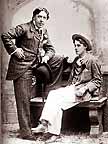
Wilde & Douglas
|
 |
And first modern sex criminal
By
Michael Bronski
The Real Trial of Oscar Wilde
instruction & commentary by
Merlin Holland
Fourth Estate
Press
How to order
The cult of Oscar Wilde has grown, without hesitation, since the man himself instigated it in the late 1880s. Wit, poet, editor, essayist, novelist, playwright, sodomite, and martyr-- Wilde provided modern culture not only an endless stream of great one-liners, but his life is a prism through which is viewed contemporary culture, literature, mores, and morals.
The basic facts are well known. The leading British playwright and literary man of his day, Wilde was condemned in 1895 after several trials to two years of hard labor for consensual sodomy-- "crimes against nature"-- as described in the Labouchere Amendment in the
Criminal Law Amendment Act. While guilty of the charges, the real crime Wilde committed was being too public with his sex life, too flamboyant, cavorting with boys outside his class, and refusing to understand that a proper English gentleman could get away with most anything if it
were kept properly quiet.
The details of Wilde's trial have become almost as famous as his writings and wit. While carrying on a fairly public affair with Lord Alfred Douglas (in addition to other dalliances) he was accused of being a "somdomite"
[sic] by Douglas's crazy father, the Marquess
of Queensberry. Wilde brought Queensberry to trial for libel-- a dumb move considering he was guilty under the law-- and lost. He himself was then twice brought to trial by the state for the crimes implied by Queensberry. The second time, Wilde was convicted.
The trial transcripts have long been around. Over the past 50 years they've been widely available in an edition edited by historian H. Montgomery Hyde. These were pieced together from a variety of sources (first-hand accounts, court papers, recollections) and have
become codified, accepted text. But now Merlin Holland (the grandson of Wilde) has pieced together a far more complete transcript of what occurred in the courtroom. Although there's not a lot of new material here, the Holland transcripts are a breakthrough for Wilde scholarship as
they bring us closer to the inner workings of both Wilde's case-- as well as the context that surrounded sex crimes in late-Victorian England. You could say that the texts here supply the prototype of how contemporary sex-crime cases are prosecuted. Oscar Wilde was such a
precursor to a modern sensibility, that, alas, even his trial was a glimpse into the future.
Reading through The Real Trial of Oscar
Wilde is sobering. Not only do Merlin Holland's excellent introduction and notes explicate the background lucidly, but it's impossible to read through these 280 pages of examination, cross-examination, and rebuttal without an awful
sense of how small a distance we've come in the past century.
While some of the trial centered on Wilde's relationship with several younger men, as well as Lord Alfred Douglas, a great deal of the courtroom drama here concerns seemingly ancillary matters: Wilde's views of art, his interpretations of poems, the inner meanings behind
his own writings. Edward Carson-- a brilliant lawyer and old classmate of Wilde's who was defending Queensberry-- knew exactly what he was doing. As the cross-examination banter between Carson and Wilde runs on like some witty courtroom drama going insane, we see the
gradual accumulation of incriminating details that were needed not so much to convict Wilde of the actual crimes (fairly easy) but to damn Wilde for his very being.
For O. Wilde to M. Jackson
Wilde's trial set the pattern replayed in the case of Leopold and Loeb in 1924-- or, for that matter, the seemingly never-ending legal wranglings of Michael Jackson. Like Wilde's, these high-profile cases rely on the prosecution mapping out a complex cultural terrain in
which the nuances of experience and sexual expression get flattened out and distorted into evidence. The prosecution seeks conviction not just on the facts (strong or weak), but also by placing the alleged crimes in a context that makes them look usually far more dangerous than
they could possibly have been. This is true, of course, not only of noted sex cases, but run-of-the-mill ones-- the countless "sexual psychopath" prosecutions in the 1950s against men engaged in various kinds of homosexual activity, and the countless cases today
involving intergenerational sex. Reading these transcripts one can see the correspondences to accounts in books such as John Gerassi's classic 1966
The Boys of Boisie: Furor, Vice and Folly in an American
City or Neil Miller's Sex Crime Panic: A Journey to the Paranoid Heart of the 1950s.
The Real Trials of Oscar Wilde is a gripping read. It's as dramatic and startling as it was in actual life in 1895. What makes it more powerful-- and frightening-- now is that we can see, through the experience of the last century, that this was only the beginning of sex
witch-hunts in the modern age.
| Author Profile: Michael Bronski |
|
Michael Bronski is the author of
Culture Clash: The Making of Gay
Sensibility and The Pleasure
Principle: Sex, Backlash, and the
Struggle for Gay Freedom. He writes
frequently on sex, books, movies, and
culture, and lives in Cambridge,
Massachusetts. |
| Email: |
mabronski@aol.com |
You are not logged in.
|