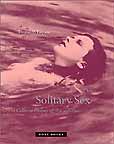
Solo swimmer
|
 |
And money spinning
By
Michael Bronski
Solitary Sex: A Cultural History of Masturbation
Thomas W. Laqueur
Zone Books
How to order
Quick: name two things that will weaken your eyesight and make you go blind. Got it? Now, how are they connected? First a little background.
Thomas Laqueur's social history of masturbation is a fascinating study of how the world's most popular solitary (well, sometimes not-that-solitary) sport was pretty much invented
and conceptualized during the Enlightenment. It's not that people didn't jerk-off before 1712-- which is Laqueur's date of its inception with the publication of a pamphlet entitled "Onania"--
but he argues that the concept of masturbation (a word first used in a British medical book 1708) as a social illness gained enormous currency during this period because of a variety of
other social changes-- specifically the advent of the novel and the stock market.
Make sense? Well actually, if you got the answer to the question in the first paragraph, you'd already know about the novel-- after all: jerking-off and excessive reading are the two
things that will hurt your eyes.
If this all sounds confusing, Laqueur makes it perfectly clear. The 18th century was a time of enormous social change. The Enlightenment had struggled to create a world in
which individuals were urged to rethink their relationship to society-- think of Rousseau's idea of the "social contract"-- and the problem with onanism was that it was solitary, it was done in
private, it was not based in actual sexual contact with others. As Laqueur explains-- masturbation "was motivated not by a real object of desire but by a phantasm, and threatened to overwhelm
the most protean and potentially creative of the mind's facilities-- the imagination."
Secondly, masturbation was private, anti-sexual, and when it was done with others "it was social in all the wrong ways: servants taught it to children, wicked older boys taught it
to younger ones..." And while "sex was naturally
done with someone, solitary sex was not." But most critically: "unlike other appetites, the urge to masturbate could be neither stated
or moderated... done alone, driven by the mind's own creations, it was a primal, irremediable, and seductively, even additively, easy transgression." And of course they were partly right; I
mean, what's more fun than an easy transgression?
The price of self-abuse
One of Laqueur's most intriguing ideas is that masturbation panic was a manifestation of the enormous social anxiety around credit and the stock market which changed how money
and capital was viewed in the early 18th century. Credit, its critics claimed, "destroyed real value" and "depended on something that was not really there." It was, in their eyes, a terrible
danger to society because it relied on the phantasm of real material wealth. These fears were often realized when large companies of investors failed and the charade of "stock" was exposed.
In the same way, the isolated and narcissistic fantasies of the masturbator could only lead to personal and societal ruin.
Nowhere do Laqueur's claims sound more correct than when he connects the fear of masturbation to the disdain that was heaped on the novel when it first appeared in the
1700s. Victorian critic Alfred Austin claimed that "the vice of reading" novels was the result of doing it for its own sake. And indeed, novels, which were "made up," were seen as morally
harmful because they did not produce anything useful. (When Samuel Richardson published
Pamela in 1740 he subtitled it "Virtue Rewarded" to let moralists know that it was an instructive
book, not simply frivolous.) In the same way, masturbation was suspect for not "reproducing" anything. If the reader's imagination were to be loosed through silly novels that produced
only emotions or "thrills"-- imagine the dangers from deploying imagination in a solely and specifically sexual manner.
The threat of masturbation exceeds the specifically sexual-- there is no chance of spreading disease, no unwanted pregnancies, no social "ills," such as the promotion of prostitution
or the creation of a despised underclass of trafficked women. The threat of masturbation was that it used the imagination, unleashing it and giving full reign to the masturbator to think or
feel whatever he or she would like. It was-- and is-- license to an unlimited sexual inventiveness that could go anywhere and do anything. It also removed the masturbator-- for the time it
is happening-- from the responsibilities of "responsible" heterosexuality: like novel-reading it exits only for itself, and nothing more. Even today-- when mainstream culture has burdened
sex with every possible disaster (from fear of AIDS, limited access to contraception, and wild paranoid trepidations of Internet abuse) masturbation is still greeted with alarm and misgivings.
That is why the "master of my own domain" episode on Seinfeld was so funny, or why the hair-gel joke in
Something About Mary provoked such spirited, but nervous, laughter. Even though
we've come a long way from 1712, the reasons why masturbation caused social and moral panic are still with us today.
| Author Profile: Michael Bronski |

|
Michael Bronski is the author of
Culture Clash: The Making of Gay
Sensibility and The Pleasure
Principle: Sex, Backlash, and the
Struggle for Gay Freedom. He writes
frequently on sex, books, movies, and
culture, and lives in Cambridge,
Massachusetts. |
| Email: |
mabronski@aol.com |
You are not logged in.
No comments yet, but
click here to be the first to comment on this
Book Review!
|