|
 |
How commie pinkos from LA remade the world
By
Michael Bronski
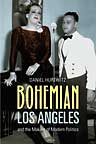
Bohemian Los Angeles and the Making of Modern Politics
by Daniel Hurewitz
University of California Press
How to order
Los Angeles steers America. Sure, there's Hollywood, which has certainly produced the best and the worst of US popular culture, and its attendant satellite worlds of celebrity and glitterati. But there's politics as well--
from George Murphy's successful run for the Senate in 1964, to Ronald Reagan's rise to the US presidency, to Arnold Schwarzenegger's current reign as California governor. While there are many books detailing (and often
decrying) the implications of the city's hold on American culture, few have considered its role in inventing a national
sensibility. Bohemian Los Angeles and the Making of Modern
Politics isn't exactly a book of gay history. But then
there's no such thing. Nor such a thing as "women's history" or "black history," for that matter-- the more useful ideal being to weave minority pasts into an inclusive, seamless historical vision.
"Identities have rarely been the exclusive product of like-minded individuals," Hurewitz argues, but rather are negotiated by "groups of individuals who engaged in similar activities and sought to adopt a shared
self-definition." He couldn't have picked a better setting to prove his point. Hurewitz, who teaches history at Hunter College, focuses on the bohemian community of Edendale, which rests on the edge of LA's Silver Lake Reservoir. From
this eclectic conglomerate of artists, queens, radicals, and free-spirits emerged-- despite official disapproval and frequent legal harassment-- some of he most exciting political changes of the century. Not just the formation of
the Mattachine Society-- the first viable American group pushing homosexuality as a political identity-- but a range of other movements.
Fey fighters
Hurewitz hangs this story on a brilliant pair of dichotomized personalities: Julian Eltinge and Harry Hay. While Hay is known today as Mattachine's founder, Eltinge is almost entirely forgotten. But in the 1920s and 30s,
Eltinge was the most famous female impersonator in the US, with a Broadway theater named after him. He later slipped into oblivion and alcoholism. By the early 1940s he was targeted by police in their anti-homosexual and
anti-gender-deviant attacks on LA's queer community.
Eltinge and Hay were both public figures who performed their sexuality and gender in ways that broke the day's prescribed social and political codes. Pairing them together is the perfect conceit for Hurewitz to bring out
an amazing amount of well-researched, often newly-discovered material. Besides bringing Eltinge back to the public eye (his famous career is hardly remembered today), Hurewitz maps out the differences and the similarities
of the queer-as-artist and queer-as-political thinker. Invoking this (false) split-- both Eltinge and Hay were more similar than unlike-- Hurewitz elaborates his thesis that identity emerges from community.
Princes of prints
Eltinge was connected to Edendale's arts scene in the 1930s, which was centered around the counter-cultural Rounce and Coffin Club-- a group of men interested in fine printing, but also a gathering place that fostered
deep and lasting friendships. It was the nucleus and spark to other groups: artistic ones, and also various manifestations of Communist-based community organizing-- especially, in the postwar years, around race. Looking at
the impact of these groups of interconnected artists, homosexuals, and communists, Hurewitz argues that art and politics were the perfect mix in "constructing an organized community."
Hurewitz is illuminating when he examines the very public fairy and pansy subcultures of the 1930s and 40s, and how they provoked a right-wing backlash that quickly intersected with hysteria about a communist menace
as well. (The theme is explored as well in George Chauncy's classic
Gay New York: Gender, Urban Culture, and the Makings of the Gay Male World,
1890-1940.)
Community formation can also lead to sustained attacks. But attacks can promote resistance, and Hurewitz brings his tale to a satisfying conclusion with a discussion of Harry Hay-- homosexual and communist-- forming
the Mattachine Society, the first enduring US gay rights group, in 1950.
This is a terrific book: smart, well written, and always engaging. As well as unearthing great new information on Julian Eltinge, Hurewitz makes an important time and place come to life.
| Author Profile: Michael Bronski |
|
Michael Bronski is the author of
Culture Clash: The Making of Gay
Sensibility and The Pleasure
Principle: Sex, Backlash, and the
Struggle for Gay Freedom. He writes
frequently on sex, books, movies, and
culture, and lives in Cambridge,
Massachusetts. |
| Email: |
mabronski@aol.com |
You are not logged in.
No comments yet, but
click here to be the first to comment on this
Book Review!
|