More ‘rub-me-harder’ than ‘rub-out’
|
 |
Curtains rise & fall in gay history
By
Mitzel
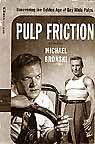
My Guide colleague, Michael Bronski, has just had his latest book published. It is:
Pulp Friction: Uncovering The Golden Age of Gay Male
Pulps. This is not Bronski's first book. He is also
the author of Culture Clash: The Making Of Gay
Sensibility and The Pleasure Principle: Sex, Backlash, And The Struggle For Gay
Freedom. He has also edited numerous anthologies. He has
been an activist, writer, and critic for over three decades.
Pulp Friction is an anthology of selections from books by and/or for the gay male market or those interested in themes involving gay men. Not all the selection are from what we
would regard as "pulps." Bronski has a general introduction to the book, explaining his purpose and his method and some of the delights he uncovered about his writers and their work in
the serendipity of his search and each thematic section is accompanied by an introduction. Some of the writers he has included are: Lonnie Coleman, James Barr, Jay Little, James
Colton (Joseph Hansen), Richard Amory and Ben Travis.
In his introduction, Bronski begins with the assumption, generally-held, that the events in New York in 1969 we now label as "Stonewall" marked a cultural turning point,
demarcating an ending of one age and the beginning of another. It was the manifestation of a revolution that had largely already taken place. Since Stonewall, the perception was that this break was
a chasm; on one side the Homophile Era and on the other Gay Liberation. Bronski makes the point that the literature of gay life was dynamic, not as uncommon as thought today, and, in
most cases, largely forgotten. Rather than accepting the chasm hypothesis, Bronski sees continuity, that the gay writings of the immediate post-war period were a new development and
they were instrumental in reflecting, and to some extent, creating the change in consciousness which led to the liberationist phase.
I think it's always a good idea to keep the plot points of this development in mind, as well as the cultural milieu in which we locate them. I think the greatest event which led to the
rise of gay communities and our cultural artifacts was World War Two. Because of the massive mobilization, men and women who otherwise might never have left their small communities
found themselves in cities, overseas, often living in sprawling same-sex environments. Gore Vidal once noted that he thought he could identity the gay guys at the Army base at which he
served in the Aleutian Islands (an experience later worked into his first novel,
Williwaw); they were the ones who signed out the novels of Frederic Prokosch from the well-stocked base library!
Talk of your profiling! After demobilization, some men and women did not go back to their home towns. The next plot point is publication of what came to be called The Kinsey Report. In
the 1950s,in spite of a Cold War climate, there were progressive developments. There was the work of Evelyn Hooker. There was the founding of The Mattachine Society. There was the
ONE magazine Supreme Court decision. Physique and bodybuilding magazines began publication. The legal culture was turning more tolerant; the Warren Court's decisions often had wide
societal impact: deseging schools and public facilities, right to read, privacy, one-person-one-vote, and on. The trend in some states to modernize their legal codes (I think Illinois was first) led
them to drop anti-sodomy laws as well as other archaic provisions in their codes which interfered with personal freedoms. And the mass market paperback book came into its splendid glory
lurid covers and all. Many of the books Bronski excerpts appeared in mass market editions and, even as I was growing up, I recall mass markets on a store rack with covers indicating gay
male content. Lurid lesbian-themed covers were, I suspect, aimed at the straight male audience. For most of this time, homosexual behavior was "a problem," clearly a social one but also a
medical one still a mental illness according the APA, which we can now read as a controlling device. Some writing was gay fantasy, some about successful adjustment and productive lives the
kind of people Evelyn Hooker would have interviewed for her study. The obligatory suicide ending for the gay man got retired. The evil queen theme stayed and why not with J. Edgar
Hoover still running the FBI? Christopher Isherwood's 1964 novel,
A Single Man, created a stir. It was a cri de coeur against the narrow-mindedness and stultifying rule of what Isherwood named
the Heterosexual Dictatorship. (A friend of mine taught
Single Man in a Gay Lit. course not many years ago. A generation of gay students born long after Stonewall simply couldn't
understand the narrator's condition. One asked: "If he's so unhappy, why doesn't he just go and see his therapist?") I believe it was in 1965 that we saw the first homophile march (at the White
House, protesting employment discrimination activist Frank Kameny had been fired from his government job because of his sexual orientation). In the last part of the Sixties, gay life garnered
some cultural cachet about it the counterculture, the anti-war movement, the general culture of dissent and refusal, the Warhol menagerie, the ambiguous sexuality of many pop stars,
essentially the unraveling of the Heterosexual Dictatorship, at least at its edges. By June of 1969, the curtain was ready to rise. According to author James McCourt, it was a speed-addled drag
quean in the Stonewall Inn who got ticked off seeing the cops come in for their shakedown, and the quean strolled up to one cop, threw a drink in his face and screamed: "This one's for Judy!"
A new play? Or just a new act?
You are not logged in.
No comments yet, but
click here to be the first to comment on this
Common Sense!
|