By
Bill Andriette
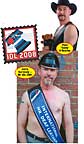
International Deaf Leather 2008 hit Philadelphia July 17 to 19, just as we were going to press. With roots going back to 1989, the annual IDL is the
major celebration of leather and kink among deaf gay folk. IDL 2008 producer Paul "Teddy" O' Rourke holds the 2004 title (not to mention Mr. Detroit Eagle 2001
and Mr. Michigan leather 2002), and is in the thick of it all.
The Guide chats with O'Rourke about matters deaf and leather.
International Deaf Leather titleholders represent the leather community and also deaf GLBTers. How did you balance
those roles?
I
grew up in Massachusetts, where sign language was discouraged and many Deaf were taught to "speak" and "lipread." I attended regular public schools,
with extra supports, such as speech therapy. It helped me to speak well. I was in Boy Scouts and became the first Deaf Eagle Scout in New England. It's all helped
me be a role model and bridge the gap between Deaf and hearing, inside the leather tribe and beyond.
I gravitated to leather because it fulfilled a void of brotherhood. It's about standing up for ideals, sharing common experiences -- like Scouting.
It's been a battle to get people in the mainstream to think of disabled folks as sexual let alone kinky...
Or even attractive. IDL wants to break those stereotypes. Deaf people can be erotic and in control of their sexual image and role, just like anyone else.
It's sad that some still get turned off when they meet the person whom they were initially attracted to from chatting online and learn he or she is Deaf. I've
had the experience at bars of being approached by some guy, and when suddenly he notices that I can't hear, he lose interest in getting know me.
The leather scene, I found, offers more of a welcoming hand -- which reinforces my pride in being part of the tribe.
Does the deaf gay scene exist wherever gay scenes in general flourish? Or are some places much more centers than others
-- owing, maybe, to different histories, or the presence of important deaf institutions?
A lot depends on place. Some institutions have relied on "oralism" (use of speech and lipreading). Othersrelied on manual communication (sign language).
The cultural difference between these two traditions -- between "deaf" and "Deaf" -- is vast and it echoes throughout the community, and into its gay and
leather scenes.
Philadelphia, for example, is home to the Pennsylvania School for the Deaf, the third oldest in the U.S. Sign language is big at PSD, and it's helped create a
strong Deaf community in general, and for Deaf GLBT and leather people in particular.
Being Deaf and gay makes you a minority in a minority. Adding "leather fetish" to that draws you further into a subculture. Of course, that's also source of
the closeness and strength.
Is there a division between those deaf from birth or very young versus those who've become deaf later on? How does
that fault line run through deaf gay social life?
People born this way don't perceive their deafness as a "disability"; they're like everyone else -- they just can't hear. For those who've lost their hearing,
the perspective will be different. They do see it as a disability. It'll be difficult for them to interact with those born Deaf. They won't know sign language firsthand
and they risk social rejection among the "born Deaf" as it will be noticed that they can speak like a "hearing" person.
Add to this all the categorizing that goes down within the gay community -- are you twink? musclejock? butch? fem? bear? drag? "str8-acting"? -- and you
can see where social challenges arise. It's part of why I find comfort in the leather community. Most leatherfolk -- whether straight, gay, bi, transgendered,
motorcycle enthusiast, or hardcore kink player -- look beyond what makes us different and home in what unites us -- a brotherhood and sisterhood in leather.
| Author Profile: Bill Andriette |
| Bill Andriette is features editor of
The Guide |
| Email: |
theguide@guidemag.com |
You are not logged in.
No comments yet, but
click here to be the first to comment on this
Queer n There!
|





 Advertise with us
Subscriptions
Contact us
Site map
Translate
Advertise with us
Subscriptions
Contact us
Site map
Translate