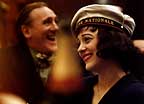
Cotillard as Piaf
|
 |
By
Michael Bronski
La Vie en Rose (La Môme)
Directed by Olivier Dahan. Written by
Olivier Dahan and Isabelle Sobelman. Starring Marion Cotillard, Sylvie Testud, Pascal Greggory, Emmanuelle Seigner, Jean-Paul Rouve, Gérard Depardieu, Clotilde Courau Jean-Pierre Martins, Catherine Allégret, Marc Barbé, Caroline Sihol, Manon Chevallier, Pauline Burlet, Elisabeth Commelin, Marc Gannot
How to order
How gay can a movie be? Anyone querying the upper bounds of the answer has to consider
La Vie en Rose (also known as La
Môme). This is the beautifully filmed and acted story of the endlessly tragic life of famed French chanteuse Édith Piaf. It is also a gorgeous reenactment
of one of the primal myths of gay culture: the spectacular disintegration and fall of the diva. From the great tragic heroines of grand opera to the real-life tragedies of Judy Garland, Billie Holiday, or Anna Nicole Smith (a media-spawned monster diva), the gay imagination gets
sucked into the messy insanity of these women's lives with the high-pressure whoosh with which genies escape bottles.
Q
uentin Crisip claims in his autobiography The Naked Civil Servant
that most homosexual males (well, at least the effeminate ones) are in search of the "great dark man"-- an ideal of masculinity that does not, cannot, exist. The doomed diva is that myth's flipside: a drama-laden
loss of brilliance which by comparison all ordinary life pales.
La Vie en Rose-- directed by Olivier Dahan and co-written by Isabelle Sobelman-- is an embodiment of that myth. Although she died in 1963 at the age of 47, Édith Piaf has never faded from the pantheon of great
performers. Her vibrant voice, declarative style, and out-of-control existence assured her status as a gay icon. Piaf devoured life as voraciously as her drinking, drugging, romancing, fucking, and general mania-- all taken to pitches of glorious excess-- devoured her.
Though several well-known documentaries and plays explore Piaf's life,
La Vie en Rose is among the few full-length cinematic renditions. (The 1983
Édith et Marcel, about Piaf's affair with French boxing champion Marcel Cerdan, is another.) Like its subject, the film's a
no-holds-barred torrent of emotional excess and voluptuous self-obsession. In short, it's great.
Structurally, La Vie en Rose is either a brilliant assemblage or a complete mess. It begins at the end of Piaf's life and then flashes back to her earliest years, and then-- well, it's all over the place. Successive scenes jump over decades (some specified, some not) and veer
unclearly from Paris to New York to Hollywood. Confused viewers might suspect at times the reels are getting shown out of sequence. But the spatio-temporal kaleidoscoping somehow meshes with exposition of Piaf's dizzying emotional roller-coaster. The result is both electrifying
and psychically satisfying.
La Vie en Rose feels like one of those old Hollywood bio-pics. From the 1950s we had
Love Me or Leave Me (with the spunky Doris Day as Ruth Etting),
Shine On Harvest Moon (with the plucky Ann Sheridan as Nora Bayes),
With a Song in My Heart (with the brash Susan
Haywood as Jane Froman), and I'll Cry
Tomorrow (with Haywood again as Lillian Roth). In the 1970s, with less Technicolor grandeur, we had
Funny Girl (with La Streisand as Fanny Brice) and
Lady Sings the Blues (with the proper Diana Ross as the brilliant Billie Holiday). These are all
four-hanky movies in which the heroines sing their hearts out as they are beaten up by boyfriends, lose their careers, become paralyzed in plane crashes, and fall into the gutter dead drunk before big opening nights. As Thelma Ritter's wise-cracking maid says
in All About Eve-- "Brother, that has everything but the bloodhounds yapping at her rear end." Gay culture loves ladies in distress, even more when they sing. All these films became staples of the queen canon.
La Vie en Rose will join them. Édith Piaf's life was a series of hit songs and hugely successful stage appearances interspersed among a train of broken-hearted affairs, serious drug use, occasional poverty, wild drinking, ill-health, temper tantrums, public scenes, and possibly
cavorting with Nazis during the occupation (a detail left out of the film). In a compelling performance, Marion Cotillard holds the film together in the lead role. Jean-Pierre Martins is superb as boxer/lover Marcel Cerdan, though hardly overshadows the flaming energy and intelligence of the lead.
Piaf's music was powerful (her declamatory, cigarette-edged voice was neither pretty nor decorous), and Dahan has found images that both enhance and magnify it. Most striking is a prolonged boxing match with Cerdan, filled with a physical brutality that is amplified by Piaf's
singing on the accompanying soundtrack. In the scene that follows, Piaf learns of Cerdan's death in a plane crash in the Azores. Dahan shoots the scene in a hysterical delirium that sends Piaf reeling about her bedroom and then out onto a fully lit stage as she pours out (yet again) her
grief. Such viscerality sets La Vie en Rose apart from most other diva pics. Dahan doesn't flinch from showing the downside of Piaf's mess of a life. By the end, she's nearly a corpse, the flame of her talent hardly an ember in her destroyed body. Yet even here Piaf's indomitable spirit
blows air on the dying glow, and she rallies, singing "Non je ne regrette rien." We can savor the struggle to survive, even as we can luxuriate in the tragedy of her death.
So why do queens love these movies so much? The old explanation for Judy Garland's gay following was that Judy was more of an emotional mess than her most down-and-out camp followers, who by the comparison simply felt better about their lives. Or is it, as has been said
of Maria Callas, that the diva's artistry and fabulousness reveal a kind of salvation by which personal imperfections and indiscretions are obliterated? Or is it just that female performers express emotion more openly and exuberantly than male ones? The answers are probably all of
the above. La Vie en Rose takes Piaf's stormy life and gives us a perfect example of gay homage to the diva.
| Author Profile: Michael Bronski |
|
Michael Bronski is the author of
Culture Clash: The Making of Gay
Sensibility and The Pleasure
Principle: Sex, Backlash, and the
Struggle for Gay Freedom. He writes
frequently on sex, books, movies, and
culture, and lives in Cambridge,
Massachusetts. |
| Email: |
mabronski@aol.com |
You are not logged in.
No comments yet, but
click here to be the first to comment on this
Movie Review!
|