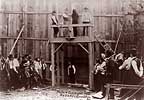
In June, a divided Supreme Court struck the U.S. off the list of nations where consensual sex can lead to execution
By
Bill Andriette
What did Barack Obama and John McCain do when
the U.S. Supreme Court on June 25 shot down laws
that -- in some circumstances -- impose death
sentences for consensual blow-jobs, teens having
sex together, and adults spinning fantasies with
each other online? The two presidential contenders
didn't celebrate
what was a fundamental victory for human rights.
Instead, they quickly denounced the high court's
contested 5-to-4 ruling.
The outcome in Kennedy v. Louisiana
removes, for now, the U.S. from the list of countries
where people face execution for consensual sex.
That makes the
case among the most important decisions since the
high court struck down sodomy laws in 2003. Had
the court's minority prevailed, Canada's
Globe and Mail said in an editorial, it
would "turn the state into a busy killing
machine."
Ugly cases, bad law
On first glance, Kennedy v. Louisiana
wouldn't seem like a contest over sexual freedom.
Defendant Patrick Kennedy, 43, was convicted in
2003 of raping his
eight-year-old stepdaughter, leaving her injured
and bleeding. Ambiguities surround the case: there
was no physical evidence implicating Kennedy, and
welfare
authorities kept the girl from her mother until she
accused her stepfather a year and a half after the
assault. But Kennedy, who is black, was sentenced
to execution
under a 1995 Louisiana law stipulating death -- or
life without parole -- for child rape.
Last December, he was joined on Louisiana's
death row by Richard Davis, a white 35-year-old
Ohioan found guilty in a case involving a five-
year-old girl. Davis
and his girlfriend (not the mother of the child)
"on several occasions... performed oral sex
on her, fondled her vaginal and anal areas, and
forced her to perform sex
acts on the couple," according to the
Shreveport
Times. In this case, the crime involved no
physical force or injuries.
Besides Louisiana, five other states (and the
U.S. military) have laws allowing execution, under
some conditions, for sex crimes involving minors.
Four of those
laws were enacted in the last two years, and
legislation in more states was pending.
"No one wants to be on the wrong side of
a 15-second political spot on whether you're for or
against child rape," says David Bruck, director
of the Virginia
Capital Case Clearinghouse.
Prosecutors in Louisiana (and nowhere else in
the U.S.) have since sought the death penalty in
four sex cases. Kennedy and Davis were the only
defendants condemned, and the only people on
death row in the U.S. for a crime not involving
homicide.
A close reading of these various laws shows
they cover conduct well beyond any standard notion
of "rape." Oklahoma's death statute,
which requires
two convictions, includes as qualifying offenses
internet sex chat entirely between adults where one
of them poses as under 14. A clear instance of child
rape was
the centerpiece of the Kennedy case -- which made
the majority ruling all the more sweeping. But far
more sex crimes than "the worst of the
worse" were
targeted in this new wave of capital rape laws.
Out of sync
"Evolving standards of decency,"
Justice Anthony Kennedy wrote for the majority,
prohibit execution for any offense short of first-
degree murder or
treason. "There is a social consensus against
the death penalty for child rape," he went on,
citing the small number of states now imposing
that sentence and the
more than 40 years that have passed since an
execution on such a charge. (Curiously, justices on
both side missed the military's provisions for
executing child
rapists, enacted by Congress in 2006.) "The
death penalty," Kennedy continued, "is
not proportional" for the crime, and so
violates the Eighth Amendment's ban
on cruel and unusual punishment.
As well, the majority cited practical problems
with putting sex offenders to death. The mere
threat might keep families from reporting offenses
involving kin.
The high evidentiary standards of capital trials
impose extra traumas for victims. The justice noted
"documented problem of unreliable, induced,
and even
imagined child testimony" creating a
"special risk of wrongful execution." As
well, rapists would lose an incentive not also to
murder.
The majority's stance had the ring of
déjà vu. In 1977 the court had
overturned the death sentence imposed on Erlich
Coker, a man convicted of raping a
16-year-old girl (who, because she was married,
Georgia held to be an adult).
Coker marked the end of an era in which
hundreds had been executed for sex crimes --
some 455 between 1930 and 1964, with about 90
percent of them black. In
Coker's wake, Florida and Mississippi
courts ruled that precedent also barred execution
for sex offenses involving children. In 2007,
Louisiana's Supreme Court disagreed.
Watch your step
The U.S. Supreme Court's decision in
Kennedy settled that dispute, and
denunciations from the presidential candidates
quickly ensued. McCain called the ruling
an "assault" on the legal system. Obama
concurred. "I think that the rape of a small
child, six or eight years old, is a heinous
crime," said the presumptive
Democratic nominee, "and if a state makes a
decision that under narrow, limited, well-defined
circumstances the death penalty is at least
potentially applicable, that that
does not violate our Constitution."
Obama's words echo those of the four
dissenting justices, led by Samuel Alito, who found
there was no "basis for striking down all
capital child-rape laws no
matter how carefully and narrowly they are
crafted." Existing laws, the minority asserted,
met the test. It was enough to set an age -- for
Louisiana, 13 -- beneath
which a single instance of consensual oral sex
warranted death. Or it was enough to require a
previous conviction, as did, the statute in, say,
Oklahoma, where one
rung on the ladder to the scaffold could be to
"lewdly or lasciviously look upon" a
person under 14. Guardrails merely ankle-high
were built into the laws Justice
Alito praised -- laws, he said, whose
"careful" and "narrow"
crafting would "limit quite drastically the
number of cases in which the death penalty may be
imposed."
A tree with sturdy limbs
The high court majority thought otherwise,
declaring that it "finds significant the
substantial number of executions that would be
allowed for child rape"
under Louisiana's rationale -- potentially tens of
thousands every year -- dwarfing the some 3400
cases of murder deemed intentional (hence
potentially
death-eligible) in the U.S. in 2005.
"Execute this man," Assistant
District Attorney Lea Hall said as he pointed to a
sobbing Richard Davis during closing arguments
last December at Davis's trial
in Caddo Parish for child fondling and oral sex.
"Justice has a sword, and this sword needs to
swing today." Yet in at least 40 cases since
the enactment of
Louisiana's capital rape law, judges handed down
no death sentences in cases where
defendants were found guilty of
killing children.
Nonetheless, says Ben Cohen, one of Patrick
Kennedy's attorneys, "I don't think we would
have seen floods of executions," as he
speculates about the
consequences had his client lost. "But I do
think we would have seen 20 years of litigation
concerning the validity of these statutes."
Still, had Kennedy v. Louisiana gone
the other way, legitimizing execution for sex
crimes would have poured gasoline on fires already
flaring.
In Weatherford, Texas, on July 3, James Kevin
Pope, 43, was sentenced to 4060 years in prison
for sex with three teenage girls -- in a case where
the victims
had not complained and no coercion was alleged.
Last December in Atlanta, Cedric Bradshaw received
a mandatory life in prison after trying, but failing
for a
second time, to fulfill Georgia's requirements to
register as a sex offender. Bradshaw previously
served five years in prison for sex with a 15-year-
old girl when he
himself was 19.
Who knows what the Supreme Court will look
like after Obama or McCain get their chance to
reshape it. But for now, a thin majority has balked
at
handing prosecutors and judges more rope for
hanging.
A Kiss & Goodbye
Making death the wages of teen sex and internet fantasizing
Could you end up on death row for consensual sex in the U.S.? Before the Supreme Court ruled in
Kennedy v. Louisiana on June 25, that was possible in half
the six states that had enacted capital rape laws.
In Georgia, a 19-year-old who got convicted of oral sex with a 15-year-old, and who then proceeded to elope with his or her partner (what a prosecutor might
call "kidnapping") would be subject to a death sentence.
Execution would be possible as well for an 18-year-old babystitter in Louisiana who gave an early birthday present of a blowjob to a boy just shy of 13. In any
case, she would face -- and still does -- a mandatory life term without parole.
But the prize goes to Oklahoma lawmakers for the most expansive view of capital sex offenses.
In 2006, Oklahoma established that two convictions for "lewd molestation" of a minor under 14 warrant execution. The category is a catch-all: It covers
people who "look upon... the body... in any lewd or lascivious manner" of a minor. It covers a crime committed by older brothers everywhere who are forced to
share rooms with younger siblings: "ejaculat[ing] in the presence of...." Lewd molestation can even cover two adults chatting dirty together on the internet where
one purports to be underage.
| Author Profile: Bill Andriette |
| Bill Andriette is features editor of
The Guide |
| Email: |
theguide@guidemag.com |
You are not logged in.
| # |
Subject |
Author |
Date/Time (ET) |
| 1275 |
Death penalty |
varonael
|
08/03/08 06:45 PM |
|





 Advertise with us
Subscriptions
Contact us
Site map
Translate
Advertise with us
Subscriptions
Contact us
Site map
Translate