|
 |
Or, Britain reforms its sex laws
By
Roger Moody
In his engaging history of pre-war homosexuality in Britain, Colin McInnes uncensoriously tells us of a village elder who regularly recruited and slept with his male pubertal
apprentices. Everyone in the hamlet supposedly knew what was going on. No-one disapproved. Indeed, this gentleman was a pillar of society in more than one sense of the term: he trained up the
next generation for community service, reciprocated their libido and kept them out of harm's way.
General attitudes to adolescent sexuality have suffered a three-hundred and sixty degree turn since then. The most recent and vicious anti-sexual and criminal justice policies
are currently being debated in the British parliament. They are designed not only to keep kids off the streets and out of the hands of any adult with whom they might forge a
nurturing relationship, but to despatch them regardless, either into detention or back to often uncaring and sometimes abusive families( This, despite a study carried out in 2002 by the
National Society for the Protection of Children (NSPCC) which showed that older siblings are actually more likely to sexually exploit young people than anyone else).
Every few years, from the late 1970s onwards, Britons have been served with a new raft of criminal justice legislation, targeted at specific, pre-profiled, members of society, rather
than their overt behavior. It was under Thatcherism that both the perverse "Protection of Children Act" of 1977 and the notorious Clause 28 were carried into law.
The first Act penalised adults purveying sexual images of under-16 year olds, even where no offense was depicted or, in many instances, implied. Nine years later a new Criminal
Justice Act began sending "consumers" of youthful sexual imagery off to jail. Clause 28 threatened to cut off funding to any local authority which legitimized homosexuality as a way of
life. Although no establishment has ever been found guilty of such proselytism, it's also true that few ever tried to test the legislation. At the end of 2002, British Home Secretary,
David Blunkett, announced that the Labor government's early undertaking to ditch the repugnant Clause would once again be postponed. This came as little surprise to those who identified
this piece of legislative blackmail as directed primarily at young gays seeking reassurance of their sexuality.
A new Criminal Justice and Sentencing Bill was tabled before parliament in the year 2000. This doesn't just envisage unprecedented violations of centuries old common law
(dispensing with jury trial for some serious offenses, and re-trials of persons previously acquitted of a crime). It is also the clearest example perhaps anywhere in the world ñ of a government's
intention to combat both "youth crime" and "predatory adults" simply by implication, rather than evidence that comes up to "proof."
Last summer, the tragic murder of two small girls in southern England provided the opportunity to demonize internet communications between people of differing ages, when it
was revealed that the ten-year olds regularly used internet chat rooms. (Ironically prime minister Tony Blair in 1997 had made it a personal aim to provide every child with internet access,
to further their education). The prospect that the victims had made a rendezvous with their killer quickly became common currency. A few hours of police computer trawling dashed the theory.
Little matter a flag had been flown on the corpses of the innocent, and a new criminal activity was conceived. Under impending legislation, it will become illegal for any "pedophile"
even to initiate electronic contact with an underage person, regardless of their actual intentions. ("Grooming" as the quasi-scientific, pseudo-legal term has it; regardless of the meaning of
the word, and the fact that all sound education is based on mutual seduction of a sort) .
No gay or lesbian rights group in the country has raise its voice against the move. Yet, it's quite clear that (for example) a teacher found guilty six years ago of possessing a copy
of photographer Will McBride's educational manual Show Me! (paradoxically now available in "all good book stores," sandwiched between the pages of I, Will McBride ) or a 17-year-old
once cautioned for importuning a willing 15-year-old in a public lavatory, could soon be banged up inside, simply for sending a one-line message saying "Hi!" to a curious adolescent they've
never met.
Until last year, no British administration had dared propose the final logical (if insane) step of placing all under-age people, regardless of their desires or capacities literally out of
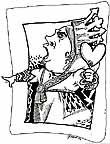
bounds to any merely suspect older person. But, however speculative this definition of "suspicion" ("A word means what I want it to mean," as the imperious Red Queen told Alice in
Wonderland, when her feisty interlocutor had the temerity to question her rationality), it had to be predicated on something more than speculative adult activity or children's vulnerability. After all,
when objectively questioned in survey after survey, most Britons have declared "youth crime," not "stranger danger" as society's biggest social threat. The perverse achievement of the
Blair administration has been to conflate widespread fears of adolescent disorder with cynically generated panic about adults who associate with them.
The criminal justice proposals, when passed, would impose instant curfews on youth gathering in public places and extend prohibitions on their free travel (so far applied,
relatively sparingly and only to adult football "hooligans"). It would also make it an offense, punishable by up to seven years imprisonment, to pay a youth of 16-18 years for sexual services
this despite the fact that Britain's age of consent is now equalized at 166, for both men and women. Should that particular clause reach the statue book during the coming year, a law will
have been successfully constructed that denies the very intent of previous legislation. Yet few, if any, political observers have raised a word against it.
You are not logged in.
No comments yet, but
click here to be the first to comment on this
News Slant!
|