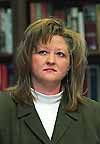
Porno Czar Paula J. Houston
|
 |
She's 41, single, and out to kill the "poisonious, deceptive snake" that is pornography
By
Jim D'Entremont
Last year, when the Utah legislature passed a widely ridiculed bill creating the office of Obscenity and Pornography Complaints Ombudsman, skeptics wondered if the position would ever be filled. The new post, whose
mission was supposed to have been launched on January 1, 2001, lacked an appointee for ten months after Governor Mike Leavitt signed the legislation into law.
On January 26, however-- six days before the confirmation of John Ashcroft as US Attorney General ushered in a new, retrograde era in American law enforcement-- Mark Shurtleff, Attorney General for the State of
Utah, called a press conference to introduce Paula J. Houston, his Obscenity and Pornography Complaints Ombudsman designate, to the media.
Proclaiming the occasion "historic," Shurtleff promised that "I, for one, will not allow pornographers to hide behind the First Amendment," and advised porn purveyors that "I'm coming after you, Paula's coming after
you." Houston herself warned, "Utah is a family-oriented state, and pornography doesn't have a place here."
On a mission...
A former prosecutor who has practiced law for 15 years, Houston, 41, is the first official "porn czar" to appear on any state payroll. (Several other states have special prosecutors or commissions focused on
pornography, usually targeting child porn.) Occupying a modest niche within the State Attorney General's suite of offices, she will act in a non-prosecutorial advisory capacity. With an initial funding allotment of $75,000-- scheduled to
be increased to $150,000 next year-- she will work with local communities to help implement their smut-busting needs, arbitrate obscenity disputes upon request, and review the relevant existing laws in both Utah and Idaho.
By October 25, 2001, Houston is supposed to have drafted both a model anti-porn ordinance for Utah municipalities and a state "moral nuisance" law intended "to abate and discourage obscenity and pornography."
Since Utah's restrictions on sexual expression already brush the constitutional limits of censorship, it remains to be seen if Houston can extend them any further without blatantly encroaching on First Amendment rights.
Houston is a Mormon-- a member of the Church of Jesus Christ of Latter-Day Saints (LDS)-- and a veteran of an 18-month missionary stint in New Zealand. Born in Texas and raised in Montana and Idaho, she has
made her home in Utah since moving there in the late 1970s to attend Brigham Young University (BYU) in Provo. Although the LDS church relentlessly pressures its members to marry and produce large families, Houston has
remained single and apparently a virgin.
Many gay and lesbian Mormons acquiesce to the church hierarchy's efforts to keep them chaste and deeply closeted; there has been widespread speculation about Houston's sexual orientation. But it does seem certain
that, whatever her proclivities, Houston has had little or no direct sexual experience. She refuses to answer questions about her personal life, which she calls "irrelevant." Mark Shurtleff and his staff are protective of Houston,
who declined to return phone calls in connection with this article.
Little is known about Houston beyond her implacable conviction that porn is bad. During her 15-year tenure as a prosecutor in West Valley City, a sprawling, downscale Salt Lake suburb, she supposedly obtained
convictions in five pornography cases involving sales or rentals of hard-core VHS tapes. But according to Carol Gnade, Executive Director of the American Civil Liberties Union of Utah, "Nobody here has ever heard of those cases.
Nobody here had ever heard of her. She just came out of the blue."
Where PG13 is obscene
F.M. Christensen, in Pornography: The Other
Side (1990), attributes the perceived need to suppress sexual content to a "high level of ignorance and misinformation about sexuality" among the general public, and "the
shame and anxiety most people in this culture... feel regarding sexuality and its portrayal." Utah, where erotophobia is a civic virtue, has long assumed a leadership role in stamping out lewdness.
Most recent pornography prosecutions throughout the state have involved video rentals; some have involved soft-core pornography. In one much-publicized Utah County case, two Movie Buffs video stores in American
Fork and Lehi were raided, and hundreds of "adult" video cassettes were confiscated. These ranged from censored-for-cable versions of hardcore porn videos to PG13 Hollywood films like
The American President. Lists of
individuals who had rented the videos were also seized. Enlisting the aid of the ACLU, Movie Buffs sued Utah County on First and Fourth Amendment grounds. The suit was stalled by legal obstacles, but a jury found the management
of Movie Buffs not guilty of criminal charges.
During the reign of US Attorney Brent Ward in the 1980s, federal and state authorities in Utah waged a moral crusade against sexually oriented material. The campaign relaxed somewhat when Ward left office, but
zealotry has regained momentum since Paul Warner, a protégé of Utah's Republican Senator Orrin Hatch, took over as US Attorney for the State of Utah in 1998. Warner, who has devoted much of his energy to apprehending real
or imagined on-line sex predators, introduced a Children's Internet Crimes Task Force last year. "The officers working on the task force spend as much time as they can each day on-line posing as children," the
Deseret News reports; their efforts have resulted in 44 arrests. Warner has informed Shurtleff and Houston of his interest in working with them.
The Internet, which Warner, Senator Hatch and other powerful Utahns have tirelessly demonized, is the Pornography Ombudsman's most pressing concern. (Hatch, a Mormon Elder, is the chief perpetrator of the
Child Pornography Prevention Act of 1996, which targets the Internet, extending prohibitions to morphed images-- pictures whose creation did not involve real children.) "People in power here are scared to death when citizens can
get hold of things they can't obtain at the corner store," notes Provo attorney W. Andrew McCullough.
Filtering devices already shield children from viewing sexually explicit material on computer screens in schools and libraries across the state; Houston wants to shield adults as well. "That is an overwhelming task
for anyone," says Darin Hobbs of the Gay and Lesbian Community Center of Utah, "and she's admitted she really doesn't have a clue how to address it." Since the Internet, like cable television, falls under federal jurisdiction
as interstate commerce, the authority of state officials to muzzle its content is limited.
Outside the Internet, hard-core pornography is difficult to find in Utah. The ACLU's Carol Gnade describes Houston's job as "a solution without a problem." Most distributors of hard-core porn will not risk shipping
books or videos to Utah addresses. Most adult video consumers drive to Wendover, Nevada, or Evanston, Wyoming. (Wyoming's Velvet Touch calls itself "Utah's finest adult bookstore.") Age-restricted "adult" areas in the few Salt
Lake City stores that carry sexually oriented books and magazines are stocked with shrink-wrapped copies of soft-core straight publications like
Playboy and gay publications like
Honcho. Videos and magazines that depict
penetration are banned outright; erections can invite prosecution.
"We're still wondering what Houston's going to do," says Andrew McCullough. "It's a scary situation." McCullough, who was defeated by Mark Shurtleff when he ran for State Attorney General on the Libertarian
ticket, represents three nude dance clubs in South Salt Lake. Clubs featuring full nudity are now permitted to operate as long as they do not serve alcohol; local officials have vowed to ban them altogether in the near future. Houston
was present at a recent hearing on the issue.
Utah is a state where a store called CleanFlicks can build its success on a program of deleting nudity, sex, violence, and profanity from rental videos of mainstream films like
Schindler's List and Titanic, in probable
violation of copyright law; where top-40 schlock like Olivia Newton-John's "Let's Get Physical" can be labeled smut and banned from broadcast; where a Mormon landlord can forbid his tenants to watch MTV; where a mural
commissioned for the Salt Lake City International Airport can be removed because of its inclusion of two decorously nude human figures; and where, as recently as 1997, classic nude sculptures by Auguste Rodin could be banished from view.
Pornography: the serpent in Utah's Eden
In a statement responding to unfriendly coverage in the
Salt Lake Tribune, Houston, who habitually uses the word
pornographic as if it were synonymous with
obscene, alludes to the obscenity test established in 1973
by Miller v. California. (Obscenity is that which appeals to "the prurient interest" according to "contemporary community standards," and is both "patently offensive" and lacking in "serious literary, artistic, political, or
scientific value.") "The standard for determining if something is pornographic is based on the community standard," she insists, "not my standards or any other individual out there. The question people should be asking is if I can
objectively listen to the people in the community and... apply that information to the community standard."
Historically, however, Mormon authorities have tended to dictate standards to Utah communities. Material is typically censored without members of the public, Mormon or otherwise, having been consulted.
Many "obscenity" complaints originate with groups of right-wing activists who find the state a welcoming milieu. These include grassroots associations like the late Joy Beech's surreally named Citizens for True Freedom, and
youth programs like Peers Against Pornography (PAP).
The enabling legislation for the Pornography Ombudsman's post grew out of ongoing right-wing anti-porn agitation. Its sponsor, State Representative Evan L. Olsen, a Mormon dairy farmer from rural Cache County,
had previously made six unsuccessful attempts to pass anti-nudity legislation. Before losing his seat in last year's primaries, he was a longtime member of a reactionary-Republican legislative majority that is tethered to the LDS
agenda and linked to dozens of "pro-family" groups. Olsen has publicly expressed fear that "pornography will bring this nation to its knees." He says he filed the legislation because "I just had the feeling it was time to do something
about the problem. Every major religion in the United States has condemned pornography, but it's growing by leaps and bounds, and it's tearing families apart."
Olsen's associates include members of a moral watchdog entity called Homes Offering Moral Empowerment (HOME), an anti-porn offshoot of the interfaith women's organization American Mother, Inc. Olsen was
a participant in an anti-pornography forum that HOME's president and chief organizer, Amy Fielding, assembled three years ago. Fielding and Olsen are now working on the formation of a network Olsen calls "Utah Family
Values." On February 19, Fielding and members of HOME joined Attorney General Shurtleff and others in a "March Against Pornography."
Utah Eagle Forum, a branch of the national anti-feminist lobby founded in 1972 by Phyllis Schlafly, is even more assertive. Its chairperson, Gayle Ruzicka, an outspoken radio talk show host, is indefatigably obsessed
with the sometimes overlapping scourges of homosexuality and smut. (Drag queens dressed as Ruzicka are a popular feature of Salt Lake's annual Gay Pride march.) Fielding and Ruzicka, who are said to be rivals, have
recently appeared to be trying to top one another's public statements in praise of Houston and in condemnation of porn.
These women and their allies are fond of citing anti-porn factoids provided by sources like James Dobson's Focus on the Family, Gary Bauer's Family Research Council, and Enough Is Enough (EIE), a propaganda
mill currently based in Santa Ana, California. Despite the secular facade provided by its chief spokesperson, Donna Rice Hughes, ex-playmate of Presidential candidate Gary Hart, Enough Is Enough is a Christian organization
whose founding president, Dee Jepsen, is a Pat Robertson associate and former co-chair of Washington for Jesus. EIE recently assisted the fundamentalist American Family Association in a successful drive to force Yahoo to purge
the "Adult and Erotica" section from its on-line mail-order Web site.
Books and pamphlets on EIE's Resource List depict sexually explicit expression as inevitably, incontrovertibly harmful, telling anti-porn moralists everything they want to hear. EIE's "educational" material, especially its
83-page Take Action Manual, is sometimes employed and even distributed by law enforcement officials. While the Utah Attorney General's office denies that EIE has any input into its anti-obscenity efforts, EIE literature is
accepted as authoritative by groups like Utah Eagle Forum, whose influence is widely felt by state and local law enforcement officials.
Among the experts most frequently cited by EIE and other anti-pornography groups is Utah-based psychologist Victor Cline, who calls pornography "the gateway drug to sexual addiction." Citing mainly anecdotal
evidence, he claims in his book Where Do You Draw the
Line? that exposure to porn results in a four-phase downhill slide:
addiction, escalation,
desensitization, and the inevitable outcome,
acting out sexually. Cline is one of the
chief proponents of the idea that pornography hooks its audience, then spreads destructively like poison through once-healthy psyches.
Such notions are firmly entrenched in Mormon teachings on porn. No LDS conference would be complete without a speech on the dangers of sexually explicit entertainment. A highlight of the recent 2001 annual
meeting was a lecture called "You Can't Pet a Rattlesnake" by Elder David E. Soren, who urged his listeners to watch TV or log on to computers only in the company of others. "Pornography," he stressed, "...is deeply poisonous, a
deceptive snake that lies coiled up in magazines, the Internet, and the television."
Tearing down the wall between church and state
Such lectures tend to sidestep Mormons' core objections to pornography: that it liberates sexuality from the confines of marriage and the strictures of the procreative acts insisted upon by the LDS church. As F.M.
Christensen points out, "Objections to pornography are basically just objections to certain types of sexual attitudes and behavior." Utah's moral rearmament agenda is, above all, about social control.
"If Miss Houston were to really do her job, we would live in a police state and the courts would be overwhelmed," says Todd Dayley, editor of
The Pillar, Utah's monthly gay newspaper. This prospect is of scant concern
to the get-tough-on-porn brigade, whose vision of law-and-order sweeps justice aside. The extent to which Houston succeeds will depend in part on the tone the law enforcement arm of the Bush Administration sets for the
nation in the next few months.
Under the leadership of former Senator John Ashcroft (R.-MO), a hard-right Pentecostal who has described the wall of separation between church and state as a "wall of religious oppression," the US Department of
Justice is expected to attack pornography, especially on the Internet, with unprecedented zeal. Since the US Attorney General sets priorities and standards for US Attorneys and for state attorneys general, and represents the position
of the Executive branch of government before the Supreme Court, an increase in federal porn prosecutions may not be the most significant result. As Ashcroft, Orrin Hatch's former colleague on the Senate Judiciary
Committee, settles into office, morality police in Utah and beyond are waiting for their cues.
Today Utah, tomorrow...
In a March 24 piece on Paula Houston, New York
Times reporter Michael Janofsky fantasized that while the creation of a porn ombudsman seemed to enjoy widespread support in Utah, "the notion of such a position
might draw snickers elsewhere." But few people are laughing, even in New York, where Mayor Rudolph Giuliani, a Catholic Republican, has just impaneled a decency task force [see this month's "News Slant"].
Paul Houston may be the nation's only porn ombudsman, but she is likely to acquire colleagues fairly soon. "There's been a wonderful response," says Evan Olsen, gratified by the national attention Houston has
received. "Paula's had calls from all over the country-- Wisconsin, South Carolina, all over-- asking how they can set up offices just like hers."
As state-supported, religiously slanted morality tribunals and "faith-based" government initiatives proliferate, the state of Utah, the Mormon Zion where the wall of separation between church and state is a fanciful
construct, may be just slightly ahead of its time.
You are not logged in.
| # |
Subject |
Author |
Date/Time (ET) |
| 1143 |
Paula Houston |
veezreality (Guide Staff)
|
01/27/03 09:01 PM |
|