Flammable, and sheds a lot of light
|
 |
Can money buy sexual freedom?
By
Michael Bronski
Harmful to Minors: The Perils of Protecting Children from
by Judith Levine
University of Minnesota
Press
How to order
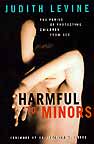
Harmful to Minors: The Perils of Protecting Children from
Sex, by Judith Levine (University of Minnesota Press, $26.95, 299 pages)
Judith Levine's Harmful to Minors has certainly stirred the already turbulent waters of children and sexuality. Calm, thoughtful, insightful, and intellectually vigorous, Levine's book is a model of how to present a topic that
sends most people and the media over the edge. The problem as Levine and her publishers found out [see pages 9-10] is that it's nearly impossible in the West today to discuss children's or teen's sexuality and eroticism with
any rationality or respect for dissenting views.
Levine's thesis so self-evident as to be mundane is that children are sexual beings whose sexuality faces constant and vigorous repression from the adult world. Most of the time the rhetoric of this repression takes the
forms that children have to be "protected" from adults, violence, themselves, sex, and most everything else. Levine contends that this "protection" hurts children far more then it helps them.
But there's another aspect to Levine's book that is eye-opening, even for self-admitted sex-radicals, and which has not been noted in the media. The cold, hard, and undeniable facts is that being poor in America is
an enormous negative factor for nearly all aspects of the sexual autonomy, knowledge, and health of youngsters.
Nearly a third of black urban gay men are HIV-positive. A child whose parents make less than $15,000 a year is 18 more times more likely to be sexually abused at home than one from a family with an income of
above $30,000. More than 80 percent of teen mothers come from poor homes, while 75 percent of pregnant high-income teens get abortions so they can go to college and have careers before having families, only thirty-nine percent
of poor and 54 percent of low-income teens terminate unplanned pregnancies. Runaway teens show HIV infection rates of nearly ten percent. In the 1990s more than half of New York City's HIV population were IV drug users
who were marginally employed and housed.
So often in the discussions of how terrible the right-wing backlash is to sexual liberation the rhetoric comes down to the slogan that sex is good and repression is bad. But that's only part of a larger picture. Levine's book
is valuable for showing not just the extent of institutionalized sexual repression, but how the terrible effects fall mainly on the poor.
It's all very well to talk about sexual freedom but like most things, it's a lot easier to get if you can afford it. And for many people especially kids the price is still too high.
Editor's Note: See our news slant Burn first for more coverage of this issue.
| Author Profile: Michael Bronski |

|
Michael Bronski is the author of
Culture Clash: The Making of Gay
Sensibility and The Pleasure
Principle: Sex, Backlash, and the
Struggle for Gay Freedom. He writes
frequently on sex, books, movies, and
culture, and lives in Cambridge,
Massachusetts. |
| Email: |
mabronski@aol.com |
You are not logged in.
No comments yet, but
click here to be the first to comment on this
Book Review!
|