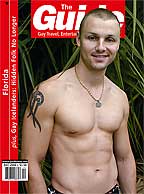
December 2006 Cover
|
 |
By
Jim D'Entremont
Cold, remote, and prone to volcanic eruption, Iceland feels like the edge of the world. For gay people, after a slow start, Iceland has become one of the warmest, coziest places anywhere.
On Saturday, August 12th the world's northernmost gay pride parade surged through Reykjavik-- Iceland's capital-- for the eighth consecutive year. The 2006 edition of the annually expanding event drew 45,000 people
to the streets of a town of 115,000 inhabitants.
The crowd included an infusion of visitors from Europe and North America, along with Icelanders-- gay, lesbian, bisexual, transgendered, unclassifiable, and straight-- from every corner of the island nation. Assembling near
the Hlemmur Bus Terminal, the marchers swirled down Laugavegur, across the heart of the downtown shopping district, and into the city's central square at Laekjargata, where-- on the site of Iceland's first Viking settlement--
an outdoor concert blared amid the ambiance of Mardi Gras. The parade and concert were the climactic moments of the five-day Reykjavik gay pride festival, known in Icelandic as
Hinsegin Dagar-- "Different Days."
T
his year, gay Icelanders had clear-cut reasons to rejoice. On June 2nd, the Icelandic parliament had passed legislation giving same-sex couples, already eligible for "confirmed cohabitation" amounting to civil marriage, the
right to register as unmarried domestic partners-- a right long available to unmarried heterosexual couples. Gay couples were also given the right to adopt children; lesbian couples were granted access to state-supported
medically assisted pregnancy. These breakthroughs brought the Icelandic gay community within a hair's breadth of full civil rights, placing Iceland in the forefront of nations that do not discriminate on grounds of sexual orientation.
"In a way we're at a crossroads," says Hrafnkell Tjorvi Stefánsson, office director of Samtökin '78, the Icelandic National Organization of Lesbians and Gay Men. "Our top priority now is education-- in schools, in the sports
world, in the Church, throughout society. Some prejudice still exists."
Some homophobic sentiment persists in the villages and towns along or near the Ringroad encircling the island's exquisitely spooky central highlands. In the northern agricultural valley of Vididalur, or in the wilds of
the Snaefellsnes Peninsula, there is no obvious gay presence. Most of Samtökin '78's 400 active members live in Greater Reykjavik, along with members of KMK
(Konur mid Konum-- Women with Women), the national gay
association of university students, and other LGBT organizations. But many gay Icelanders remain in the seeming isolation of wilderness domains.
"I'm not sure it's correct to talk about isolation," Stefánsson observes. "This culture has migrated to the internet. Gay people here are more connected than ever. They're going online for dates or information or just friendship."
Many gay Icelanders, rural and otherwise, make connections via the Icelandic website
Einkamál
, or through international sites such as Gay.com. But in a country the size of the state of Kentucky, no one is ever
very distant from anyone else; in a nation of 300,000, whose only city is marginally larger than Peoria, Illinois, no one is completely anonymous. Once made, connections between Icelanders sprout deep and durable roots,
and sometimes bear political fruit.
"The fact that Iceland is so small and that you could not escape to big cities and get lost helped our movement," says activist/filmmaker Hrafnhildur Gunnarsdottir, Samtökin '78's current chair, who is known to her friends
as "Hrabba."
"I have always thought," she adds, "the US could learn from us the importance of staying in, or at least returning to, the place where one is born, in order to change that society." Gunnarsdottir herself returned to Iceland
after 16 years in San Francisco, a city she calls "my first love and my second home," in order to help effect such change.
Where geology farts and fissures
Hrabba's organization is the rallying point for a gay community scattered over land hurled out of the ancient North Atlantic by volcanic cataclysms. Perched on the Mid-Atlantic Ridge near the Arctic Circle, the island
straddles the point where the tectonic plates of North America and Eurasia drift apart at the rate of one to two centimeters a year. Among the most active seismic hotspots on earth, Iceland is still being sculpted by lava,
magma, boiling water, shifting masses of ice, and rock-splitting tremors.
Beyond Reykjavik, visitors encounter glaciers, volcanoes, waterfalls, geysers, otherworldly rock formations, slopes where steam pours out of fissures, lava beds tipped with iridescent moss. The terrain could pass for the
work of sardonically prankish sorcerers. It's not surprising that 54 percent of Icelanders say they believe in elves, trolls, and other beings who comprise the
huldufolk-- the "hidden folk"-- a fitting name for gay Icelanders prior
to 1975.
Iceland may have been the land mass known to ancient seafarers as Ultima Thule. Its first human settlers appear to have been Irish monks who, seeking meditative isolation, formed all-male coastal enclaves that probably
struck the island's first sparks of gay life. In 874 CE, pagan Vikings invaded from Norway and took control. Their legacies include the world's oldest parliament, the Althing-- the national assembly first established at Thingvellir in
930 CE-- and the Norse language, surviving today, little changed, as Icelandic.
Early Icelandic law did not proscribe homosexual acts, though Norse sagas and legal manuscripts mentioned male rape and male prostitution. A common
nid, or term of insult, was egri, a word equivalent to "butt-boy," one
of many Norse words deriding the passive partner in male anal sex. After the Icelandic Vikings' forced conversion to Christianity at 1000 CE, references to the "appalling secret sin" of homosexuality began to appear. By
1100, Christian refinements to the law upheld a man's right to kill anyone calling him homosexual.
In 1397, Norway and Iceland were placed under Danish sovereignty. (Iceland did not gain independence until 1944.) From 1565 to 1838, Denmark's Great Edict imposed harsh penalties for sexual crimes in all Danish
territories. In 1869, the Althing passed a comprehensive Icelandic penal code based on Danish law. Clause 178 of the new code imposed prison terms for "unnatural forms of sexual intercourse" including homosexual activity and
bestiality. The law was frequently invoked in the latter part of the 19th century; enforcement slackened after 1900.
In 1924, wrestling champion Gudmundur Sigurjónsson Hofdal, who admitted having sex with men, was convicted in Reykjavik of violating Clause 178. Hofdal was pardoned, however, a few years after Denmark
decriminalized consensual sex between adults of the same gender in 1930. A decade later, Iceland repealed Clause 178. But gay Icelanders remained deeply closeted, taking respites in Europe or North America, sometimes emigrating for life.
"People were frequent travelers in the Western gay culture flourishing in the '70s," says Icelandic gay scholar Thorvaldur Kristinsson, a former head of Samtökin '78. "They became able to compare our provincial and
prejudicial Iceland to the blossoming gay culture, with bars, bathhouses, and discos, in our old capital Copenhagen as well as Amsterdam, Berlin, London, New York, and San Francisco. The comparison made gay people better aware of
the opposition and silence at home." Kristinsson stresses that Iceland's once-dominant provincial homophobia was "quite comparable to [that of] any province in the Western world."
Speaking up
In 1975, Icelandic actor/singer Hördur Torfa (see
Singing Out, Acting Up)
declared his homosexuality in a fan magazine. The move was a rare act of courage at a time when most gay artists and entertainers worldwide remained
closeted. The subsequent uproar nearly scuttled Torfa's career; threats and attacks drove him into temporary exile. But Iceland's closet door remained ajar. That same year, multi-media entertainer Nonni came out during a
television broadcast; other Icelanders followed.
In 1977, Torfa returned to Iceland determined to create a national gay support organization. In May 1978, he helped launch Samtökin '78 (literally, "Organization '78") with approximately 20 founding members. The group
was directly based on Forbundet '48, the Danish lobby formed in 1948 in response to an anti-gay witch hunt.
Through meetings, publications, and events, Samtökin '78 set about demystifying gay people for the Icelandic public, and promoting gay visibility. Its tone was non-confrontational. High on its agenda were efforts to
replace standard slurs with hommi and
lesbia, and to supplant the prevalent term
kynvilla, meaning "perversion," with
samkynhneigd, a newly coined, neutral word for homosexuality.
In 1983, a year when a Reykjavik disco could still advertise, "All welcome except gays and lesbians," the newly formed Social Democratic Alliance declared its support for gay rights. In 1985, as the appearance of AIDS in
Iceland leveraged a more open public discussion of gay issues, four political parties united to propose legislation advancing gay equality. In 1992, the Althing passed some anti-discriminatory measures and appointed a commission
to explore others.
Eventually, in 1996, civil "confirmed cohabitation" paralleling heterosexual marriage became legal for same-sex couples. While initially denying rights to adoption or assisted pregnancy, the new law did confer joint custody
of biological offspring to same-sex partners.
At present, only civil authorities can marry Icelandic same-sex couples. Religious authorities have yet to gain such power under law; some do not wish it. Controversy over same-sex marriage persists within the Icelandic
Lutheran Church, which otherwise approves of gay civil rights. This year, six Lutheran priests participated in the interdenominational pride mass at the Hallgrimskirkja, Reykjavik's Lutheran cathedral, but endorsement of the service
was not universal among members of Iceland's state Lutheran Church, a congregation that nominally includes 85 percent of the population.
Gay Icelanders regard the issue of same-sex religious nuptials with varying degrees of concern. Most are not notably religious. A few embrace marginal non-Lutheran faiths, including the pagan-revival sect Asatru.
Part of Iceland's religious fringe decries gay rights. On the day of Reykjavik's 2006 pride parade, Pentecostals ran a full-page ad in the daily paper
Morgunbladid, asking homosexuals to repent. The most vocally
homophobic Pentecostal group is Krossinn-- The Cross-- a 600-member congregation led by Pastor Gunnar Thorsteinsson in Kópavogur. Much of Krossinn's anti-gay rhetoric seems borrowed; the sect has ties to Good News Today,
a Christian ministry based in Fayetteville, Tennessee. Whatever his sources of inspiration, Thorsteinsson's shrill condemnations of same-sex marriage may have helped promote its acceptance, since Icelanders can't abide bullies.
An independent posture
Wary of being pushed around, Icelanders tend to resist the will of both Europe and the US, though cultural influences from both sides of the Atlantic have washed up on their shores. (That the widening island is drifting in
opposite directions toward both continents has symbolic resonance.) For generations, Iceland has favored political neutrality. In 1949, its decision to join NATO provoked a riot. Fear of being sucked into the American vortex has
caused some Icelanders to call for entry into the European Union-- an acutely divisive issue.
The US presence first arose during World War II, when the US and Britain installed a strategic supply and refueling station at Keflavik. Foreign servicemen poured into Reykjavik, where tensions erupted over their
heterosexual and sometimes homosexual exploits. The bar at Reykjavik's Hotel Borg became a notorious pick-up spot where gay Icelandic men could meet American and British military personnel.
The American military tenure in Iceland ended, finally, in September 2006, with the pullout of a US-led NATO force encamped at Keflavik since 1951, This operation had engendered ambivalence heightened by the advent
of George W. Bush.
Politician Jon Baldvin Hannibalsson, a former Icelandic ambassador to the US, condemned the Bush administration in a recent issue of Reykjavik's English-language newspaper
The Grapevine. He spoke for many when he
called his government's token participation in Bush's "Coalition of the Willing"-- and its implicit endorsement of the Iraq war-- "the most shameful stain on the record of the Icelandic republic since its foundation."
Except when confronted with Americans' sense of entitlement, however, Icelanders remain courteous and friendly toward visitors from the US. Icelanders greet strangers of all kinds with guarded amiability that grows
less guarded in the course of conversation, especially conversation fueled by drinks. On weekends in Reykjavik, foreign visitors can be swept into a raucous, freewheeling, omnisexual party scene.
Sexual freedom seems to agree with a population whose life expectancy-- 78 years for men, 82 for women-- is among the highest in the world. Preferring not to be considered "the Bangkok of the North," Iceland is
circumspect about its own liberation. In 2003, when Icelandair attempted a humorous ad campaign citing Iceland as a "dirty weekend" destination, women's groups complained, and the commercials were withdrawn.
Iceland's age of consent is 14 for both sexes, straight or gay. According to figures released in 2005 by Durex, the condom manufacturer, Icelanders become sexually active at 15.6 years of age, about a year-and-a-half
below the global average. Worldwide, Icelanders rank fourth in terms of numbers of sex partners. Seventy-one percent of Icelanders admit to having had one-night stands. Fifty-seven percent have had unprotected sex without
knowing their partners' HIV status; HIV transmission is, however, low.
Gay visitors to Iceland don't encounter a carnal playland in a class with Paris or Berlin, but they enter a milieu where casual sex is neither demonized nor flaunted, just accepted as a fact of life. In Reykjavik, at least, they
step into one of the world's most unselfconsciously gay-positive environments. The social scene is mixed, with groups of gay men, lesbians, and straight people dining together, visiting one another, or joining in the
traditional weekend pub crawl.
"I always noticed that in the USA, gay people tend to become ghettoized," says Hrabba Gunnarsdottir. "And although it is really great to live where everybody understands what you mean and how to be sensitive towards
you, it is my opinion that one loses power-- or, rather, the group loses power-- by living in this isolation."
But Reykjavik does have its gay spaces. Samtökin '78's fourth-floor suite at Laugavegur 3 includes a library, a TV room, and the Rainbow Cafe, a lounge serving drinks and snacks on Monday and Thursday evenings and
Saturday afternoons. A few blocks away is Cafe Cozy (Austraeti 3), Iceland's only full-fledged gay bar.
During the week, Cafe Cozy draws mostly regulars who hang out with friends, drinking and ordering light meals that may include one of Reykjavik's best versions of
kjötsůpa, Iceland's traditional lamb soup. The place has the
air of a neighborhood pub, but cruising does take place and hook-ups occur, especially when the place fills up with revelers on weekends. (For most Icelanders, the price of alcoholic beverages restricts merrymaking to Friday
or Saturday night.)
MSC (Motor Sports Club), whose unmarked location is off a courtyard behind an iron gate on Ingolfstraeti, is an all-male leather and fetish establishment, with darkroom, that only opens on Saturday nights. "There's
supposed to be a dress code," says one patron, "but it mainly means you can't wear a suit."
Icelandic weather makes outdoor cruising a spotty and seasonal pro-position, but cruising areas do exist, most notably Öskjuhild, the wooded stretch between Perlan and the Reykjavik airport.
Air cold, water warm, clothes off
One benefit of Iceland's use of geothermal resources for electricity, heat, and hot water is the availability of naturally heated swimming pools, hot tubs, and mineral baths. The
Spartacus Guide cites the sauna at
Vesturbaejartaug-- the Western Swimming Pool-- for its sexual possibilities; other sources say the current center of action is the swimming pool sauna at suburban Kópavogur (home of the anti-gay sect Krossinn). No sauna or thermal bath
is identifiably gay, though Iceland's best-known spa, the Blue Lagoon, can seem so during invasions by MSC's Leather Summit or the annual Bears on Ice gathering.
During a recent visit to the Blue Lagoon, four presumably straight American men could be seen showering in baggy knee-length trunks in defiance of a posted request that, for sanitary reasons, patrons shower "without
bathing suits" before entering the non-chlorinated pool. Perhaps they sensed that, like every precinct of this nonchalantly mixed society, the Blue Lagoon is a little bit queer. Or perhaps, despite themselves, they were responding
to the "gorgeous Vikings" whom Bears on Ice organizer Frosti Jónsson cite as some of the best reasons to come to Iceland.
Reykjavik's gay hostelries include A Room With a View and the Tower Guest House; all hotels are gay-friendly, and must be by law. Jómfrúin, a gay-owned Danish restaurant on Laekjarkata, serves a popular Sunday brunch
to survivors of Saturday night. Since the demise of the once-popular Spotlight, no new gay dance club has appeared, but dance parties and performance events are frequently sponsored by Samtökin, MSC, and other
organizations. (See
Gayice.is
for listings.)
Most foreign pride attendees-- or visitors drawn by other gay Icelandic happenings-- stay to investigate Reykjavik's art and music scenes, or to explore the Western Fjords, Thingvellir National Park, or the edges of
the Vatnajökull Icecap. Outside Reykjavik, a growing gay presence is felt in such places as Kidafell Horse Farm, a ranch and guest house north of the capital.
In Icelandic culture, gay influence is now inescapable. The once-reviled Hördur Torfa has become a cultural icon; various Icelandic pop stars such as Páll Óskar (a.k.a. Paul Oscar) are now openly gay. Gay themes turn up in
novels and films like Reykjavik 101. Gay theater ranges from Felix Bergsson's
The Perfect Equal to cabaret extravaganzas by drag performer Heklina.
In 2003, Hrafnhildur Gunnarsdottir and Thorvaldur Kristinsson collaborated on
Straight Out: Stories from Iceland, a film chronicling the coming-out stories of nine young Icelanders. The documentary, which won awards at
the San Francisco International Lesbian and Gay Film Festival and elsewhere, is now routinely shown in secondary schools across Iceland.
Having made decisive gains in their own country, many Icelandic activists are turning their attention to the neighboring Faroe Islands, whose lack of anti-discriminatory legislation was thrown into relief this October when a
young man was gay-bashed. But members of Samtökin '78 regard their work in Iceland as an ongoing process.
"To gain formal legal rights which protect your civil rights is one thing," says Thorvaldur Kristinsson. "It paves the road to freedom, but it is not freedom itself.... Our most important issue is still to make gay life more visible
and more relevant, insisting for instance on educational programs where gay life is presented in a positive way as a good and respected life, and not covered with silence. We are a minority, and a backlash can always happen."
You are not logged in.
No comments yet, but
click here to be the first to comment on this
Magazine Article!
|