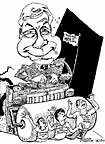
Ed Jagels-- on a roll
|
 |
By
Jim D'Entremont
In 1985, John Stoll was sentenced to 40-years' imprisonment for sexually molesting five little boys. Now, 19 years later, all but one of Stoll's purported victims have come forward to
swear that his crimes were wholly imaginary.
Held behind bars for a third of his life, Stoll is 60 years old. The Kern County, California orgiasts' network to which he supposedly belonged has been shown to be fictional. The
group was said to be a circle of polymorphously perverse devil-worshippers whose ranks included more than 70 adults and dozens of children. Kern County authorities claimed to have
unearthed a total of eight interconnected occult "sex rings" operating in Bakersfield, the county seat, and nearby communities, notably Oildale, a working-class suburb. One of 39 adults convicted
of participation in Kern County sex-ring atrocities, John Stoll is among the last to remain imprisoned.
Stoll's case was reopened by the Northern California Innocence Project in 2002. Last year, his lawyers filed a petition contending that his trial was invalidated by a host of factors.
In November, Kern County Superior Court Judge John Kelly granted Stoll a review based on three concerns: (1) the possibility that his conviction was obtained through false testimony; (2)
the issue of whether the methods of interrogation authorities used in questioning the young putative victims were fundamentally flawed and forensically useless; and (3) the lack of
unedited tapes of investigators' interviews with the allegedly molested children.
The defense presented its case at a hearing that began in mid-January. Four men, now in their late twenties, who had been between five and seven years old when Stoll and
three associates were tried for Satanic rape, recanted under oath. "This case tore my whole family apart when I was a kid, and it's doing it now," 27-year-old mechanic Christopher Diuri
snarled at the prosecutor. Sign painter Edward Sampley offered Stoll a tearful apology after testifying that investigators had pressured him to lie.
Victor Monge recalled being threatened with separation from his immigrant parents, and their deportation if he failed to cooperate. At the original trial, eight-year-old Monge
had revealed under cross-examination that he did not understand the purpose of the oath he had taken, or that it obliged him to be truthful.
Donald Grafton, 26, remembered being told that if he stuck to the prosecutors' script, "things would go better" for his mother. Marjorie Grafton, one of Stoll's three co-defendants,
was nonetheless also convicted of sexually abusing children; her victims were supposed to have included Donald and his brother Allen. She later appealed her conviction and won her
release. Allen, who has told reporters that he forgives his mother, clings to the idea that the abuse took place, but that he does not remember the experience. He nevertheless appeared at
Stoll's review hearing to admit under oath that he recalls nothing of his putative Satanic molestation.
Stoll's son Jed, the only holdout among his father's original accusers, says he stands by the testimony he gave at age six affirming that his father had sexually assaulted him.
Following his father's trial, however, Jed had publicly admitted making false statements under oath.
In cross-examination, Deputy District Attorney Lisa Green sought to portray the recanting witnesses as mercenary low-lifes with dysfunctions dating back to childhood sexual
abuse. Although most of the Kern County sex-ring cases have been discredited (half had been overturned by 1995), District Attorney Edward R. Jagels and his staff have continued to claim, in
the face of undeniable exculpatory evidence, that the sex rings existed and that multi-offender, multi-victim sexual abuse was a common occurrence in their jurisdiction.
In the early '80s, John Stoll made a good living as a foreman at a natural gas plant. The large house he owned was a populated, hospitable place. He rented rooms to several
tenants, and entertained friends including truck driver Timothy Palomo and computer programmer Marjorie Grafton. He permitted neighbors' children to swim in his pool. Stoll and his ex-wife,
Ann Karlan, had obtained joint custody of their son Jed in acrimonious divorce proceedings; Karlan was angered by the arrangement. When Jed returned to his mother's home after sojourns
with his father, he would be grilled by his mother and her pastor, whom she had begun to date.
Among Stoll's tenants was a man named Grant Self. Stoll and his friends were unaware that Self was a parolee who had been forbidden to associate with children. When,
under questioning by his mother, Jed Stoll said that Grant Self had touched him and Donald Grafton on the outside of their pants, Karlan reported the incident.
At the time, across Kern County, sex-abuse panic was in full cry. A contagion of belief in Satanic Ritual Abuse (SRA) was being spread by rumor, encouraged by sectarian Christian
clergy, and inflamed by reports in the Bakersfield
Californian and in broadcast media.
"If it bleeds, it leads," says attorney Michael Snedeker, describing the editorial bias of Kern County media. "Around Bakersfield, crime and punishment is the local sport." Snedeker,
who brought the Stoll case to the attention of the Innocence Project, has been instrumental in obtaining freedom for 18 of the Kern County SRA defendants.
Panic was also fueled by a growing subculture of
soi-disant abuse experts. Validating one another's tainted findings, local police and officials of Kern County Child Protective
Services began seeing perverts everywhere. Karlan's complaint alone was enough to convince law enforcement officials that a sex ring was operating out of John Stoll's home; the
ensuing investigation was pro forma. In addition to Grant Self, three others-- Palomo, Grafton, and Stoll-- were arrested.
Material evidence was nonexistent. Much was made of the presence of "pornography"-- the magazines
Penthouse, Playboy, and Club-- on Stoll's premises. But the accusing boys
seem never to have mentioned even seeing the magazines, some of which belonged to Stoll's non-accused tenants.
The children's chief interrogator, Deputy Connie Ericsson, later admitted that he had neither read nor heard of the California
Peace Officers' Standards and Training manual's
interviewing guidelines, and had relied on leading questions and suggestion to get the boys to say what he wanted to hear. The children were also badgered, coached and prodded at home by
parents and other adults.
The fact that all the alleged victims were boys and most of the accused were men enmeshed the case in strains of homophobia peculiar to the culture of Kern County, a place
where Christian fundamentalism, class tensions, and political corruption have been producing gay-conspiracy lore for generations. Ironically, Stephen Tauzer, chief prosecutor at the four
defendants' joint trial, was a closeted gay man. (See box.)
Although the accusing boys recounted stories of being mercilessly fucked and sexually mauled in other ways that would have caused injuries, their bodies showed no
corresponding trauma. As Stoll's friend and advocate Nicholas Peters notes in an online report, "The defense request for medical examinations of the children, even when offered with safeguards to
protect the children from discomfort, inconvenience, embarrassment, and intrusion, was denied by the court. In this case the prosecution was clearly not interested in obtaining any medical
evidence to support the incredible testimony of the children."
During the trial, Tauzer made repeated reference to kiddie porn produced during sex rites staged at Stoll's house. No such pictures were admitted into evidence, however; none was
ever found in this or any other Kern County sex-ring case.
Truth is no defense
The absence of evidence has never stopped Ed Jagels from sending accused men and women to prison. The county DA's website proudly states, "During Jagels's tenure as
District Attorney, Kern County has had the highest per capita prison commitment rate of any major California county." In
Mean Justice (1999), his bestselling exposé of Kern County's criminal
justice system, Pultizer Prize-winning investigative journalist Edward Humes examines the Jagels regime and tallies as many as 269 wrongful investigations and arrests, and 92 erroneous
or wrongful convictions.
Jagels first took office in 1983 and remains entrenched, despite rumors that he might seek early retirement. He has recently been plagued by allegations of corruption, the
embarrassments of a messy divorce, and questions about his sexuality. A scion of the monied elite in an oil-rich county whose per capita income, according to US Census figures, was $15,760 in 1999,
Jagels was educated at Stanford University and UC Hastings School of Law. His 1982 election campaign took a rigorously vengeful law-and-order stance that appealed to right-wing hard-liners
and victim-culture activists; his slogan was "Ask a Cop." Having played a role in the passage of California's Proposition 8, the Victims' Bill of Rights, Jagels promised to be a strong advocate
for victims of criminal wrongdoing.
An efflorescence of lurid sex cases in Kern County may have helped carry Jagels to electoral victory. Abuse hysteria had been brewing since 1980, when a local woman named Mary
Ann Barbour became obsessed with the idea that her two step-granddaughters, Bobbie and Darla McCuan, aged six and four, were being molested by their biological grandmother's
current husband. Barbour, prone to erratic and sometimes violent behavior, suffered at least two breakdowns attributed to her anxieties over the girls' welfare. Her abuse accusations
received organizational support from Stronger Legislation Against Molesters (SLAM), and a local group, Mothers of Bakersfield.
Bobbie and Darla were subjected to rounds of interrogation by social worker Velda Murillo of Child Protective Services, who would soon be training other investigators in methods
of securing "disclosures" from children. After Barbour formally revealed her suspicions to law enforcement officials in October 1981, Murillo's efforts were aided by Sheriff's Deputy
Betty Shaneyfelt.
In Satan's Silence, their groundbreaking 1995 account of American ritual-abuse panic, Michael Snedeker and journalist Debbie Nathan describe an informational videotape
Murillo prepared in 1984 for child-protection workers delving into sex-crime allegations: "...she tells how important it is that only the investigator and the child be present. The room must be
locked, and Murillo also recommends that interviewers allow themselves plenty of time with the child-- a whole day, if necessary-- because 'you never know what you're going to get into.'
She stresses the need to talk about what
might have happened, then to seek a yes or no answer from the child."
In the course of Murillo and Shaneyfelt's investigations, tales of abuse by Bobbie and Darla's father, Alvin McCuan, began to emerge. McCuan was arrested. The girls were committed
to a Kern County children's facility called Shalimar, and later released in the custody of Mary Ann and Gene Barbour. Accusations against the girls' mother, Debbie McCuan, and at least
eight others soon followed.
When the McCuans' friend Scott Kniffen agreed to appear as a character witness, the accusations engulfed Kniffen and his wife Brenda. Their home was eviscerated by police in
a fruitless search for pornography. Their sons, aged six and nine, were made wards of the state. At Shalimar, the boys were pumped for information by Velda Murillo and Carol Darling, a
social worker whose husband headed the Kern County Sheriff's Child Sex Abuse Unit.
The McCuans and the Kniffens went on trial in the autumn of 1983, a few months after Jagels, pledged to make life hell for the sex-abusers of Greater Bakersfield, became DA
The prosecution crafted a narrative in which the two couples played a central role in secret bacchanalia. None of the other individuals accused by Barbour and her step-granddaughters ever
went to trial.
As the McCuan/Kniffen proceedings dragged on into 1984, one witness who made a decisive impression on the jury was the state's diagnostic medical expert, Dr. Bruce Woodling,
who said he was certain that the Kniffen boys had been anally penetrated by adult male penises with some frequency. The reason, he said, was that when he teased their anuses with a Q-tip,
the openings widened rather than tightening shut, showing that their sphincters had been trained to relax. Woodling could cite no other physical evidence; the "anal wink" theory has since
been scientifically shown to be a pipe dream.
All four defendants were found guilty; each was sentenced to over 240 years in a state penitentiary. The length of the sentences set a state record. The couples appealed and
were finally released in 1996 after serving 14 years of their prison sentences-- during which the spouses were kept apart while their traumatized children grew to adulthood living in other
people's households.
In subsequent Kern County sex-ring investigations, at least 84 people were charged with SRA-related crimes. Even when charges were dropped or not filed at all, many families
were damaged. The Kern County witch hunt spawned copycat cases elsewhere and laid the groundwork for the McMartin Preschool case, which erupted soon after the McCuans and the
Kniffens entered prison. Forming a virulent positive-feedback loop, the McMartin debacle fed on Kern County cases that preceded it, and fertilized-- within Kern County and beyond-- the crop of
cases that followed.
In Manhattan Beach, a community on California's Santa Monica Bay, Virginia McMartin operated a daycare center whose staff included several family members. In the summer of
1983, a troubled mother named Judy Johnson began claiming that her two-year-old son had been sodomized by Ray Buckey, the owner's grandson. Although the McMartin Preschool had
been operating without incident since the mid-1960s, rumors that it hosted a Satan-worshipping abuse cult quickly erupted. At least 15 children were said to have suffered arcane forms
of victimization. The school was shut down and physically destroyed in the search for evidence.
Ms. magazine's Gloria Steinem helped fund archeological digs to locate "abuse tunnels," not
a hint of which was ever found, beneath the property.
Buckey, McMartin, and their codefendants became the objects of the longest and most expensive trial process in US history, beginning in 1987 and ending more than three years
later in acquittals on most charges and hung verdicts on others, leaving the defendants destitute and emotionally scarred, but free.
The long arm of hysteria
Long before first of two McMartin trials began, however, the cadre of self-designated abuse gurus who perpetrated the case had begun dispensing advice to law enforcement
personnel and child-protection workers as far afield as Massachusetts, where Middlesex County prosecutors were pursuing a similar case against the Amirault family, whose Fells Acres daycare
center was held to be a matrix of perversion. McMartin-related disinformation and its attendant media circus helped bring about a string of abuse convictions that reached its apotheosis in the
mid-'90s with mass-molestation panic in Wenatchee, Washington. On September 24, 1984, when John Stoll's trial began, McMartin had been in the news for over a year.
By the mid-'80s, there was considerable give-and-take among child-savers across California and around the nation. Horror stories were presented at conferences for the delectation
and instruction of attending professionals. Some reports by Kern County caseworkers and law enforcement officials read like exquisitely twisted slapstick pornography. Parents and
co-conspirators were supposed to have hung children from ceiling hooks and raped them as they swung above the floor; made them snort 18-inch lines of cocaine; filled girls' vaginas with
pet food which cats and dogs would extract with their tongues; pissed and defecated on children who sprawled beneath them; made children eat shit and drink blood; ritually hacked up cats,
pigs and cows; screened snuff-porn videos showing what happened to girls and boys who "told;" and forced children to witness human sacrifice.
Carolyn Heim, a children's therapist who worked at Shalimar, helped spread the idea that Satanic abuse scenarios encompassed ritual killings. Children known to be missing couldn't
be traced back to the Satanic sex rings; no bodies were found. But police and social workers swore that child-murder was a frequent practice, and that many of the murdered children were
"altar babies" bred for slaughter. Born in secret, lacking birth certificates, burned to ashes that were ground to powder and dispersed, these infants were victims of an airtight murder scheme.
That no evidence of such a phenomenon has ever been found has been cited as evidence of its existence.
The extremity of some of the allegations began to raise doubt, but the investigations continued. Occasional true instances of child abuse, usually within families, were routinely
plugged into the sex-ring conspiracy theory. As case after sex-ring
case went to trial in Kern County, some of the defendants were seemingly punished for their scruffy lifestyles. In the trial of
Rick and Tootie Pitts and their six codefendants, Judge Gary Friedman, president of the local Rotary Club, treated the accused with condescension bordering on open contempt,
expressing distaste for the fact that some had tattoos. Hoping to show that his alleged victims had never seen his genitals, defendant Wayne Forsythe admitted that
Fuck This was tattooed on his penis. That no child ever mentioned having seen this memorable adornment counted for less than the idea that only a person with deviant tastes would have such a tattoo.
As zealotry gained momentum, some complained that even DA Jagels was dragging his feet. But divisions between true believers and a growing number of skeptics became
evident across the region by the end of 1985, and steadily widened. By 1989, when Margie Grafton and Tim Palomo were released, the local witch hunts were subsiding. But Jagels and his
acolytes kept on insisting the sex-ring defendants were guilty of actual crimes.
In retrospect, the seminal role of Kern County in the American sex-abuse panic of the 1980s and '90s seems unsurprising. The region encompasses the southern end of
California's Central Valley, an area blighted by agribusiness and industrialization. Situated 110 miles north of Los Angeles, Bakersfield and its surroundings have been steeped in reactionary politics
for generations. In the 1920s, the Kern County Ku Klux Klan was among the most active chapters of the xenophobic, right-wing secret society outside the Deep South.
An infusion of indigent, Bible-believing Dust Bowl refugees in the '20s and '30s heightened the prevalence of Old-Time Religion. In the post-Anita Bryant age of homophobic
fervor, Baptists and Pentecostals in the Central Valley mobilized against weird sex. Though immersed in secular, blue-collar, shotgun-and-pickup-truck culture (Merle Haggard and Buck
Owens launched their careers in the Bakersfield country-music scene), the county's population of 676,000 includes tens of thousands of fundamentalist Christians who have perfect faith that
the Devil and his works are constant threats that must be vanquished with Old Testament zeal.
As the gulf between wealth and poverty gaped wider under President Ronald Reagan, the Devil seemed acutely present in depressed small-town and rural areas like Kern
County. "Theories of collective behavior," writes sociologist Jeffrey S. Victor in
Satanic Panic (1993), "arise from shared sources of social stress" that are often socio-economic.
Victor also notes that the SRA panic "serves the unifying function of a search for internal enemies." In the 1980s, it conveniently replaced the waning menace of Communism,
bringing together traditional adversaries-- Protestants and Catholics, "family values" activists and feminists, secular conservatives and the Christian Right. By the 1990s, adherents like
Gloria Steinem had backed away from the Satanic aspect of SRA-- a hard sell in leftist circles-- and begun calling the phenomenon "Sadistic Ritual Abuse." The abbreviation remained the same,
to the advantage of both secular and religious true believers.
The true believers of Kern County-- and a DA's Office trying to save face-- are now focused on efforts to keep John Stoll under lock and key. As
The Guide goes to press, Stoll remains in the county's Lerdo Jail. He and his supporters are opitimistic; even Grant Self, target of the original accusation, has recently been paroled. But when Stoll's review hearing resumes
on February 23 after a month-long hiatus, the prosecution will present its case. If Judge Kelly nullifies his original trial, the prosecution may seek a new one.
"People need to know that problems of false accusation and wrongful conviction for sexual abuse have not gone away," says Michael Snedeker. Those problems will persist as long
as the people of Kern County-- and America at large-- continue to demand invented monsters.
You are not logged in.
No comments yet, but
click here to be the first to comment on this
Magazine Article!
|