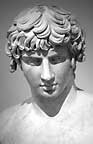
Antinous everywhere!
|
 |
By
Michael Thompson
Rome is a wonder of
archaeological and artistic heritages. Some might visit St. Peter's
for one kind of spiritual inspiration. But gay travelers are likely
to feel different connections and resonances. What remains of
pre-Christian Rome is a window onto older concepts of sexuality, and
an alternative aesthetic. The relation of the Church to that prior
legacy is complex and conflicted.
A visit to almost any
Italian museum reveals that the ancients didn't equate nudity with
a lack of modesty. Gods, emperors, athletes, warriors, and noblemen
could embody ideals of human perfection without the artifice of
garments. As had the Greeks, from whom they inherited so much,
ancient Romans revealed man without reserve. Manifestations of this
comfort with the male form are found in marble all around the city.
The Vatican Museum (Viale
Vaticano 13), paradoxically, is home to one of the world's most
amazing collections of nude male beauty, diverse as to time and
place. The Church wasn't always so tolerant. Fourth-century
Christian emperors looked the other way when roving mobs led by
monks looted and destroyed temples, particularly in the countryside,
and countless statues of incredible beauty were shattered. More than
a millennium later, with the old pagan religions safely dead, a more
confident Church (following the fashions of the political elite)
commissioned new works inspired by these same artifacts.
During the
remarkable 15th century, the finest artists of their time were
employed by patrons such as the Medici family of Florence, who also
contributed four popes. As the West emerged from the "dark ages"
it looked back to the old Roman empire as a cultural beacon. Much as
local gods and sacred places of conquered peoples had been
incorporated into Roman pagan religions, so too the temples,
institutions, holidays and aspects of the Roman gods had been
quickly assimilated into the new Christian milieu. Eventually much
of pagan art was also accommodated. The sexual proclivities of some
church superiors seem often to have made them sympathetic at crucial
times in this transition.
The Vatican complex
includes the Museo Pio Clementino with its 54 galleries, and the
tour here ends with Michelangelo's masterpiece at the Sistine
Chapel. Postures and knowing looks so faithfully captured by the
master artist betray his affection for the street youth and urchins
who portray the angels and saints, intact with the grit and grime
they brought with them as models (and likely bedmates). Through him
they transcend humble origins, and bridge the millennia, recalling
fragments of an older world we can no longer fully comprehend, when
the divine could guilelessly assume mortal flesh.
Spare some time
also for other halls, including Museo Chiaramonti, Museo Gregoriano
Etrusco, and Museo Egiziano, with their ancient Roman, Greek,
Etruscan and Egyptian materials. Get a head start from the Vatican
Museum's website (Mv.vatican.va), which offers extensive virtual
tours.
Other worthwhile
destinations include the Borghese Gallery (Piazzale del Museo
Borghese 5; Galleriaborghese.it), with examples from the works of
Caravaggio, Bernini, Canova, Rubens, Raphael, Titian, and many
others from the collection of Cardinal Scipione; and the Capitoline
Museums (Piazza del Campidoglio 1, atop Capitoline Hill;
Museicapitolini.org) which ranges over ancient art and architecture.
In Rome, you don't have
to stay indoors to savor magnificent art. The Fontana delle
Tartarughe in the Piazza Mattei depicts four youths, one at each
corner, each astride a porpoise with turtles above. The fountain
dates from 1588, and was restored and modified in 1658. You'll
find this tiny square just off Via Arenula, near the tranquil
courtyard of the Palazzo Mattei di Giove, which is adorned with
antique statues, busts, and bas-reliefs, and home to the Italian
Center for American Studies.
The Villa of Hadrian (Via
di Villa Adriana 204) was the emperor's retreat to the northeast
of the city, now in Tivoli. that includes the greatest Roman example
of an Alexandrian garden. The Spanish-born Hadrian was also
responsible for the building of the Pantheon and the wall that bears
his name that protected Roman Britain from parts north. Hadrian was
the lover of Antinous, whom he made a god after the youth's death.
Antinous represents a Roman ideal of youthful beauty, and his visage
survives in countless busts and coins as perhaps the most common
among extant portrayals of any face from the ancient world.
But many ancient
cults left few relics and scant information. It would be fascinating
to know more. In Greece and Rome, sex could be sacred, and bodies
were regarded more holistically, before concepts such as sin and
pornography profaned them with divisions of good and evil. About
Mithraism, for instance, little is known except that it was popular
with soldiers, exclusively male, celebrated underground, and
involved intense initiations. The cult of Apollo was close to
official ideals of the Roman state, but it was complemented by
now-lost rites and rituals honoring Bacchus and Dionysus.
Such mysteries and
ecstasies could be celebrated in temples and public festivals. Some
famous marbles and paintings, if wrought today, would verge on the
illegal. One wouldn't want to gloss over some brutal aspects of
Roman society, but their civilization had characteristics we might
envy.
The dissonances are
instructive. Stone endures only a little longer than flesh in terms
of the ages, but unless intentionally broken, long survives film
negatives or digital files. One trusts these ancient artworks will
outlast our own age to inspire unimaginable futures.
You are not logged in.
No comments yet, but
click here to be the first to comment on this
Magazine Article!
|