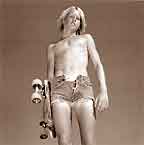
One of Mel Roberts' boys
|
 |
...is not when it's cool
By
Michael Bronski
Shorter Views: Queer Thoughts and the Politics of the Paraliterary
by Samuel R. Delany
Wesleyan University Press
How to order
Cool Rules: Anatomy of an Attitude
by Dick Pountain and David Robins
Reaktion Books
How to order
California Boys
Mel Roberts
Fotofactory Press
How to order
What do the following all have in common: James Dean, Chrissie Hinde, Bogart smoking, Marlene Dietrich's cheekbones, Gangsta Rap, Lauren Bacall's gaze, Berthold Brecht, heroin, Billie Holiday, Castigloini's 1516
Book of the Courtier, Eldridge Cleaver,
Lenny Bruce's irony, Grace Kelly, and Cary Grant? They are, for lack of a more precise word, cool. Taking their cue from Susan Sontag's seminal 1964 essay "Notes on Camp," Dick Pountain and David Robins in
Cool Rules: Anatomy of an Attitude (Reaktion Books,
$19.95) attempt to delineate that elusive and ambiguous entity. Declining to investigate the "ontological status" of cool "is it a philosophy, a sensibility, a religion, an ideology... an attitude, a zeitgeist?" they claim that we all "know cool when we see it."
Pountain and Robins's working definition is that "cool is an oppositional attitude adopted by individuals... to express defiance to authority," and while this might seem obvious, the pleasure and joy of their brief, elucidating study is in their
delicious delineation of the details. It's no surprise that much of what gets cast as "cool" such as Dean, Dietrich, Bacall, and Holiday is key to gay culture. These icons positioned between classic camp and sincere idolization are defining items in both a homosexual
and oppositional context.
Pountain and Robins cast their net wide, and they chart how rebellions against standards of sexual, gender, race, class, artificiality, and "decency" lead to coolness. While they acknowledge the gay underpinnings of some of this, they could have
done better. Still Cool Rules entertains and illuminates, and for the most part, is pretty cool itself.
Samuel R. Delany's Shorter Views: Queer Thoughts and the Politics of the
Paraliterary (Wesleyan University Press,
$22) follows close on the publication in 1999 of
Times Square Red, Times Square Blue and Bread &
Wine. The first was a witty, politically potent analysis of sexuality and public space that, using Times Square's Disneyfication as a starting point, argued for cruising's democratic value. Delany fused autobiography, social and economic analysis, postmodern theory, and simple common
sense to make his case, with bold and illuminating result.
Bread and Wine is a graphic novel filled with drawings of sexual intimacy that details Delany's meeting and ensuing relationship with his lover, Dennis Rickett. This courtship and evolving love story between
a homeless man and a university professor who meet on the street where Dennis is panhandling was the perfect visual and emotional counterpart to
Times Square.
In Shorter Views, Delany collects 25 essays, interviews, and reviews that appeared between 1987 to 1998 in magazines and anthologies. Delany's topics are wide-ranging. He is as much at ease explicating Derrida's literary theories as they apply
to science fiction as he is writing an analysis of the African-American SM scene. In "Pornography and Censorship" he discusses how debates about pornography would be more valid if the critics discussed their own arousal. While this point may be obvious to anyone
who reads pornography with the intent for which it is written, the fact that it needs saying shows how erotophobic is our culture. The same could be said of his essay "The Making of
Hogg," in which Delany discusses the process of writing
Hogg considered so sexually violent that it could not be published for 22 years and the work's critical reception.
Throughout the collection, Delany's remarkable erudition and range of literary reference is as evident as his ability to generate controversy, push boundaries, and generally get under the reader's skin. In the middle of an interview on the literary
canon, he includes a ten-page riff (replete with new scholarship) on how the suppression of information about Stephen Crane's homosexuality helped secure his place in American literature. By making so many social, literary, and historical connections, Delany helps our
world make a little more sense.
Mel Roberts' photos of California surfers and skaters-- and guys who looked the part were a staple of gay erotica in the 60s and 70s. Born in 1923, Roberts helped define American gay iconography. A sample of his work appears in the just-published
California Boys (Fotofactory Press, cloth, $50)
| Author Profile: Michael Bronski |

|
Michael Bronski is the author of
Culture Clash: The Making of Gay
Sensibility and The Pleasure
Principle: Sex, Backlash, and the
Struggle for Gay Freedom. He writes
frequently on sex, books, movies, and
culture, and lives in Cambridge,
Massachusetts. |
| Email: |
mabronski@aol.com |
You are not logged in.
No comments yet, but
click here to be the first to comment on this
Book Review!
|