More than meets the eye
|
 |
By
Richard D. Mohr
Nearly every week, the Partnership for a Drug-Free
America places a full-page display ad in the
business section of the New York Times.
The often gorgeous designs of the ads are as subtle
as their
overt messages are blunt: Drugs Scramble Your
Brain. Fire Employees Suspected of Drug Use-- It's
For Their Own Good. Drug Use Cuts Corporate
Profits. That sort of thing. In their iconography,
however, the ads roam over a much wider social
field and frequently convey insidious messages--
ones no less powerful for their indirection.
An easy case: a disproportionately high
percentage of these ads picture a professional
woman
as the drug user in need of social disciplining.
Frequently these women are the only women to be
seen anywhere in the Times' business
section. The ads freight these pages with the
message that
women do not belong in business-- they belong
somewhere else. The ad campaign uses America's
demonization of drugs as both an energy source
and vehicle for advancing an agenda of "traditional
family values."
It should not then come as much of a
surprise that the ad campaign also includes
iconography
which links, indeed virtually identifies, demon
drug-use with being gay. Several times over the
last
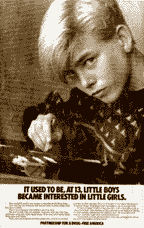
three years, Drug-Free America has run an ad
which features a nearly life-size portrait of a
sylph-like
boy. You have to look twice to tell that it is a boy,
for he is coded all over with signs of femininity.
His lips are slightly glossed, slightly pursed. His
posture coy. His head tilts forward over a unisex
sweater causing luscious and illuminated blond
tresses to cascade over one eye. The other looks
seductively at the camera-- square at you. The arc
formed by his neck and hair continues on to a
plastic tube which he holds towards cocaine lined
on a mirror, which in turn reflects his image.
Indulgent and languorous, Narcissus invites you to
drown with-- in-- him.
The caption's huge sans serif
headline reads: "It used to be, at 13, little boys
became interested in little girls." What is the
unstated antistrophe? One obvious possibility is
"But now little boys
are becoming interested in drugs." The copy,
dripping with nostalgia and, like the caption, cast in
the
Norman Rockwell tense-- the imperfect--
continues: "Boys and girls used to use straws to sip
sodas
at the drug store." Our world is out of kilter, things
are somewhat queer. At a minimum, drug-use is
billed as arresting heterosexual development. It
deflects youth from the culturally proper object of
erotic choice (coke replaces 'woman'). And it
disrupts the social rituals by which culture prods
youth
along nature's path (snorting replaces courting).
But this verbal flag of deviance is not entirely queer,
for it fails to establish for the youth a positively-
limned perverted identity. The ad's iconography
takes up this chore. It layers over the boy both of
the tropes by which our civilization marks out
perverted male sexuality: sexual inversion (being a
woman trapped in a man's body) and bad object
choice (desiring a man rather than a woman).
The codes of femininity which engulf the
boy iconographically suggest that a feminine
essence is seeping through the shell, the pores, of
his marginally male body. The boy-- really, deep
down-- is a girl. The caption's cadences invite us
to another possible antistrophic horror: "It used to
be that little boys became interested in little girls,
but now-- with drugs-- little boys become little
girls." The ad would have us believe that more than
corrupting the body, drugs corrupt, pervert, the
soul.
A man's boy
But what of the lad's enticing glance? This
provides him with a bad object choice-- you, the
viewer. It is practically an axiom of contemporary
art theory that the gaze of the viewer is presump
tively a male gaze. But even without theory, we
know that overwhelmingly the readership of the
Times' business pages is going to be
male. The boy's come-hither glance is for a man.
He invites the
man to become absorbed in his gaze. As a
consequence, the boy's association with drugs
makes him
doubly homosexual-- as having both inverted
gender and improper object choice. The ad uses
homo
sexuality and drugs to mutually demonize each
other. But the ad achieves this identification
only at a high and surprising price: The ad is so
thickly laden with codes and subterfuges that, top
-heavy, it inadvertently trips over its intentions and
unwittingly reveals new ranges of meaning.
Through the very glamour and lure which the ad
uses to homosexualize its subject, it turns its
viewer
into a pedophile. The sumptuous layout gives the
boy a sensuous, enticing star quality. Paradoxically
the very medium of its anti-gay message makes
the boy sexy to men.
Perhaps we have here an example of what
Foucault hints at when in the
History of Sexuality he repeatedly but vaguely
refers to "perverse implantations," those means by
which culture instills or
invokes sexual desires, rather than represses or
punishes them. The ad gives its viewer ideas, ones
that he might very well not have had otherwise. If
not exactly nudging him toward action, the ideas
at least open the mind to new possibilities for
actions; and they do so, even though they are put
forth
in a context of condemnation and suppression.
Thus for Foucault, psychiatrists create perversions
even as they are ostensibly trying to suppress
them; insane asylums make their inhabitants crazy;
and
prisons produce, rather than rehabilitate, the
criminal type. Similarly, the ad, even as it
demonizes
sexual perversion, implants in the mind of the
beholder the idea of the most condemned
perversion
of all.
Pedophilic images are surprisingly common
in society-- surprising given that society careers
from hysteria to hysteria over the possible
sexiness of children. Society seems to need these
images.
And the images are allowed to the extent that they
are buffered, not read in the first instance as
sexual representations, and do not develop beyond
mere suggestive idea into a pedophilic discourse,
a context of meaning for the pedophile. Indeed the
social requirement that the pedophile's existence
be shadowy helps realize the social requirement
that sexy images of children will not be read as
such. Society needs the pedophile: his existence
allows everyone else to view sexy children inno
cently. But his conceptualization by society must
not be allowed to be rich enough to be interesting,
to constitute a life. Sexy images of children
abound, but NAMBLA remains a universal whipping
boy.
Society's panicked worry then is not chiefly
about the sexiness of kiddy pics-- either as
something inherently dirty or as having aesthetic,
erotic, and moral effects on people in general.
Rather, social conventions simultaneously insist
upon and convulse over the existence of a certain
type of mind, one which-- quite
independently of what it sees and does-- can be
branded as perverted. This becomes even clearer if
one sorts through the tangle of statutes,
regulations, administra
tive interpretations, and judicial decisions that
makes up current kiddy porn law.
All in the mind's eye
What makes a picture of a kid into kiddy
porn? For starters, the child's being naked, even
partially naked, is not a necessary condition for
kiddy porn. Under the current administration, the
child pictured may be completely clothed and the
picture may still be considered indictable kiddy
porn. Further, the child need not be performing
any act that would be socially counted as sexual in
order for the picture to still be legally treated as
kiddy porn. Nor need the child even be posed pro
vocatively, lewdly, or seductively. But then what's
left? What distinguishes kiddy porn from Christ
mas snapshots? The mind of the beholder. The
image is kiddy porn if it is possessed by someone
who, quite independently of the image's content,
can be considered perverted. And whether or not
parents find themselves indicted for bear-rug and
bathtub shots of their kids turns on what prosecu
tors (and juries) think was in the parent's mind in
taking the photos-- rather than on anything
distinctive about the pictures themselves. It is the
mind, not the image, that is dispositive.
Insulate that mind from the rest of the
culture, label it perverted, and sexy children are
alright. We see them-- virginal and alluring-- in
mainstream clothing ads. Havana Joe Boots invites
the straight male yuppie readers of Details
to "Save Your Sole," even as you lose it (your soul,
that
is) in the bare butt of a naked, ambiguously sexed
child, tush thrust camera-ward.
On the back page of the New York
Times Magazine's
special issue on children (October 9, 1995) and on
billboards up and down the Metro-North commuter
lines, Tommy Hilfiger ads display
a naked-tummied, adultly dressed boy of about
six dangling insouciantly from a branch. His tongue
slurps the air. His boxer shorts scooch up above
his belt loops just as underwear does in adult jeans
ads which everyone acknowledges as sexy in the
main because of this joint peek-a-boo revelation
of
torso and boxers. A cliche of cultural studies holds
that wearing briefs says "I have a penis," while
wearing boxers says "I am the penis."
Nevertheless, stamp the ad, with its child phallus,
"not kiddy
porn," for it incidentally serves as a promotion for
the
Times' favorite child-oriented charity, the
Fresh Air Fund.
Using social concern as a pedophilic
medium is also the lucky gambit of photographer
Larry
Clark's movie, Kids. The hugely successful
media blitz attending the movie's release carefully
avoided any reference to, let alone an examination
of, Clark's history of obviously pedophilic photo
graphs-- Teenage Lust (1983, 1987),
1992
, and Die perfecte Kindheit (1993). The
publisher of the
last collection of photos, fearing customs seizures,
has not released the book in the United States.
The collections include photos of Clark himself
cavorting naked with naked boys in fountains.
Indeed Clark himself-- an ex-con-- was no where
in evidence during the media blitzes. Instead the
morning TV shows offered a parade of latter-day
Officer Krupkes-- Krupkes with PhD's-- to discuss
what the hell's the matter with kids today, to
bemoan their "social diseases," and to praise the
pseudo-documentary's realism and grit in facing
or at least showing these problems. Drug taking,
cat
kicking, petty thievery, unsafe sex, public
urination, assault-- you name it-- Clark has
carefully
larded his film with kids' naughty doings in order
to distract the critics' view from the cinemagraphic
point of the movie which is to linger on naked
boys-- naked boys spritzing each other, naked
boys
relaxing in hustler poses, naked boys shooting the
macho breeze, naked boys showing off their
cocks. Moralizing becomes, like the Fresh Air Fund,
both a vehicle and buffer for prurient interest.
The film's pseudo-documentary style
compliments the effects of its moralizing content.
The
documentary style makes the pretense of simply
"presenting the facts"-- a would-be charitable and
disinterested act. But this posturing simply serves
to insulate both director and viewer from taking
responsibility for the movie's voyeurism, its visual
lusting for kids.
The movie's final scene-- the sleepy
aftermath to a teenage orgy of sex and drugs-- is a
take
-off on Michelangelo's 1492 sculpture "Battle of the
Lapiths and Centaurs" with its swarm of naked
male flesh deployed for a good moral cause--
saving women, who, however, are conveniently
absent
from the sculpture. With Clark, the swarm of naked
male flesh hugged and caressed by the roving
camera is kiddy flesh, all deployed for a good
cause. The gorgeous support-actor awakens
shocked to
the glistening carnage and, as the movie's last line,
queries for the Krupkes, "Jesus Christ. What
happened?" This ending is laughable, but the
critics ate it up like talk-show fodder.
A live virus vaccine
Everyday pedophilic iconography can even
be used as a force for innocence. Such is Michael
Jackson's 1995 videographic appropriation of
Maxfield Parrish's 1922 pedophilic painting "Day
break" as part of Jackson's return and rehabilitation
from charges of child molestation. Despite its
central image of a pubis-exposed ten-year old in
the pose of a succuba, the Parrish painting has
stood
as a cultural icon on a par with Duerer's "Praying
Hands." Today, in the afterglow of Norman
Rockwell, it seems hard to imagine, but by the end
of the 1920s, one in every four American house
holds had purchased a print of the Parrish painting
with its fulsome depiction of a wholly naked
sylph, hands to knees, leaning over a supine
wakening woman clad in flowing robes, framed by
Grecian columns, all set against flowering trees, a
peaceful lake, and purple misty mountains.
Jackson remakes this image to accompany
the first love-song released as a single, "You Are
Not Alone," from his double-album HIStory:
Book I
. A convincing love-song from Michael is going to
be a tough sell given the cultural backdrop of the
molestation charges. In August 1993, a twelve
-year old boy accused Jackson in a civil lawsuit of
sexually molesting him over a four-month period
the previous year. Jackson denied the accusations,
but settled out-of-court for an undisclosed sum
that some estimates said amounted to millions of
dollars. What to do? Well, the thirty-seven year old
black man re-casts himself in the role of Parrish's
ten-year old white all-but-genderless sylph. Icono
graphically he regains for himself his earlier status
as child star and sends the recuperative messages:
How can I be a child molester when I am a child
myself? How can I even be sexual since I do not
have a sex? I'm not a sexual threat: I'm white.
He reconfigures and neutralizes the picture's
succuba overtones by substituting for the reclin
ing Arcadian the woman whom he married after the
molestation charges broke into the general press,
Lisa Marie Presley. By contrast to Jackson she looks
in the video like a beached whale. Here artistic
effect is sacrificed in order to heterosexualize the
video's hero. Jackson deploys Parrish's pedophilic
image to make himself over to appear as innocent
as a child-bride, while also pressing the view that
if there are any pedophiles around-- and there
may well be-- they are in the audience, not in the
frame.
Who needs an All Party Congress to restore
one to grace when one can use images homeo
pathically. Jackson is cured by a dose of the very
poison that ailed him. He has brilliantly recycled
and teased America with a pedophilic image, which
he has stunned and altered so that it can serve as
a live-virus vaccine against the very charges of
pedophilia laid against him. And it worked. He's
back.
By contrast, during the week that I drafted
this article, a journalism professor at Toronto's
prestigious Ryerson Polytechnic University was
suspended for having suggested in class that not
all
acts of intergenerational sex should be counted as
child abuse. Looking is okay, thinking about these
issues is not.
Why does the American national psyche
need the pedophilia of everyday life? What drive
does it stoke, even as the nation condemns any
mention or thought of it? Following the lead of
some
other social critics like Kenneth Plummer and
James Kincaid, Walter Kendrick argues in a brave
piece for the New York Times Magazine's
all-kids issue that our contemporary
understanding of
childhood as a period of innocence and purity
began only in the Victorian era, and that before
then,
going back to the Middle Ages, children were
viewed simply as little adults.
Apparently having gone about as far as he
felt he dared in the
Times, Kendrick concludes by pointedly
reducing the anxiety that these revelations no
doubt stir in the average reader: "Today's
hysteria over child pornography springs mainly
from adults' fear of themselves, the guilty
knowledge
that you don't have to be a pedophile to get an
occasional frisson from looking at children." But
guilty self-knowledge does not hysterical witch-
hunts make; one simply lies low. True: today's
hysteria springs mainly from adults' fear of
themselves, but this fear issues from their half-
recogni
tion that to admit explicitly, as pornography does,
that children are sexy would mean that virtually
everyone is a pedophile. In light of the current
cultural view that sexual interest in children flows
only from, is contingent solely on, the mind of the
pedophile, for anyone to admit that he or she has
any frisson at all from looking at children is
necessarily to be branded as deviant. Were society
to
allow itself to articulate that it does have sexual
interests in children-- little adults are not sexy, but
innocence and purity are-- society would have met
the enemy and seen that he is us.
The hysteria over kiddy porn, then, is not
simply the result of America's epicyclical prudish
ness about matters sexual. Rather it is the result of
our general worries about purity, innocence, and
identity-- who we are. Childhood-- the social
concept-- cannot do the moral work society has
created
it to do. In a century whose distinguishing marks
are depression and Depression, genocide and the
prospect of omnicide, life can look pretty damn
nasty, brutish, and short. And so to serve both as
ethical prop and security blanket, we have created
a moral museum of innocence and purity-- our
Eden-- and we have labeled it childhood. But then
the paradox of everyday pedophilia is this: once
we have made over childhood into purity and
innocence, we naturally enough want to have it, but
to
have it would make it what we no longer want. **
Editor's Note: A slightly differently-edited version of this article first
appeared in Art Issues #42 (March/April
1996), 8721 Santa Monica Blvd. Suite 6, West
Hollywood, CA 90069; for inquiries, call 213-876
-4508.
| Author Profile: Richard D. Mohr |
| Richard D. Mohr is Professor of Philosophy at the University of Illinois-Urbana and author of
"Knights, Young Men, Boys" from Gay Ideas: Outing and Other Controversies
(Beacon Press, 1992). |
You are not logged in.
|