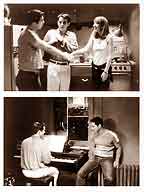
Just lookin' for some space...
|
 |
Trick is cute but anemic
By
Michael Bronski
Trick
Jim Fall, director; written by Jason Schafer; with Christian Campbell, J.P. Pitoc, Brad Beyer, Lorri Bagley, Stephen Hayes, Kevin Chamberlain, Helen Hanft
How to order
Ten years ago, the idea of "gay films" still was new. Maybe there were one or two independent American films each year with gay themes, probably written and
directed by gay people. Gay audiences flocked to see them, feeling they had never seen themselves represented on screen. Now gay films are released all the time--
sometimes several a month. Within the past year we've seen
Billy's Hollywood Screen Kiss, The Opposite of
Sex, High Art, The Hanging
Garden, Boys Love Two, Relax... It's
Only Sex, All the Rage, The Velvet
Goldmine, Edge of Seventeen, Get
Real, Gods and Monsters, and a bunch more. Who would have dreamed of such riches? But the new
glut bumps against the law of averages: the more gay films made, the higher the proportion of less-then-perfect product.
Take Trick-- the new gay-film-of- the-month, written by Jason Schafer and directed by Jim Fall. On the surface, this is an entertaining, tidily written little
comedy set in Greenwich Village and focusing on true love in the late 1990s. Shy Gabriel (Christian Campbell), a writer of as-of-yet-unproduced musical comedies,
meets hunky Mark (J.P. Pitoc) a go-go boy who doesn't hustle, and while lacking the expected heart-of-gold does possess a sense of humor and self-respect. But this is
boy-meets-boy with a gimmick. Mark and Gabriel meet as the evening is turning into night and discover that-- time and time again, no matter which way they turn--
they cannot find a place to fuck. Gabriel's straight roommate Rich (Brad Beyer) is bedding his girlfriend Judy (Lorri Bagley) at home; Mark lives with his mother;
Gabriel's friend Perry's (Stephen Hayes) place is available and then rescinded when he re-unites with his ex-lover (Kevin Chamberlin); a trip to a dance bar turns into a fight;
even a quiet late-night snack turns into a gab-fest with Gabriel's friends (although off-Broadway legend Helen Hanft turns in a very funny performance as the waitress).
At first this feels like a gay riff on a 1930s screwball
comedy-- It Didn't Happen One Night-- and it all works in a quiet sort of way. But as the film proceeds,
it becomes less and less likable. There is little story develo pment-- this truly is a
one-trick pony-- and we don't know or care enough about Mark and Gabriel to
worry about their getting their rocks off, never mind falling in love.
And there are other problems as well. Gabriel's best friend is Katherine (Tori Spelling), an aggressive, motor-mouth fag-hag actress who simply cannot
understand why she drives people away. While Spelling is effective as a non-talented demi-shrew, the gag runs thin quickly. There is something misogynist in the
conceptualization of Catherine's character-- she is there merely to be laughed at, and as a foil for Mark and Gabriel's sexual dynamism. All of the other women in the film, including
Judy, Katherine's theater friends, and even Mark's off-screen mother are either bimbos or anti-gay.
Given the lack of content, Trick has to have something going for it and that is the charm of Mark and Gabriel. Both J.P. Pitoc and Christian Campbell are
cute enough and act reasonable well. But as the film progresses their very presence also begin to grate. At its core,
Trick conveys a clear
sex-is-less-important-than-love-and-friendship message that resonates with current criticisms of gay sexual culture, such as Michelangelo Signorile's
Life Outside or Gabriel Rotello's Sexual
Ecology. And no matter what one thinks of that message, some gay men embrace it. But
Trick places this message in a film that embodies all of those aspects of gay culture it seems
to be criticizing. Both Mark and Gabriel look like models and are photographed as beauties. Their solidly bland, ad-copy-perfect good looks are reinforced when the
film treats Perry and his ex-lover-- both older, less slim and traditionally attractive men-- as silly, asexual jokes. Even Katherine's theater friends-- all of whom are
quirky-- are treated as asocial weirdoes, when each of them shows more personality than Mark or Gabriel.
Trick wants to have a patina of sentimental morality about gay life but it refuses to make any statement or show any image
at odds with the most plastic, commercialized versions of that world. It has all of the charm and reality of an Abercrombie and Fitch
shopping bag crossed with an Absolute ad. It's prepackaged urban gay male
lite filtered through the mist of boy-meets-boy and boy isn't it great.
In a world like this, true love can conquer all, sex can be put on hold, and isn't life wonderful because it isn't really life at all.
| Author Profile: Michael Bronski |

|
Michael Bronski is the author of
Culture Clash: The Making of Gay
Sensibility and The Pleasure
Principle: Sex, Backlash, and the
Struggle for Gay Freedom. He writes
frequently on sex, books, movies, and
culture, and lives in Cambridge,
Massachusetts. |
| Email: |
mabronski@aol.com |
You are not logged in.
No comments yet, but
click here to be the first to comment on this
Movie Review!
|