|
 |
Gays and the Supremes
By
Michael Bronski
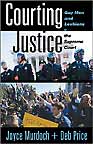
Courting Justice: Gay Men and Lesbians v The Supreme Court
by Joyce Murdoch and Deb
Price
Basic Books
How to order
Everyone loves the Supremes, at least the ones that featured Diana Ross, Mary Wilson, and Francs Ballard. The other Supremes-- the ones in Washington-- get more mixed reviews. Especially
from homosexuals. At best the US high court has usefully asserted, in a few cases, that it's illegal to discriminate against queers. But for the most part-- particularly in cases such as the 1986
Bowers v. Hardwick in which they judged that there was no constitutional right to commit homosexual sodomy-- they have, in the parlance if
Variety "laid an egg." This detailed history of the Supreme
Court's judgments on cases that involved issues related to homosexuality-- from censorship of gay-related materials as when the US Postal service banned the homophile magazine
One to Bowers v. Hardwick to cases of discrimination as with the recent case brought against the Boys Scouts of America-- is well researched, chatty, and informative.
As conceived by Murdoch and Price-- the former is a former editor and reporter at the
Washington Post, the latter a syndicated columnist on lesbian and gay issues-- Courting Justice
covers more than simply the Supreme Court decisions. The authors have drawn on court documents, written briefs, news reports, oral arguments, and interviews with plaintiffs, defendants, lawyers,
the court clerks for the "Supremes" (the justices themselves never speak publicly about their decisions). At its best
Courting Justice is a comprehensive social history of these decisions as well as
an engaging, but somewhat spotty, history of changes in attitudes about homosexuality itself. While many people know about
Bowers v. Hardwick or the more recent ruling granting the Boy
Scouts of America the right to define themselves as a private group that does not wish to condone homosexuality, Price and Murdoch explicate other decisions that were as important and groundbreaking.
Take, for instance, the 1958 case of ONE Inc. v.
Olesen. In 1954 the homophile magazine
ONE had been banned by postal officials for obscenity. Although they cited a slightly risqué
short story and a poem as the cause, it was clear that it was the very topic of the magazine that was the problem.
ONE fought and in 1957 the Ninth Circuit handed down a decision that essentially
stated that magazines that promoted homosexuality were, by their very nature, obscene. It was a year later when the Supreme Court reversed the decision with an one-sentence unsigned
judgment. Murdoch and Price have not only found the thinking behind this verdict-- it relied on the terms of the 1957
Roth obscenity ruling-- but also uncovered new information on insane-queen J.
Edgar Hoover's vendetta against ONE.
They do an equally fine job with the little-known, but again pivotal 1962
Manual v. Day case. Once again, it was the postal authorities who were now banning queer physique and
physical culture magazines published by H. Lynn Womack who also ran the Guild Press, one of the first major gay publishers who also operated book club with a subscription base of over 40,000
members. Womack's magazines Trim and Grecian Guild
Pictorial were banned and Womack lost on the appeal. The Supreme Court arguments focused on whether homosexual material was to be judged
by a different standard than heterosexual material. Could, indeed, these magazines seduce young people into becoming homosexual? The court ruling-- that magazines that might have
homosexual content or appeal to homosexuals-- were no better or worse then striptease calendars set a standard that radically changed the possibilities for queer publishing from then on.
Price and Murdoch also touch on a number of smaller details which are fascinating: the discovery that many of Justice Powell's clerks were gay or lesbian or detailing the life of Justice
Frank Murphy who served from 1940s to his death in 1949 at age 59 who was most probably gay himself. If there's a problem with the book it is that Murdoch and Price have a firm belief that the
court will eventually make a major difference in the lives of queers. While they never downplay the many ways in which the court has made life worse for homosexuals, they consistently have faith in
its potential. The reality is that the Court (and the legal system) has never particularly been open to ideas about sexual freedom. When they have made "good" gay decisions it is usually on the
grounds of "privacy" and not top protect an individual's right to sexual expression. A deeper, more complicated, critique of the Court and legal system's hostility to all forms of sexual expression would
have gone further to make this a more challenging and forceful book.
| Author Profile: Michael Bronski |

|
Michael Bronski is the author of
Culture Clash: The Making of Gay
Sensibility and The Pleasure
Principle: Sex, Backlash, and the
Struggle for Gay Freedom. He writes
frequently on sex, books, movies, and
culture, and lives in Cambridge,
Massachusetts. |
| Email: |
mabronski@aol.com |
You are not logged in.
No comments yet, but
click here to be the first to comment on this
Book Review!
|