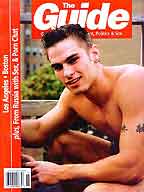
November 1999 Cover
|
 |
Cops raid gay club
By
Jim D'Entremont
Eclipsed by Cincinnati as the anti-sex capital of North America, Boston began backing
away from its traditional commitment to prurient prudery in the 1960s. Recently, however,
city authorities have taken steps to reaffirm Beantown's New England Puritan heritage.
On Wednesday, October 6, just before 10 pm, city Inspectional Services officers
appeared at the reception window of the Safari Club, Boston's closest equivalent to a gay
bathhouse, clutching a warrant in rubber-gloved hands. When it became clear that the establishment
was, in effect, being raided, the 50 towel-clad patrons who had rented rooms or lockers
slipped back into their street clothes and quietly left. After spending an hour and 40 minutes
combing through trash and probing into corners, the inspectors ordered the facility shut down.
The club houses a gym room filled with exercise equi pment, a locker room with showers,
a large TV lounge, 48 private changing rooms with beds, and a darkroom where erotic videos
are shown. Despite at least one over-the-top exposé in the
Boston Herald, a sexphobic blue-collar tabloid, the Safari Club has experienced no serious police harassment since the week it
opened. During nearly seven years of uneventful operation, the club has routinely passed
inspections by fire officials and the Department of Public Health. According to manager Fred Kyser,
"The last health inspector who came through here said we were cleaner than the YMCA."
Despite opposition from a vocal minority within the gay community when the facility
was first proposed, the Safari Club was perceived by many gay Bostonians to fill a need. By
the early 90s, as the AIDS epidemic wore on, Boston's gay bathhouses had succumbed to
poor attendance and probable arson. Opening its doors in 1993, the Safari Club presented itself
to the public as a gay men's social club and gym. The nature of the socializing that took place
on the premises was certainly no secret. Responsibly, the management worked to promote
AIDS awareness and safer sex.
The mainstream press has been unsympathetic. Uncritically recapitulating the
Inspectional Services account of the closure, the
Boston Globe falsely stated that club rented rooms by
the hour, and described "condoms and vodka bottles strewn across the floors."
Patrons who have visited the club regularly, however, describe the facility as
immaculately clean. Actual evidence of alcohol use on October 6 amounted to two vodka bottles
discarded by patrons who had smuggled them in. One longtime regular says he has "never even
sensed the presence of alcohol" at the Safari Club. Evidence of drug use amounted to the presence
of "small brown bottles" (presumably empty popper vials) found in trash containers.
Although inspectors witnessed no sexual activity (the lights were turned up as they
were admitted), they noted that free condoms were available by the bucketful. To prove that
sexual activity had recently taken place, the inspection team gathered several used condoms
from trash receptacles and the darkroom floor. To prove that sexual activity was encouraged,
they photographed safe-sex posters provided by Boston's respected HIV service organization,
the AIDS Action Committee.
The laundry list of violations that produced the order to close also includes
inadequate lighting, lack of dressing and sanitary facilities for both sexes, remaining open after 10 pm,
and the absence of a massage license-- although the club has never employed a massage
therapist nor offered massage.
The most disturbing item on the list, consistent with the rubber-glove mentality of
city officials, is a citation for permitting staff members and patrons "with communicable
diseases"-- i.e., HIV-- to be present in a health club. The question of how the inspectors
determined anyone's HIV status aside, it's fair to ask if city inspectors now intend to inquire into the
HIV status of employees and patrons at gyms, spas, YMCA, and YWCA facilities throughout
the city.
Gay v. gay?
Although the shutdown bore familiar overtones of pre-election harassment, observers
found themselves at a loss to pin the blame on any one political villain. Kyser believes the
original complaint came from an angry patron ejected from the club several weeks prior to the
raid. Whatever triggered the city inspectors' crackdown, its implementation constitutes a
convergence of zealotries from sources in both city and state government. In applying for an
Administrative Inspection Warrant to invade the Safari Club, Inspectional Services cited "at least
two complaints... from the Boston Police Department and the Office of the Attorney General
for the Commonwealth of Massachusetts."
State Attorney General Tom Reilly, a militant erotophobe, opposes efforts to strike
down sodomy laws that remain on the books inviting selective enforcement, and has been a
key proponent of the state's constitutionally dubious sex offender registry. The Attorney
General's Office refused to explain its role as a complainant in the Safari Club matter. According to
State Attorney General's Office spokesperson Adam Needles, "As a rule, we neither confirm nor
deny that we are pursuing any particular investigation, so we're not about to comment."
Despite public relations efforts to improve its image in the gay community, the
Boston Police Department has long been dedicated to demonizing gay sex and stamping it out.
The Boston Police Patrolman's Union, which provides the department's political leadership,
leans toward the hard Birchite right. The last large-scale Boston police bust directed at gay
men took place in October 1992, when a 140-man party sponsored by Boston Jacks was
dispersed and its principal organizer arrested. Although trumped-up charges were dismissed,
Boston Jacks never recovered from the raid and fell apart in a matter of months.
It's also worth noting that the Safari Club, which occupies a second-story space near the
end of a warehouse block behind Holy Cross Cathedral, is located within the district of City
Councilor James Kelly, a reactionary Catholic whose power base is in neighboring South Boston.
And Boston's mayor, Thomas "Mumbles" Menino seems to model much of his behavior on that of
a fellow authoritarian corporate prude, Mayor Rudolph Giuliani of New York, while
superficially portraying himself as gay-friendly.
"The Safari Club was doing a fine job of getting people into a safe environment," says
Mark Adams, owner of the Movie Place, a popular video store a few blocks away. "What
particularly annoys me is that the city has shut down a positive alternative to outdoor cruising areas
where people can get themselves killed. It's dangerous out there." While the Safari Club remains
dark, a significant number of its customers can be expected to return to the reeds of the Back
Bay Fens, where recent bashing incidents have resulted in serious injuries.
Safari Club owner D.C. Allen, who intends to fight the closure with every legal means at
his disposal, has vowed to return to business as usual soon. "This is just one more example of
the city of Boston harassing gay men," Allen says, "and they're making a big mistake." They
also seem confused about which century begins in 14 months. **
You are not logged in.
No comments yet, but
click here to be the first to comment on this
News Slant!
|