|
 |
By
Michael Bronski
The Life of Reilly
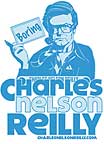
a film version of Charles Nelson Reilly's one-man stage show
How to order
It's a queen's dream: A One Man Show! Just imagine, talking only about yourself for an hour and a half. Heaven. Most shows of this sort would be boring, but in the case of
The Life of Reilly -- a film version of the late Charles Nelson Reilly's one-man show of the same title -- this really is heaven. On-target and overwhelmingly moving,
The Life of Reilly is a terrific film and a wonderful homage to the man who most audiences knew as a flighty television game-show comic, but who was one of the outstanding actors and directors of the past half century.
P
eople old enough to have watched TV from the 1960s to the 1980s know Charles Nelson Reilly by sight. Tall, gawky, quick-witted, and very gay, Reilly was a regular on early Johnny
Carson, a fixture personality on Match Game and then Hollywood Squares, and guest star on The Ghost and Mrs. Muir, Nanny and the Professor, The Doris Day Show, All Dogs Go to Heaven, and
even (as a voice) SpongeBob SquarePants. On stage Reilly was in the original cast of
Bye Bye Birdie, Hello Dolly, How to Succeed in Business Without Really
Trying, and Skyscraper, and he directed Julie Harris in
The Belle of Amherst. While he was always entertaining on television and wonderfully dry on stage,
The Life of Reilly is a revelation.
Cry till laughing
Something of a cross between An Evening with Quentin
Crisp and Elaine Stritch: At Liberty, Reilly's one-man show is -- to the surprise of most audiences -- serious and even
heartbreaking. It deals less with his career as a TV funny man than with his family life and early career after moving to New York in the 1950s and hoping to break into show-business. The film's
visceral engagement comes from Reilly's narration of the ongoing saga of his life.
Reilly reveals himself as something far exceeding his former public personas. Most audiences remember him as a tall, ungainly comic who was great with pithy responses but showing
little other personality. Here Reilly -- one presumes that this is also a "performance" but closer to the actual man -- is remarkably different. Stalking the stage with looping, halting steps, he's
witty and sharp, but also angry and a little sad. He moves quickly from prop to prop -- the stage has some chairs, a small group of theater seats, a table and a counter -- often delivering his
lines in a furious, even bellowing tone. Sure, there's a lot of bitter irony here -- the backbone of gay sensibility -- but it's not the irony that floors us, but the glimpses of pain beneath.
What does Reilly have to be angry about? His mother was mentally ill and racist, his father had a nervous breakdown, and his aunt was lobotomized. His whole family was living in
poverty, and he was singled out for being odd (read: queer). Reilly certainly had more troubles than some -- but also a lot of good raw material for his comedy. Indeed, this is a textbook study of
the transformative power of pain into art. Later in the show he speaks about his acting classes with the late Uta Hagen, and here we can see how that famous Hagen style -- intense
delivery, concentration, and no excess emotional content -- pays off. Reilly's emotional clarity dazzles -- it's like watching a Strindberg play or the final scene from
Who's Afraid of Virginia Woolf -- and we react in kind. This is not what we expect to see with Reilly-the-class-queen-clown.
Aside from being an amazing performance, The Life of Reilly
documents the formation of a gay sensibility in the mid-20th century America. Along with Paul Lynde, Reilly was one of the
few out (almost) funny men in show business. Both were famed for their flamboyant, fussy characters who were not just comic relief, but -- more importantly -- crucial commentators on
their heterosexual co-characters. They were considered by some "more out" gay people as being the closeted court jesters of a homophobic media.
The Life of Reilly shows us the pain behind that persona as well as the human being. Don't expect a lot here about Reilly's sexuality -- an off-handed mention here or there, and the story that for his first TV job interview in the
early 1950s he was told, without having said a word, "They don't put queers on TV." But it's clear by the end how profoundly Reilly's sexuality influenced his life and work.
Reilly died this past May, having been touring with the one-man show for several years. Lucky for us it was recorded. The film version interrupts his stage work with some film clips,
which don't mar the performance's dramatic power.
The Life of Reilly is now in limited theatrical release, but will have a long, healthy afterlife on DVD.
| Author Profile: Michael Bronski |
|
Michael Bronski is the author of
Culture Clash: The Making of Gay
Sensibility and The Pleasure
Principle: Sex, Backlash, and the
Struggle for Gay Freedom. He writes
frequently on sex, books, movies, and
culture, and lives in Cambridge,
Massachusetts. |
| Email: |
mabronski@aol.com |
You are not logged in.
No comments yet, but
click here to be the first to comment on this
Movie Review!
|