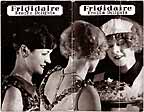
Iceboxes are just so 1910s!
|
 |
Words past their sell-by date hiding in the back of the fridge
By
Mitzel
I was reading an article about New York City Mayor Michael Bloomberg the other day. He was addressing what the Transit Authority in his city was doing after the bombings in London.
Mayor Michael rattled off a list of things that were being done and he asked subway and bus riders to report unattended knapsacks.
I stopped and pondered this. It seemed to me that the correct word would have been "backpacks." "Knapsack," though a perfectly good word, has a specific meaning. It's an old
word, going back five-hundred years or so, and refers to the personal tote carried by soldiers and hikers on their treks, in which they carry toiletries, personal effects and snacks
(knapp is Late German for "a bite of food," a nosh). The word "backpack" has a modern ring to it, something not necessarily exclusively utilitarian, more in the line of an urban fashion accessory,
cousin to shoulder bag, fannypack, etc.
Was the Mayor inexact in his word choice? Was he just being old-fashioned, a man who grew up in times when such items were in fact called knapsacks? I do not know.
Words and their referents do become dated. A friend my age (mid 50s) told me this story apropos this subject. His partner is 20 years younger and one Sunday morning the
partner asked my friend what they should do with the leftovers. "Just toss them in the Radar-range." Partner looked at him and asked: "Radar-range?" I will occasionally say "icebox," though in
fact I have never used an icebox. Why is this? Having read about the Mayor's reference to the knapsack, I thought, in the same vein, whether anyone still uses the word "co-ed." Just
minutes later, reading yet another newspaper (I read three a day and still feel uninformed), I came across the word "co-ed," referring to a female college student. Is the word "co-educational"
out of date? Is "uni-sex"? "Co-sexual"?
When I was a high school student, I do not recall my fellow students toting their books and gear in knapsacks. We just carried our books under our arms. Sometime in the 70s,
folks suddenly began schlepping their stuff around with them. Is this when backpacks became popular? Why did people change
en masse into critters having to tote their possessions around
with them? I attribute this to the collapse of the economy in the early 70s. Poor people have to carry more stuff with them; rich people rarely tote their crap themselves. You never saw a
picture of Jackie Kennedy with a knapsack slung over her firm, well-formed shoulders. I recall watching as these items got larger and larger-- like boom boxes, another curse of the age, which
also got bigger each year. Young schoolchildren could be seen on their way to their studies with huge backpacks weighing them down. Was this necessary?
Why do words and phrases go out of use? Does the word "uranian" have any application, except in a historical context? What of "homophile," "Homintern," and maybe, "hissy-fit"?
How about "hair fairy"? One friend, a
soi-disant expert on everything, once told me that the word "tacky," used to refer to cultural detritus, had never been used publicly before 1968.
Imagine my surprise, when watching, a few years back, a TV re-airing of
Breakfast at Tiffany's, when Audrey Hepburn, who was always wrong for the role-- Capote wanted Marilyn Monroe, who
would have been much better-- is with her beau outside a famous venue in Manhattan and uses the word "tacky," with the full vigor of some snarly quean. Given the character of so much of
this culture, over scores of decades, I suspect "tacky," in the way that Holly Golightly used it, has been around and will be around for a long time. The occasion calls. And I will save the vast
and fascinating subject of tackiness for a meditation later.
I like words and texts that sound "old-fashioned," but in the modern sense. Stories by Robert McAlmon, Thorne Smith (author of
Topper), and even some Gertrude Stein, some of
whose writings are like bugs in amber. One literary theory has it that Stein developed her distinctive literary voice from studying newspaper advertisements in the late 19th century.
Copywriters went for the long form then. And ads always have a fake and/or subversive quality to them (the best of them) and Stein followed suit. (My favorite ad from the 70s promoted some
new synthetic fabric: "It's not fake anything. It's
real Dynel." It's how you can come to think in that business. I even knew a drag quean, perhaps impressed by the ad campaign, who took the
word Dynel for her gay name, not fake anything, a real Dynel!)
Time now to don my bloomers and swing out and jitterbug!
You are not logged in.
No comments yet, but
click here to be the first to comment on this
Common Sense!
|