Reptilian
|
 |
The return to print of a 70s gay masterpiece about one sort of wound from Cupid's arrow
By
Bill Andriette
Minor Incidents
C.J. Bradbury Robinson
Williams Mix, and Young Thomas
available as PDF files on CD from www.cjbr.co.uk
How to order
Every Christmas Eve, millions temporarily join the ranks of high-church homosexuals and tune-in to the BBC's global broadcast of "Lessons & Carols" from Cambridge U's King's College Choir, thus seasonally indulging-- and at a safe and legal distance-- in 'philias Anglo and pedo.
In C.J. Bradbury Robinson's Minor Incidents, Cambridge and one of its famous choirs are like the Hollywood Strip in the oeuvre of Dennis Cooper-- scene of decadent, dangerous, and smoldering homoerotics.
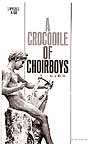
Or rather, literary precedent demands saying that Cooper's Los Angeles recalls Robinson's Cambridge-- because Robinson's book, then titled
Crocodile of Choirboys, was published in pre-skateboard, pre-Punk 1970; published, as it happens, by the Los Angeles pulp-porn
press Phenix Books (an imprint of the famous Greenleaf).
Crocodile became an underground classic, and inspired William Burroughs to pen the introduction to Robinson's subsequent
Williams Mix, which was purchased by Olympia Press-- publisher of
Lolita, The Story of O, and Naked
Lunch.
Robinson's novels almost made the pantheon of 20th century erotic classics. But
Williams Mix never saw print-- Olympia Press, always chaotically managed, went under in 1973. In any case, the era of highbrow erotica was over with the opening of the floodgates of frank
visual porn. Crocodile of Choirboys-- among the few needles in Greenleaf's haystack of pulpy pleasures, became a collector's oddity. In 2004, the novel-- now corrected, updated, and renamed, was republished by the author as a PDF file on CD-ROM, along with Robinson's
Williams Mix, and-- new this fall-- Young
Thomas, "a more gentle companion to the savage
Crocodile," first published by Greenleaf in 1971 and now also rewritten.
As larks in exaltations and wolves in packs, a "crocodile" is what choirboys come in, in Cantabridgian patois-- a reference to their appearance walking in line. No one's come up with a name for a collection of "Stevens," but
Minor Incidents involves a trio of them, living in
curious quantum-mechanical parallel at times somewhere simultaneous from the 60s to the present. While "Stefan" is a choirboy, the elder "Stephen" and "Steven" are, respectively, a Cambridge philosophy undergrad, and an alumnus of and teacher at the choir school. Like electrons,
the characters are not always determinate-- a literary conceit apt enough for a book about how arrows from Cupid's quiver can boomerang upon the archer.
What's clear is that Stefan is object of his elder name-likes' affection. Between lectures on Wittgenstein, Stephen pores over pictures in medical textbooks at the university library, and measures the worth of his days by the inch-stick of glimpses caught, glances
exchanged, and cocks-at-urinal descried of the treble for whom he's hopelessly fallen.
Up-the-butt for culture's sake
In novels about forbidden love, the hook of advocacy always sticks out, ready to puncture the surface-tension-- a peril
that, in an ever-more-tolerant West,
troubles gay-lit less and less. Robinson's work stays always out of bounds, yet
Minor Incidents avoids bursting its balloon-- ironically, by prophylactically wielding upon itself as many scalpels as Shiva has arms. The result is like a corpse undertaking its own autopsy. But in this course of analysis, Robinson's eye is so gimlet, his hands so sure, that
Minor Incidents becomes a starkly-beautifully wrought
Gray's Anatomy of desire. And not just of its own out-on-limb, cuckoo-for-choirboys kind, but of sodomy in general: which, as Michel Tournier is quoted, "instead of subordinating sex to the propagation of the species, exalts it." Along the way, Robinson pours forth monomaniacal,
reptilian porno-prose that's icy hot.
The life of the elder Steven goes around in not-entirely-happy circles-- which sex-tours to Morocco and the Philippines (don't try these today!) only temporally relieve. Still, there's something glowing and elegaic at the center of his pointless ambits, as there has ceased to
be among the characters in Cooper's harder-nosed, heroin-injecting nihilist urban tableaus. Partly that difference is the difference between Cambridge and Los Angeles: no matter how much England descends into a security-camera ridden surveillance state, so long as King's
College Choir channels the centuries in its shimmering singing, there'll remain some ember of civilization in the place. And partly, with aid of Beckett and Tournier, it's that Robinson has a radio-telescope-- compared to Cooper's TV aerial and boombox-- to catch news of the West's
existential angsts.
Williams Mix is a novel more experimental in form than
Minor Incidents. Its polyphonous stream-of-consciousness nonprogression-- like an enveloping English mist-- serves, even without the driving rain of plot, to thoroughly soak the reader in its story.
Whether you come for the porn, the prose, the politics, or the psychologizing, Robinson's writing cuts clean. He plunges into outta-kilter desire sometimes with a pathologist's eye, but in service to the health of the body politic. When these books were first written, the
desire over which they linger was just one bloom in the general 60s sexual springtime. Today, a monstrously demonized pedophilia-- along with "terrorism"-- are drumbeat for the West's march unto what seems like its totalitarian endgame. Which makes Robinson's works more relevant
than ever, and explains their current self-published, samizdat status. Read them, and if this month you catch King's College heralding Christmas's coming, you'll take fresh lessons from the carols.
| Author Profile: Bill Andriette |
| Bill Andriette is features editor of
The Guide |
| Email: |
theguide@guidemag.com |
You are not logged in.
No comments yet, but
click here to be the first to comment on this
Book Review!
|