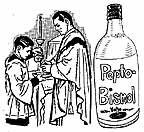
Did gay men hold key to preventing assaults on tender digestive tracts?
The Catholic Church was already reeling from payouts of some ten billion dollars to former child victims of food poisoning at parish dinners and church pot-lucks during 1950s, 60s, 70s,
and 80s. Now the Church faces shocking allegations that homophobic archbishops blocked the ordination of gay priests who might have saved youngsters from digestive abuse by insuring
higher standards of food preparation and luscious presentation.
The allegation that homophobia lurks behind the burgeoning scandal comes from LA's Gay Actor/Waiter Guild (GAG). "The Church's food-poisoning crisis is just another aspect
of Catholicism's out-of-step creeds, which include advocacy for the poor and opposition to war," charges GAG president Wayne LaBarbara, a server at West Hollywood's cool fusion bistro
L'Eau Lourd, and whose latest role was as the UPS man in a 1998 episode of "As the World Turns."
"The Church has refused to give gay actors the starring roles they deserve in high masses, weddings, ordinations, and other over-the-top theatrical spectacles-- and now Rome is
paying the price," GAG said in an official statement.
Not just a grim statistic
As story after story about horrific victimization comes out, it's growing clear that gays could have saved the day for the Church-- and provided cattier gossip and better
color-coordinated table settings at diocesan coffee hours.
Former Teaneck, New Jersey, resident John Socarides puts a human face on an abuse scandal run amuck. Today Socarides is a feisty survivor, living in a recently purchased
24-room mansion in Bel Aire. It's an almost unbelievable recovery considering that in the wee hours of April 17th, 1972 he was bent over a toilet bowl. That was the night that Socarides, only 14
years old, suffered a 24-hour bug that included a 2:35am vomiting and a 101-degree fever. The source of the infection? A communion luncheon he'd attended the day before at Teaneck's
Our Lady of the Immaculate Vagina.
The contamination has been traced to the Campbell's Cream o' Chicken being served a Tupperware container-- which experts say is a sure sign of bad taste and inadequate
reheating. The victimizer was now-defrocked priest James O'Grady. As the celebratory meal was to commence on that unseasonably warm day, Father O'Grady lingered recklessly over his
benediction. The priest further delayed the hungry and fidgety diners by asking for prayers for parishioner Mrs. John O'Brien-- who, ironically, was stuck at in bed with a bad case of the runs.
Meanwhile, the reconstituted soup was becoming a cesspit of disease-causing E. coli bacteria.
"No gay man would have allowed the serving of lukewarm chicken soup in Tupperware," said Socarides, now sailing in his yacht off of Baja California, in a message conveyed to
The Guide by his attorney, Zozar Garibeedee, who has recently purchased the nation of Haiti.
Justice may have been delayed, but it has proven guillotine-edged: the 74-year-old O'Grady was given 15 years in prison on December 24th. Though his record was otherwise
spotless, Judge Sandra O'Brien imposed the stiff sentence after FBI agents running a sting operation secretly taped O'Grady admitting he did not always wash his hands after touching doorknobs
or taking public transit.
Failure to face problem
Would more gay priests have saved Socarides and victims like him? That gay men are handier in the kitchen than heterosexual bachelors isn't just a droll stereotype. Outbreaks of
food poisoning have struck 11 out of 13 parishes throughout the US and Canada over the last 50 years. But statistics reveal that in parishes where altar boys regularly enjoyed fellatio
after confession, standards of food safety were higher, and nuns report greater satisfaction with the tasty range of fresh food ideas in the refectory.
"No surprise there," says GAG's LaBarbara. "Gay men see mouths and anuses as orifices of pleasure, and so we take care that what we put in them is wholesome and satisfying."
At St. Joseph's Seminary in LaCrosse, Wisconsin-- where the Jesuit brothers privately joke about their novitiates as
"semen-arians"-- records show no cases of ptomaine or
botulism over the institution's 80 year history. "Our caring attitude at St. Joseph's," says abbot Rod Steele, "is like a little pill that has so far prevented the headache of crippling lawsuits,"
despite the institution's tender and gastrointestinally vulnerable population. "At St. Joseph's, we're working feverishly to keep it that way," Steele added
But as investigators pore over formerly secret Church records documenting decades of hushed outbreaks of salmonella and listeria, St. Joseph's is proving the exception.
Longtime critics of the Church say its no surprise the centuries-old institution, based in Italy, is now becoming the hotseat of scandal. With huge families and overworked mothers, in many
Catholic homes poor hygiene was just a fact of life.
Sensitive, typically gay priests understood these realities and worked to help relieve busy mothers of their little burdens. Reginald Muldoon, an altar server at San Diego's Church of
the Sacred Spleen in the 1950s, warmly recalls parish priest Joseph Panteen. "If Mrs. McGillicutty brought a tub of her Chicken Legs Velveeta to bingo night and there was old cheese
encrusted between the tongs of her serving fork, then Father Pantene would take the implement to the sink on the QT and work it until it was clean-as-a-whistle," Muldoon remembers, "which is
the same state he'd leave my privates after the weekly blow-job in the vestry, even when I forgot to wash underneath my foreskin."
But while Father Pantene was "cleaning up," others in the Church were busy sweeping Catholicism's hygiene problems under clerical robes.
"We didn't allow ourselves to see what was going on right under our noses," says Patricia McVittle, whose son Milton was a victim. Milton McVittle received a $800,000 settlement
from the Daly City Archdiocese last year for a stomach ache he suffered on a Sunday School picnic 1985. "Many mothers thought that when our kiddies sometimes had fevers and tummy
troubles after church outings they were just channeling the death agonies of St. Theresa of Toledo," the patron of sewerage workers who succumbed to dysentery in 1481 after being locked in
a Moorish dungeon and subsisting only on stagnant water.
"The scales covering our eyes," Mrs. Nealon, "were as thick as those clogging the kitchen drain after a Friday night Lenten dinner."
Miraculous transubstantiation
With the overheating of America's litigious climate at the turn of the millennium, lawyers are taking those unsightly scales and transforming them, like alchemists, into sparkling
golden flakes. Victims are filing-- and winning-- multimillion dollar lawsuits against the Church for the spoiled and unwholesome foodstuffs served at church festivities decades ago.
Juries are moved to generosity by pathetic cases such as survivor Russell Grimbsley, 26, who as a 10th grader at Holy Perineum High School in 1993 disagreed with some cafeteria
egg salad, and today clocks in at 462 pounds. "I can't trust anything I eat anymore," says Grimbsley, who instead says he trusts in eating everything. "With a continual force-feeding, I figure
the dangerous toxins go through me like light through a stained glass window."
"The victims I see have been devastated," says Dr. Annette Burgess, professor of nursing of University of Pennsylvania, and a leading expert witness. "For a child to discover that
its body can be the source of foul-smelling, off-color emissions is a life-long blow to self-esteem," Burgess explains. "Youngsters lack the cognitive capacity to deal with the
overwhelming sensations of nausea or diarrhea, particularly when these conditions are acquired in situations that were conceived to be immaculate."
Church-linked food poisoning harms its victims in ways incomparable to any other kind suffering, according to experts. "An Iraqi youngster whose neighborhood is blown away by
a Tomahawk missile faces a quick, collateral death," says Northwestern University professor Gary Shills. "But a victim of digestive-tract distress at the hands of a trusted authority
is reassaulted every time he chews a burger or passes a stool."
Helping abusees heal
For years, psychologists didn't know how to help victims. But thanks to groundbreaking work at the Harvard School of Education, there is a promising new treatment called
"iatrogenic therapy." However the recovery process is expensive and arduous-- involving hundreds of sessions in which a highly-trained professional carefully inserts her index finger into the throat
of the survivor, inducing a gag reflex and vomiting.
"The healing happens homeopathically, by allowing the victim through repeated repetition to 'own' the trauma," explains Dr. Burgess. "The survivor learns to break the cycle of
self-blame and rebuild his identity from scratch. We call it the process of 'rebarfing.'"
After three years of induced vomitings in the safety of the clinical context, the recovering survivor is ready to confront nausea in more public setting-- such as in the vicinity of a
Catholic institution-- without using fingers as a crutch.
In phase-2 therapy, Dr. Burgess takes her victims to scrounge for food scraps in the dumpster at Blessed Foreskin Medical Center in Bala Cynwyd, where they devour moldy remains
off of hospital dinner trays, while ritually slashing effigies of priest-offenders with knives. Over the course of the treatment, victim Roger Loo says he's lost 60 pounds-- but as his body
has weakened, his spirit has grown stronger, and he finally feels like he's growing closer to God.
However, with Church-run nursing homes, AIDS wards, and hospices now being forced to close due to abuse payouts, Dr. Burgess's patients aren't the only ones gathering at the
hospital dumpster as more and more people turn to garbage-picking for sustenance. "Sometimes a discarded foreskin, and other medical wastes, are all there is to chew on," Loo says.
While the crowds scouring the dumpster make therapy for her clients that much more of a challenge, Dr. Burgess says she's encouraged by the spotlight now focused on activities
once hidden under a veritable Shroud of Turin.
"At least when the terminal cancer cases are out on their own they can practice safe food-preparation practices and not be beholden to an institution that-- whether it's having
everyone drink from the same wine cup or playing at communal cannibalism-- is addicted to unhygienic practices."
You are not logged in.
No comments yet, but
click here to be the first to comment on this
News Slant!
|





 Advertise with us
Subscriptions
Contact us
Site map
Translate
Advertise with us
Subscriptions
Contact us
Site map
Translate