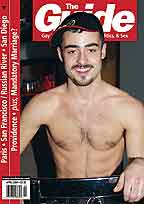
April 2004 Cover
|
 |
The current national debate about gay marriage has been clouded by muddled thinking-- from all sides. And the key confounding issue is the role of sex in our lives and law.
Those leading the crusade against gay marriage are inspired by the Religious Right; to them, traditional marriage sanctifies otherwise sinful behavior-- sex. Same-sex marriage
would bless gay sex, a religious anathema to the phobic Right, so gay marriage
must be opposed. Thus, we endure the Bush Administration preaching the virtues of secular government to
occupied Islamic lands, while simultaneously campaigning to enshrine fundamentalist religious views into our own constitution.
And gay marriage proponents like to claim that marriage is a "fundamental human right." But they miss the point that the fundamental human right is to couple-- sexually
and habitationally. And that right was won with the overturn of sodomy laws in
Lawrence v Texas. Justice Scalia, one of the four dissenting justices happy to imprison adult men for
having homosex in their own bed, presciently noted in his dissent that the import of
Lawrence was so fundamental that gay marriage would be around the corner. Indeed, gay marriage is
predicated on the foundation built by
Lawrence-- while deemed de facto sexual felons, gay folk were unlikely to be allowed to wed. But many gay marriage proponents' euphemistic version of
"human rights" is daintily distanced from anything reminding the public of sodomy and sexual privacy.
But in a secular society marriage is not a sacrament. Nor in a country that already recognizes a broader-than-matrimonial vision of sexual freedom is it a human right. Marriage is
a contract.
A secular government-- which the Religious Right denies we should have and vows to destroy-- cannot "sanctify" only couples who pass religious tests about their virginity, or
fertility, or race, or religion, or gender. In a secular government, all citizens are free to seek out the same contracts available to others and to expect those contracts to be recognized and
enforced. Churches are, of course, free to withhold their blessings on unions they deem sinful-- as they have for widows remarrying, for couples of different races, for those marrying "outside"
the faith-- but religion cannot expect the government to enforce their
sacramental particulars on a secularly
contractual matter: marriage.
Many activists in the pro-gay marriage debate urge walking on eggshells lest we offend the (straight) political system presently "deciding our fate." Lobbyists and some gay
politicians urge marriage proponents to "wait"
The real heroes in the present fight are those mayors, town clerks, and couples who are calling on society, like lunch-counter protesters from the Jim Crow South, to
uphold the law now. They understand that marriage is a contract. They understand that objections to same-sex couples are religiously inspired, thus as legally impermissible as not-so-long-ago objections
to inter-racial and inter-religious couplings. They recognize that such marriages might discomfit some, but that equality under the law cannot be sacrificed to accommodate religious
bigotries. And they, like Martin Luther King, Jr., writing in Birmingham a few decades ago, believe that waiting is no longer ethically
or politically wise.
You are not logged in.
No comments yet, but
click here to be the first to comment on this
Editorial from The Guide!
|