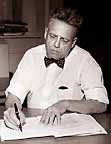
CEO of sex
|
 |
Making sex speak
By
Mitzel
Author T.C. Boyle's latest novel, The Inner
Circle, is an imaginative recreation of sex researcher Alfred Kinsey's life, work, and associates. Bill Condon, director of the award-winning film
Gods and Monsters (based on Christopher Bram's novel,
Father of Frankenstein) has a new film out,
Kinsey. We must live in interesting times when a general-release film can get made about the work of Dr. Kinsey. Both Boyle and Condon were recently on a Saturday news show on National Public Radio. During the course of the discussion, one of the gentlemen
said this: "No one under 50 knows who Kinsey was." I was shocked upon hearing this. Could this possibly be true? I didn't think so. (A friend who teaches at Dartmouth College told me that none of his undergraduate students knew who Kinsey was; it's a fine school and they
will soon find out, maybe by going to the movie.)
Cultural conservatives and your usual band of right-wingers know all to well who Kinsey was. He is represents pure evil to them, the man responsible for launching the sexual revolution and bringing on what they describe as the moral mess today. They
still attack his work-- belittling his credentials ("a bug doctor"), his methodology (sample loaded with prisoners and perverts, photographed male hustlers masturbating), his intentions, even his character (sexually weird and exploitative), and on and on. This spilled over into the biographies
of Kinsey. Jonathan Gathorne-Hardy's book, Alfred
C. Kinsey: Sex, The Measure of All
Things, was considered thorough and sympathetic. The 1997 biography by James Jones depicted Kinsey as a little twisted and disreputable. From the reviews I've read of Condon's film,
it appears to portray Kinsey in a kindly light.
In 1938, Kinsey was teaching at Indiana University; his specialty was the study of gall wasps. In that year, he was approached to teach a non-credit course on marriage. He did. This lead him to find out that very little statistical data existed of what people actually
did sexually. And Kinsey was a man of facts; neither he nor his wife read novels, preferring texts that were factually based. (Though he liked serious music, he had a distaste for opera.) So he set out to find the facts. He devised a questionnaire and began his famous
interviews. What was his plan? To get people to talk one-on-one about their sexual histories. Do people talk honestly about their sexual histories? I have a friend who says that everyone lies about what they do. Did Bill Clinton teach us this? Does it matter? Yes and no. Since Kinsey was
the first to go raking for this data, it is a fresh imprint. I recommend to you all that you read the Kinsey books. When interviewing men, he did not ask, "Have you ever had a homosexual experience?" He phrased his inquiry thus: "Tell me about your first homosexual
encounter." These may have not been his exact words, but he tried to make his questions as neutral as possible to get people to talk openly and to encourage them. Times were different then. We are the beneficiaries of what Kinsey wrought, which I think a good thing.
In the comment about these two events-- the book and the movie-- someone said: Kinsey got people to talk about sex. Some have said that about Freud. People have always talked about sex, nothing new there. What Kinsey did was try to find out what was true
about what people said about sex. And he made an important contribution. Did his group's findings change the world? Well, it helped. There were lots of things in the cultural brew at that time which created change. Still, the Kinsey book on women's sexuality was a formative event.
When you get to the core of Kinsey's work, it was the interview, the face-to-face exchange of information. And it is true that there is no independent verification of what people told Kinsey and his staff. There never is. Think of exit polls. What is substantive is the
body of the work-- all that data. Is it useful? Well, it is without precedent and no one has done anything comparable since. And in this climate never will. It is interesting that in what we regard as a somewhat more liberated climate-- today compared to the 1950's-- there remain
so many inhibitions, so much censoriousness, so much fear.
Think about the interviews. In David Johnson's fascinating book,
The Lavender Scare: The Cold War Persecution of Gays and Lesbians in The Federal
Government, there were also other interviews taking place. Often in the State Department, the Defense Department
(née The War Department) and other venues in the vast bureaucracy. Persons were lugged in and quizzed. Dimes were dropped and names were named. People were called to testify at Congressional hearings. Some were fired, others blacklisted. Compare and contrast. Kinsey
was interviewing the good folks and getting their histories-- just the facts, ma'am-- and the inquisitors were interviewing to scare, to purge, to ruin people. Is it Salem or Stalin? No complaint from the right-wingers and cultural conservatives about
these interviews. All Kinsey wanted to do was report the facts. And I think he did a pretty good job, and it's still news today!
You are not logged in.
No comments yet, but
click here to be the first to comment on this
Common Sense!
|