'Only the specter of queerness'
|
 |
But Road Trip is only a trifling queer
By
Michael Bronski
Road Trip
Directed by Todd Phillips
Starring Breckin Meyer, Amy Smart, Rachel Blanchard, Seann William Scott, Paulo Costanzo, D.J. Qualls
How to order
It is indisputable that male homosexuality well, at least queerness has been an undercurrent in Hollywood films since their earliest days. Sometimes it was overt like the gay bar scene in Clara Bow's charming
1932 shocker Call Her Savage. More often it was coded, as with the ironic sissies and fairies played by Eric Blore, Edward Everett Horton, or Franklin Pangborn in social comedies of the 1930s and 40s. And as Mark
Rappaport points out in his documentary The Silver Screen: Color Me
Lavender what did audiences make of Bing Crosby and Bob Hope in their
Road movies or of Walter Brennan, as the young, cute cowboy's best friend in
endless westerns of the 1950s. And weren't Midnight
Cowboy's Joe Buck and Ratso Rizzo just more open, urban versions of the closeted
Butch Cassidy and the Sundance Kid? And just who is Russell Crowe flexing his tits for
in Gladiator? There are hardly any women in the film, and lets face it this isn't being marked as a chick flick or a date movie. Boys, apparently, just wanna have fun, too.
But what happens when queerness raises its cute little head so much that there is no possible way to avoid it? There are now 786 minor gay characters on TV sitcoms, even semi-straight rock stars flocked to
DC to play at the Millennium March, and queer-bashing murders are now considered important enough to make the news. Homosexuality has always been a preoccupation in the American popular imagination, and in the past
30 years now that the love that once dare not speak its name can't shut up the once relatively quiet preoccupation has moved to the forefront. Take,
Road Trip please.
The great-great grandson of Animal
House and Porky's, Road Trip is far more sophisticated version of those late-teen boys gross-out films. It is closer to
American Pie in both sensibility and sexual politics
that is, the women are generally smarter than the men, it has an understanding of sexism and homophobia, and it is the silly, sex-starved men (acting like idiot adolescents) who are the target of much of the humor. Written by
Todd Phillips and Scot Armstrong and directed by the former,
Road Trip is a picaresque cum coming-of-age film about four college guys who have to quickly drive from Ithaca, New York to Austin, Texas, in a desperate attempt
to retrieve a video tape of one of them having sex with a causal-girlfriend that was accidentally sent to his long-term female lover. And while this is not exactly Proust, it is a workable premise to get four guys in a car and
have them make jokes about putting peanut butter on their balls so their dog can have lunch. Like I said, a more sophisticated version of
Animal House.
But what is amazing about Road Trip is not that we don't get to see the aforementioned pet feeding scene thus being assured that no dogs were having too good a time during the making of the movie but
the endless preoccupation that the films writers and director show towards male genitals (and assholes) throughout the film. There are surely as many dick jokes in this film as there were tit jokes in
Animal House. And for that, I guess we should be happy. Or should we?
The plot of Road Trip is set in motion when Josh (Breckin Meyer) a nice-enough nice guy who worries about being faithful in his long term relationship scores a night with even nicer Beth (Amy Smart) a
co-ed who has a crush on him. Being nice, middle-class, college kids who talk sensitively about things like relationships they decide to film their night's fuck fest. This is accidentally (and we know what Freud said about
accidents) sent off to Josh's longtime girlfriend Tiffany (Rachel Blanchard). But heterosexual relationships in
Road Trip are clearly queerly? beside the point. Director and writer Phillips is far more interested in where the boys
are (and what they are doing) than in straight fucking and quickly gives us all the boy-types. Josh is sensitive, wants to do the right thing, but longs for some sexual freedom. E.L. (Seann William Scott) is the cool-talking
ladies man who never gets enough. Rubin (Paulo Costanzo) is super-brilliant (the film implies that he is Jewish to explain why anyone in a college-guy tits-dick-ass movie knows anything) and is worried about not being able to
have a good time. Now, these guys are all friends, but are car-less so they convince the geeky Kyle (D.J. Qualls) (he of the pet dog) to come on the "road trip" with them.
Phillips constructs his story in such a way following the rules of classical tragedy
and comedy that all of the characters learn something about themselves. So Josh leans that his expectations of romantic
and sexual fidelity are unrealistic. Rubin leans that he can have a good time. Kyle leans to stand up to his overbearing father and that he
can get laid. And E.L. learns that he really, really likes to have at least three fingers
shoved up his butt when he comes; a self-understanding that hardly ever appears in classical drama after the Greeks.
Cult o' phallus
But what is somewhat startling about the film is that much of the comedy revolves around the youths' dicks. In an early scene Josh is desperately trying to get Tiffany on the phone to make sure that they are
still a couple. Meanwhile E.L. is crouched down in front of Josh having a conversation with his friend's penis about what
it would really like to do with Beth. Later in the film various characters get visible hard-ones (through
their underwear) and one character's grandfather in a Bob Dole Viagra moment sports a boner that keeps knocking knickknacks off of end tables. To make things even more phallic, Phillips and Armstrong have placed the film
in a frame narrated by an older classmate Barry Manilow (Tom Green) he has been in college for eight years who is obsessed with feeding cute little white mice to Josh's pet boa constrictor. The snake that striking symbol
of maleness simply isn't hungry. So much for the insatiable appetite of the phallus.
While it is always nice to see dick jokes in a movie, there is something a little disconcerting about
Road Trip for with all the emphasis on the sexual male body and boys and sex not to mention the palpable,
if incipient, homoeroticism between the young men the movie is resolutely straight. All of the innuendo, the sexual play and joking, and the tension is subsumed by, covered up with a totally het plot. In older film, like
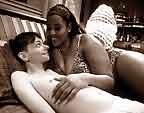
Animal House Kyle would have been geeky and gay now he is aggressively heterosexual. So much so that he even scores with a black chick and we know what that means in Hollywood movies. E.L.'s exploration of his
anal eroticism is sort of startling for a mainstream Hollywood film, but again, while it is good for a laugh it is actually treated as a completely heterosexual phenomenon. The running joke with it is that it might hurt (although
it obviously doesn't) it doesn't make him queer. Even Rubin's braininess in the past an indicator of queerness in teen comedies is not gay at all here.
There is no need to have gay characters in every movie and, in fact, often when they do appear as in
Ten Things I Hate About You they are characterized by a "funny" queer-bashing scene there is
something distinctly odd when the subject of queerness keeps getting raised (indicated, hinted at, suggested, whatever) and there are no gay characters. Is this sublimation or repression? Titillation or astute psychological explication?
Or is it the ultimate integration of gayness in popular culture its here, its queer, it ain't going away, but its isn't really attached to anyone or any sexual action. It is the specter of queerness without the reality;
the acknowledgment that it is present and here to stay, but really when you get down to it hardly there at all. In many ways, the old pansies like Edward Everett Horton and Franklin Pangborn with their arched eyebrows
and charming innuendo were more flagrantly and honestly gay.
| Author Profile: Michael Bronski |
|
Michael Bronski is the author of
Culture Clash: The Making of Gay
Sensibility and The Pleasure
Principle: Sex, Backlash, and the
Struggle for Gay Freedom. He writes
frequently on sex, books, movies, and
culture, and lives in Cambridge,
Massachusetts. |
| Email: |
mabronski@aol.com |
You are not logged in.
No comments yet, but
click here to be the first to comment on this
Movie Review!
|